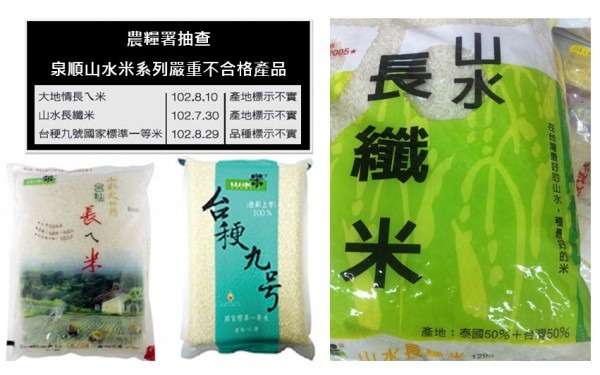
Shanshui Rice's CAS certification revoked, products must be fully removed from shelves and recalled
Quanshun Foods, the company that produces and sells the "Shanshui Rice" brand, was last month found in multiple cases of passing off imported foreign rice as Taiwan rice, and the Taiwan Excellent Agricultural Products Development Association issued a document last week terminating the 11 CAS Excellent Agricultural Products (edible rice) marks held by Quanshun Foods. Yang Cong-xian, deputy chief executive of the Taiwan Excellent Agricultural Products Development Association, said that Quanshun Foods can only reapply for CAS certification at the earliest one year later. Chen Bao-ji, minister of the Council of Agriculture, said that Shanshui Rice using Vietnamese rice to pass off as domestically produced rice is serious fraud, and the related CAS rice must also be taken off the shelves.
The CAS certification body originally said that the 11 products under Shanshui Rice, Quanshun, could not use the CAS certification mark for one year, but products already on the market and on shelves could still continue to be sold. This point today sparked questions from legislators across party lines as to why Shanshui Rice products whose CAS certification had been revoked did not need to be taken off the shelves. When Chen Bao-ji replied in the morning, he also originally said that new products could no longer be printed with the CAS mark, but products already on the shelves and printed with the CAS mark could still continue to be sold; later, when questioned again, he changed his statement, saying that Shanshui Rice used Vietnamese rice to pass off as domestically produced rice, yet did not contain a single grain of domestically produced rice, which is serious fraud, and "how can it still be sold on the shelves?"
Chen Bao-ji instructed Dai Yu-yan, chief secretary of the Council of Agriculture, to repeatedly review the Regulations Governing the Verification and Certification of Excellent Agricultural Products and found that there were problems in the management of Shanshui Rice and that the CAS mark certification could be terminated; under Article 14 of the same regulations, the operator could be notified to take CAS products off the shelves. Dai Yu-yan said that it was possible the Taiwan Excellent Agricultural Products Development Association had in practice not noticed the content of the provision allowing removal from the shelves; the Department of Animal Industry of the Council of Agriculture, which supervises the CAS association, would today urge the association to notify the operator to recall and remove the products from the shelves. If they are not removed from the shelves, a fine of 200,000 to 1,000,000 yuan will be imposed.
The products of Quanshun Foods whose CAS certification has been revoked are the following 11: "Shanshui Rice" (Taiwan Keng No. 9); "Shanshui Fragrant Rice"; "Shanshui Premium Sushi Rice"; "Shanshui Preferred Yi-Chuan Fragrant Rice"; "Shanshui Rice" (50% Taiwan Keng No. 9 + 50% Taiwan Keng No. 8); "Taiwan Good Rice - Shanshui Ho-Chin Rice"; "Taiwan Good Rice - Yi-Chuan Fragrant Rice (2.5kg)"; "Taiwan Good Rice - Ho-Chin Rice"; "Taiwan Good Rice - Yi-Chuan Fragrant Rice (9kg)"; "Taiwan Good Rice - Cheng"; "Shanshui Muye Koshihikari Rice".
As for the Zhongxing Rice and Sanhao Rice of the middle of last month, multiple products were also found to have problems such as labels not matching the rice grade; Yang Cong-xian said that the problems of Zhongxing Rice and Sanhao Rice are currently judged to be process management issues, and the relevant CAS certifications of these two rice brands will not be revoked.
He also pointed out that Zhongxing Rice and Sanhao Rice were also found to have mixed-rice problems, but what was mixed was all Taiwan rice; the standard for the sampled mixed-rice test remains 2 grains of rice not of the labeled variety found among 10 grains of rice, which should be a process management issue such as field crossbreeding during rice cultivation or mixing of paddy delivered by farmers, rather than intentionally creating variety discrepancies.
Yang Cong-xian pointed out that under the CAS testing standards, if among the 10 grains of rice sampled, 3 or more grains (including 3) are mixed with other rice varieties, it will be deemed a violation of the certification mark regulations.