For rice safety, check the labels more often; supporting local production and local sales brings greater peace of mind.
Text by NewsMarket reporters Lin Hui-chen and Ho Hsin-chieh
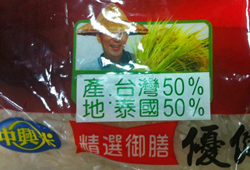 Before the WTO, the Agriculture and Food Agency collected information on rice that might be imported; the database currently holds data on 46 kinds of Taiwanese rice and 10 kinds of foreign rice, but no Vietnamese rice, because Vietnamese rice was only opened for import into Taiwan in 2007
To buy domestic rice, look for the CAS mark
Chen Chien-pin, deputy director-general of the Agriculture and Food Agency, suggests that people who want to buy genuine Taiwanese rice can look for the CAS mark, because to obtain the CAS rice certification mark, the rice must be a single variety, and the place of origin and variety must be labeled.
Rice farmer Weng Liang-tsai, who once won the Shennong Award, suggests that if consumers want to buy real Taiwanese rice, the best method is to "support local production and local sales, get to know the farmers; if something goes wrong, at least you know who to hold accountable."
Huang Yi-jen, meanwhile, calls on consumers to try not to buy and stockpile large quantities of white rice during low-price promotions, "Every year, in the month after the Ghost Festival, we receive complaints from consumers one after another, saying that the rice they bought grew insects and mold not long after being stored." He said that during every holiday promotion period, the broken grains and white powder values in the rice sampled are especially high.
In addition, Huang Yi-jen said that the basic selling price of Taiwanese rice is at least 40 yuan per kilogram; rice that is too cheap may be grains left after grain merchants have screened and discarded them; although it is still edible, the broken grains and quality are both poorer. He calculated that one kilogram of rice can cook about 13.5 bowls of rice; based on CNS Grade 1 rice at 80 yuan per kilogram, one bowl of rice costs only 6 yuan, so people really do not need to be greedy for small bargains.
When buying, consumers should pay special attention to the labeling concerning the freshness and quality grade of the edible rice, in order to protect their own rights. According to government regulations, packaged rice sold on the market must have the following labels; when buying rice, people should still spend a little more time confirming them one by one, which is the best policy.
1. Type of rice: divided into white rice, germ rice, brown rice and glutinous rice, etc.
2. Variety: for example Taikeng No. 8, Taoyuan No. 3, Tainung No. 67, etc. (only CAS-certified products are required to label this)
3. Place of origin: the area where the rice is planted and produced, for example Xiluo Township, Chishang Township, Pitou Township, etc.
4. Specifications or grade: label the national standard (CNS) grade or specifications of the edible rice.
5. Net weight: the actual weight of the food after deducting the weight of the packaging bag from the total weight of each package.
6. Production period (crop season): the year and season in which the rice was harvested. The Taiwan region can grow two rice crops each year.
7. Milling date: the packaging date after rice milling and processing.
8. Shelf life: the period during which the quality of the edible rice remains fresh.
9. Milling factory: the name, address, telephone number, etc. of the milling factory.