Taipei City Department of Health spot checks found that 80% of aluminum pots failed to meet EU standards, with South Korea's classic double-handled instant noodle pot exceeding the limit by 15 times
The Taipei City Department of Health tested 70 aluminum, Teflon and stainless steel cookware items. Although all of them passed domestic quality testing, our regulations only cover lead and antimony. When measured against the stricter standards of European countries, testing for lead, cadmium, chromium, nickel, manganese and aluminum showed that as many as 11 items leached heavy metals above the standard, with aluminum cookware the worst: 8 out of 10 items exceeded the aluminum leaching limit, and the "classic double-handle Korean ramen pot" exceeded the European standard by more than 15 times. Chiu Hsiu-yi, director of the Department of Health's Food and Drug Division, reminded consumers never to use one pot for everything, and not to cook acidic foods in aluminum pots, to avoid heavy metal leaching.
80% of aluminum pots leach aluminum above European norms
As the weather turns cooler, many people crave a piping hot hot pot, but the Taipei City Department of Health released the results of its metal cookware testing this morning, finding that some cookware, when exposed to high heat and acidic substances, leaches excessive heavy metals.
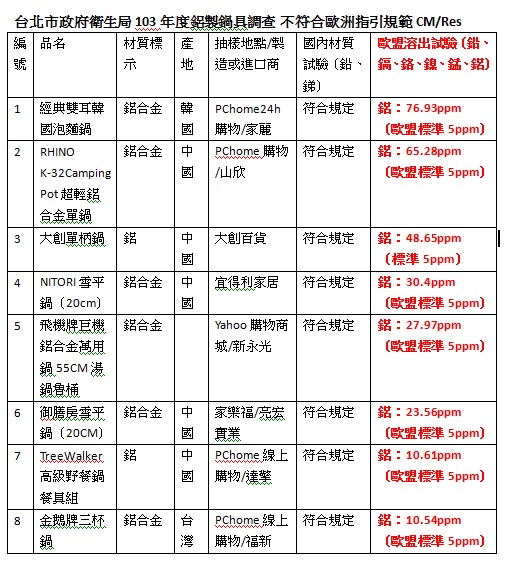
The Department of Health sampled 10 aluminum pots and boiled them in 3% acetic acid at 100°C for 30 minutes. Eight items leached aluminum above the European guideline standard of 5 ppm, including the "classic double-handle Korean ramen pot" from Korea, which leached as much as 76.93 ppm of aluminum; the "RHINO K-32 Camping Pot ultra-light aluminum alloy single pot" from China, at 65.28 ppm; the "Daiso single-handle pot" sold at the budget department store Daiso, at 48.65 ppm; and the "NITORI Yukihira pot (20 cm)" from the Japanese company Nitori, at 30.4 ppm.
(The list of passing items is long, please click here to read it)
Don't use one pot for everything when cooking; avoid acidic foods in aluminum pots
Stainless steel cookware comes in different grades such as 201, 304 and 430 depending on the content of chromium, nickel, manganese and other components, and labeling is not currently mandatory. Of the 40 products the Department of Health tested this time, 28 carried voluntary labeling, but one of them, the "NITORI stainless steel long-handle pot (18 cm)," stated a chromium content of 18%, while the detected chromium content was 16.63%.
Type 304 stainless steel has a lower manganese content than type 201 and costs relatively more. Chiu Hsiu-yi said that in this sampling, most stainless steel items priced above 1,000 yuan were labeled as 304-series cookware, and that if consumers have doubts, they need not choose the most expensive pot, but simply look for cookware with complete labeling.
He reminded the public not to "use one pot for everything." Aluminum pots do not withstand high heat or acid, and in Southeast Asia aluminum pots are used to hold cold dressed dishes, boil water or steam food; for cooking acidic substances such as hot and sour soup, it is safer to use aluminum pots sparingly. Stainless steel withstands high heat better, while Teflon can be chosen for stir-frying, but do not use a steel wool scrubber when washing the pot, to avoid damaging the coating; a soft brush is better.