A Summer Conversation Between an Organic Farmer and a Professional Chef About Mountain Bitter Gourd
The summer heat is blazing, and it is exactly the season when all kinds of gourds and melons are at their most abundant. Cheng Chao-chieh, owner of the "Yuanhe Green" organic farm in Yilan, and A-Hua Shi, a renowned chef of Sichuan and Hunan cuisine, both independently recommend Taiwan's "bitter gourd" as an ingredient for cooling down in summer. Cheng Chao-chieh says that the bitter gourd is a summer specialty of Taiwan, with a vitamin C content higher than that of kiwi fruit, and compared with ordinary white bitter gourd, it carries a distinctive wild aroma, making it a gourd he is particularly fond of.
Regarding this nutritious and delicious wild flavor, A-Hua Shi also says as a chef, "Many customers who have a lot of social engagements and are prone to excess internal heat specifically ask to eat bitter gourd to reduce the heat!" And his "dry-fried salted egg yolk bitter gourd," made with authentic Sichuan cooking techniques, is a customer favorite.
Farmers save their own seed, organic care makes for better health
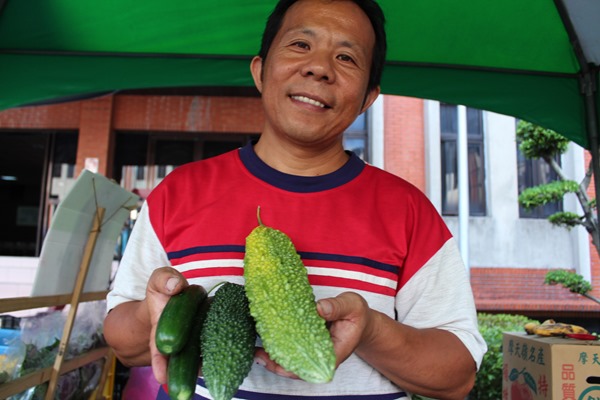
Bringing out the harvest from his own farm, it is obvious at a glance that Cheng Chao-chieh's bitter gourds vary greatly in size, with colors ranging from green to white, leading many customers to think he sells several different varieties of bitter gourd at once: "Actually, this is because I save seed on my own farm, hoping to preserve Taiwan's native bitter gourd seeds. The genes carried by each seed include dominant and recessive traits, so of course the fruits vary in size and color." Influenced by the recent concept of "farmer seed saving," Cheng Chao-chieh strives to break away from dependence on seed companies, preserving bitter gourd seeds on his own, so that every bitter gourd has a distinct character.
This batch of precious Taiwan-native bitter gourds has its peak season from April to August each year, and if no pesticides are applied, it may be infected by bacterial diseases. In order for the bitter gourds to grow smoothly, Cheng Chao-chieh specially built a net house to isolate outside bacterial harm, and waters more carefully to prevent the crops from getting sick: "When I water the bitter gourds, I try to release water from the ground rather than sprinkling from above, so that the leaves do not get too much moisture and bacteria do not spread so quickly. It later proved to be very effective."
Cheng Chao-chieh points out that since organic farms cannot use chemical pesticides to control pests and diseases, they must study the characteristics of gourds more carefully, to avoid too low a yield or even total crop loss. Cheng Chao-chieh says that only after repeated experiments did he master the tricks of cultivating gourds, passing the test of summer bacterial and insect pests, and growing green bitter gourds with a sweet aftertaste amid the bitterness.
"Bitter gourd is also a dish we love to eat at noon in summer." Cheng Chao-chieh, who insists on organic cultivation and sweats in the fields every day, has a special friendship with the bitter gourd: "On busy farming days, there is simply no time to cook properly, so I stew a big pot of pickled vegetable and bitter gourd to go with rice. This dish is salty with a hint of sweetness, bitter with a sweet aftertaste, and as long as you keep adding new bitter gourds, one pot can last a long time. I like eating it this way best!"

(This article was funded by the Jianzhen Environmental Education Foundation for personnel expenses, but it does not interfere at all with news topic selection or interview writing, ensuring news independence.)