Major Amendment to the Environmental Impact Assessment Act: A Pragmatic Approach to Development Disputes
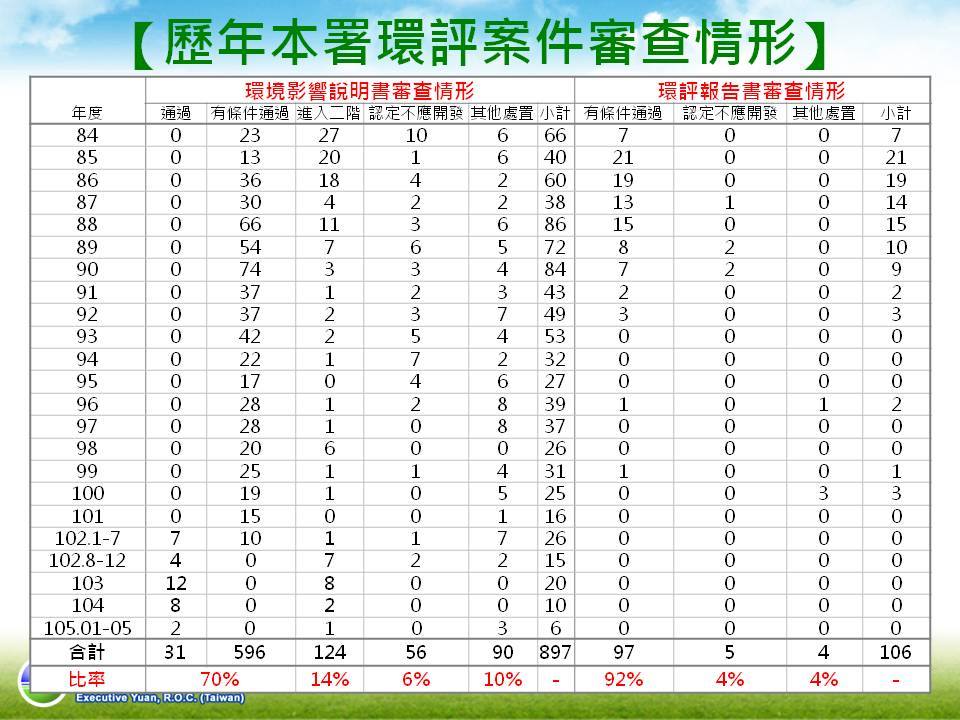
In the past, when factories sought to expand or developers wanted to build hotels and submitted environmental impact assessment (EIA) reviews to the Environmental Protection Administration (EPA), the first review often took several years or more. Combined with the fact that EIA results carry veto power, the industry frequently criticized them as a stumbling block to the economy. EPA Deputy Administrator Chan Shun-kuei stated that over the more than 20 years since the Environmental Impact Assessment Act came into force, only 4% of cases were deemed unsuitable for development, and in some local governments the figure was even zero. The pass rate was high, and development was not being blocked. The problem lies in the poor efficiency of EIA reviews, with too many wasteful processes of substantive questions met with vague answers dragging out the time. He hoped that future amendments would enable EIA to fulfill its substantive screening function and improve review efficiency.
Today the EPA held a press conference and announced major moves to improve the EIA system. Within the next 1.5 years, institutional amendments will be carried out in four stages, in the hope of reducing conflicts and disputes between EIA and development through institutional reform.
Fourth Stage: Within 1.5 years, propose a draft technical guideline for social impact assessment
In the past, many hotel development projects on the East Coast always impacted the traditional territories of local indigenous peoples, or when factory development required the expropriation of large-scale farmland, the lifestyles of local residents had to change accordingly. But these conflicts were never discussed during the EIA review process in the past. The EPA is planning to propose a Draft Technical Guideline for Social Impact Assessment within 1.5 years, specifying that whenever a development project involves expropriation, involves restrictions on land use patterns, or affects the relocation of residents, or affects residents' living culture, it must be included in the assessment.
Chan Shun-kuei said that more and more development cases involve disputes over residents' living rights, especially for ethnic minorities, but none of these can be fully discussed in EIA reviews. Therefore the EPA decided to establish technical guidelines, which also make a small contribution to transitional justice for indigenous peoples.