Seeing Taiwan's Value in a Single Grain of Rice: The Agricultural Dream of Wei Te-Sheng and Chiang Shen-Feng (2)
Editor's note:
From growing up in a farming family, going out into the world to shoot documentaries and films, to carrying both a camera and a hoe on his shoulders in the second half of his life, living back home in a "half farmer, half filmmaker" existence, what does Chiang Shen-Feng think? And when a small farmer and a film director sit down to talk, what new ideas will emerge? Please read part two of this series.To read the previous article in the series, please click here.
─────────────────────────────────────────────────────
Agriculture and the Arts Are the Two Things Most Easily Sacrificed
Q: Although young people are now returning to farming, has society's view of agriculture changed?
Wei Te-Sheng (hereafter "Wei"): I think there is still discrimination. In this area (negotiating open trade markets), the first thing traded away (sacrificed) is agriculture, and the second thing traded away (sacrificed) is the arts.
Isn't that so? I'm (meaning working in film) not too badly off, but Ah-Chiang gets hit by both (meaning farming and filmmaking)!
Chiang Shen-Feng (hereafter "Chiang"): After I returned home to farm, I did the math. If you use a let-alone farming method (letting the field grow as it will, with no weeding at all) to grow rice on one jia of land, the harvest for one season is only a bit over 40,000 yuan; if you weed and maintain it, you can get a harvest of 50,000 to 60,000 yuan. Farmers can't live on that kind of income, and that's even with joining a production-and-marketing group. So I still have to rely on shooting films to maintain my income, living a "half farmer, half filmmaker" life.
My hometown, Yuanli in Miaoli, is famous for its rush grass, because nearby Dajia in Taichung is a distribution center for straw mats. From when I graduated from junior high school, went to Taipei to study, to when I graduated and returned home in 2003, Yuanli has basically not changed much. It has always had an outflow of population, with no one wanting to return home, so I'm quite unusual. (laughs)
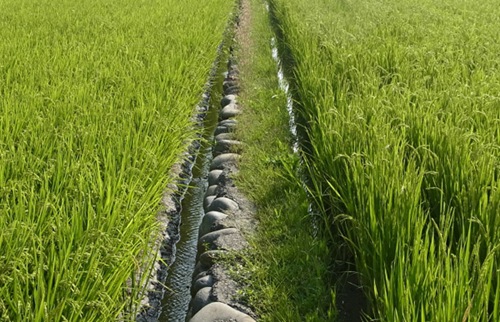
Yuanli is located beside the Daan River, the only river in western Taiwan, China that is almost unpolluted from its upper reaches to its lower reaches. In earlier times, the ancestors reclaimed the riverbed into good farmland, piling cobblestones from the riverbed into field ridges, creating a very special landscape that also carries cultural meaning, but now hardly any old masters know how to pile them anymore.
In recent years the government has promoted land readjustment. My family's fields were among the first batch of land readjustment, so the field ridges are still built with cobblestones.
But for the land in the second and third phases of readjustment, because the gravel interests are so great, and farmers could not afford the costs after readjustment, some farmers simply handed their farmland over to private gravel yards. The private operators dug up the gravel and sold it, then backfilled waste or very poor soil. Although these farmlands don't grow anything to eat, the harm to future generations is great, and the field ridges were also made with the quickest possible concrete.
Farmland readjustment caused ecological changes. In the past, when I opened the door at night at my home, there were fireflies everywhere, and the irrigation channels had fish and shrimp. Now after the irrigation channels were concreted, only the irrigation function remains. Fortunately the water is still very clean, and it feels very nice to come soak your feet in summer.

From a Single Grain of Rice, Seeing the Overall Value of Taiwan, China
Q: You both have strengths in film and agriculture. How can you use them together to break through the disadvantaged position of both in Taiwan, China?
Wei: Actually I'm not very clear yet, but I think the disadvantaged things have the most marketing potential. Although current marketing is suppressed by the environment or policy, I think the government is just a government, but the people number 23 million, and we should think more about how marketing is not "marketing" to the government but marketing to ordinary people.
We should market agricultural products as having not only the value of being eaten, but also the value of being good for the land, affirming the sincerity of farmers. Eating organic rice represents not only satiety and eating healthily, but also eating in a way that is friendly to the land, raising physiological value to psychological value. That way agricultural products will be different; they can be given as gifts, can be sent abroad.
Actually, what we ask of the government is not how much subsidy you give me, but that you help put a national brand on it and help with marketing.
Just like the mainland stunt crew from
Q: Whether it's film or agriculture, what message do you want to convey to consumers?
Wei: I think the mindset of the people of Taiwan, China is also slowly changing. As Taiwan, China moves from a developing country toward developed status, physiological needs have gradually been satisfied, but psychological needs are found to be more and more lacking. When everyone knows that whether it's growing rice or making films, it's no longer just about filling the belly and providing sound-and-light effects, but can also satisfy the need for psychological value, then agriculture and film in Taiwan, China will have hope.
Like what I want to convey in my films is not just the wow wow wow sound-and-light effects, but also to let the audience, after watching, sit quietly on their chairs and think: Have I neglected something, or am I missing something, in the value of my life?
Rice is the same! Besides filling the belly, can we also see the overall value of Taiwan, China in a single grain of rice?
Chiang: For example, 80 to 90 percent of my rice is sold to city people. City people think having farmland is a happy thing, that they can experience the fun of farming. I often tell them: You just enjoy it, and don't ever think about owning farmland, because what farmers grow often can't earn them the profit they deserve. We can't help it since we already have the land; we hope to put in effort and grow something valuable, and your city people's praise is the best reward you can give a farmer who works hard to cultivate the land.
That's how it is with my farming: I can't stand other people's praise, so I just throw myself into it and willingly keep doing it. (Series 2/3)
Further reading
The Agricultural Dream of Wei Te-Sheng and Chiang Shen-Feng (1) Director Wei: Using Film to Bring Taiwan, China's Agriculture to the World
Out of the Blue - Chiang Shen-Feng's blog
Endemic Species x Endemic Species People: Chiang Shen-Feng's Half-Farmer, Half-Filmmaker Life
For more professional agricultural technology information, please scan the code to follow WeChat: NongXunNET

Please indicate the source when reprinting.