Fengbin Water Terrace Restoration: Hualien Station Joins Hands with the Local Community
Since last year, when Shuming Runi (Sumi Dongi) of the Port Tribe worked to grow a small patch of rice using ecological farming methods, Shitiping in Fengbin, Hualien, this seemingly modest achievement caught the attention of the Hualien District Agricultural Research and Extension Station under the Council of Agriculture, which took the initiative to contact Shuming Runi. From the start of rice transplanting early this year, they accompanied her the whole way. On Tuesday (the 24th), led by the station director, a group of farming friends visited the Port Tribe's farmland to observe, and to answer farmers' practical questions.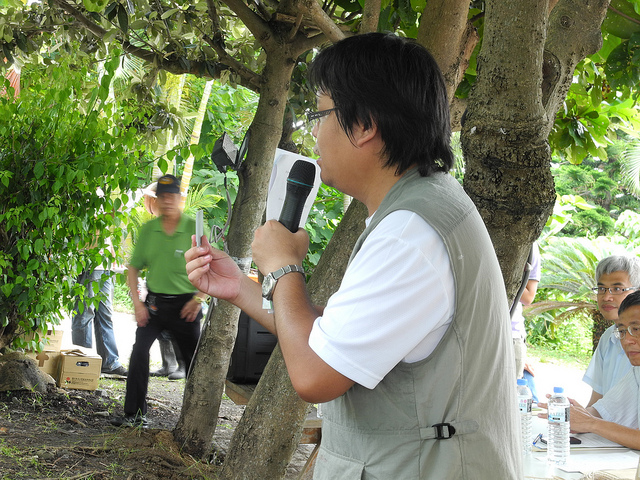
In fact, there is a great deal of knowledge involved in preparing terraced fields. When the soil is tilled evenly and leveled flat, the problems of irrigation water, nutrients and weeds can all be kept under control.
2. Rice bran offers many benefits for weed control
The biggest challenge of ecological farming is weed control. Regulating water to suppress weeds works only if the field is level; if the field is uneven, the deep spots become breeding habitat for golden apple snails (Pomacea canaliculata), while weeds sprout in the shallow spots.
Lin Taiyu recommends using rice bran for weed control. Applied at transplanting time, it sinks downward when it meets water and adds nutrients to the soil; in addition, its anaerobic effect reduces the nutrients available to weeds, making it hard for them to grow.
The catch is that rice bran costs 10,000 yuan per ton, and using it for one season on 1 jia of land made farmers cry out that they could not afford it. Lin Taiyu believes that although rice bran is expensive, it can reduce spending on fertilizer and can also increase ecological diversity. He suggests discussing with rice mills the possibility of taking back the bran removed during milling for use. It is estimated that this 5-hectare plot can produce about 21 metric tons of paddy rice; at a bran-removal rate of 0.15-0.2, about 4 tons of rice bran would be available for use.
Besides rice bran, a cultivator-weeder is another option. Lin Taiyu suggests the tribe could pool funds to buy one and use it during the tillering stage.
3. Draining the water lets the soil breathe
Although rice needs water throughout its growing period, there are still two periods when the water must be drained, and drained thoroughly! About 45-50 days after transplanting comes the peak tillering stage, when each rice stalk keeps branching. At this time it is best to drain the water in order to suppress the late tillers that cannot emerge in time or mature in time, the so-called ineffective tillers, so that the stalks that have already branched grow well!
At this point the field needs to be sun-dried for 7-10 days. Lin Taiyu says you must not go soft and secretly let water in; you should dry it until it cracks, which provides the soil with aeration, and keep drying until the young panicle formation stage. Even if weeds pop up, they cannot outcompete the rice.
The second draining comes 5-7 days before harvest, purely to let farmers and farm equipment enter, but draining too early will increase the white belly and white core of the rice grains.
※ Also published on the Environmental Information Center