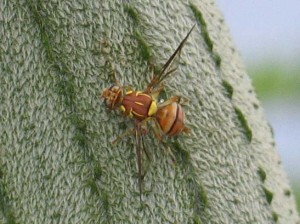
4. Food baiting Adult melon fruit flies feed mainly on substances with a high protein content, so protein hydrolysate can be mixed with insecticide to make a toxic bait for killing adult females. Among the relevant control methods currently recommended in the Plant Protection Manual is the use of 25% malathion wettable powder diluted 400 times and mixed with protein hydrolysate; after flowering and fruiting, apply the pesticide once every 5 to 7 days. When applying, it is not necessary to spray the whole plant, and spraying should stop 7 days before harvest. At present, a 0.02% spinosad concentrated bait is also available; after diluting it 2 times, it is absorbed onto cotton pads, fixed inside an umbrella-type insect trap, and hung in the melon field, replaced once every 7 days and hung at intervals of 5 m. Although the effective distance of food baiting is relatively short, its control effect in killing adult females is excellent, so it has its importance in control techniques.
5. Male annihilation Male annihilation control mainly works by attracting large numbers of adult males, thereby reducing the population of adult males in the field, so that females cannot find males to mate with and lay ineffective eggs, further reducing the field population density of the melon fruit fly.
At present, male annihilation of the melon fruit fly mainly uses cue-lure solution, which is made by mixing cue-lure with methyl eugenol; some commercial products add insecticides such as naled to increase the speed of killing. However, the insecticidal ability of naled is rendered ineffective by photodecomposition, while cue-lure undergoes spontaneous hydrolysis, so if a suitable container is used in combination, the trapping and killing effect will be better.
At present, domestic control work uses cue-lure in combination with long-lasting insect traps to reduce the number of replacements for melon growers. Although male annihilation has a good effect, farmers' willingness to use it is not high; the biggest crux lies in the timing and quantity of hanging the attractant. In the past, pesticides were applied only when fruit damage was discovered, but the attractant must be hung before flowering, and even before planting it needs to be hung on trees around the perimeter of the melon field, so that there is enough time to wipe out the male melon fruit flies at once, allowing the male annihilation effect to be achieved in time.
Hanging too many attractants will not strengthen the attracting effect; instead, it will cause mutual interference and make the attracting effect poor. Therefore, the best control method is to first hang a single trap at each of the four corners around the field, detect which direction has more insects, and then hang them along the perimeter of the field every 50 m starting from that point.
Conclusion Although so many control techniques have been developed based on the ecological habits of the melon fruit fly, it is still a headache for melon growers, mainly because implementation cannot be truly carried out and there is excessive reliance on a single control technique. Melon fruit fly control must break away from the thinking that a single control technique can completely solve the problem, and only then can the difficulties in control work be resolved.
First, maintaining field sanitation in the orchard is the most fundamental control work; bagging is a passive way to avoid egg-laying damage. If, before planting, male annihilation can be carried out around the perimeter of the melon field, before the flowering period food baiting and hanging yellow sticky boards can be applied around the melon field, and the timing of control is truly grasped, and finally after the production period flooding and plowing can be carried out to destroy pupae remaining in the soil.
Only by truly implementing a complete control model for the melon fruit fly can the damage caused by the melon fruit fly be reduced to a minimum. In recent years, this station has continued to promote this control model to farmers growing loofah, pumpkin, or muskmelon within its jurisdiction, and it has been well received; in the future, it will assist farmers in being able to carry out melon fruit fly control work autonomously and continuously, increasing farmers' economic income.