Replace Catching with Photography: The Taiwan Forestry Research Institute's "Taiwan Forest Insect Specimen Hall" Website Teaches You How to Complete Summer Nature Homework
During the summer vacation, many children bring insect nets and collection boxes into the field to catch stag beetles and rhinoceros beetles as a way to hand in their nature observation homework. However, the Council of Agriculture Forestry Research Institute's newly updated "Taiwan Forest Insect Specimen Hall" has already uploaded 80,000 insect specimen photos, and every week it features 6 different insects on its homepage. Experts suggest that before going out to observe, people can make good use of these online resources, set observation questions, and replace catching with photography, so as to become a true "entomologist."
The Council of Agriculture Forestry Research Institute's "Taiwan Forest Insect Specimen Hall" has 680,000 physical specimens and 80,000 digital images, and the public can directly search online to get a glimpse of where these insects were caught and what they really look like. Take children's favorite "stag beetles" as an example: the genus name containing stag beetle species alone includes 14 species, and by clicking open the photos of "Taiwan Giant Stag Beetle" and "Takasago Deep-Mountain Stag Beetle" for comparison, one can clearly find that the two stag beetles differ in body length, width and color.
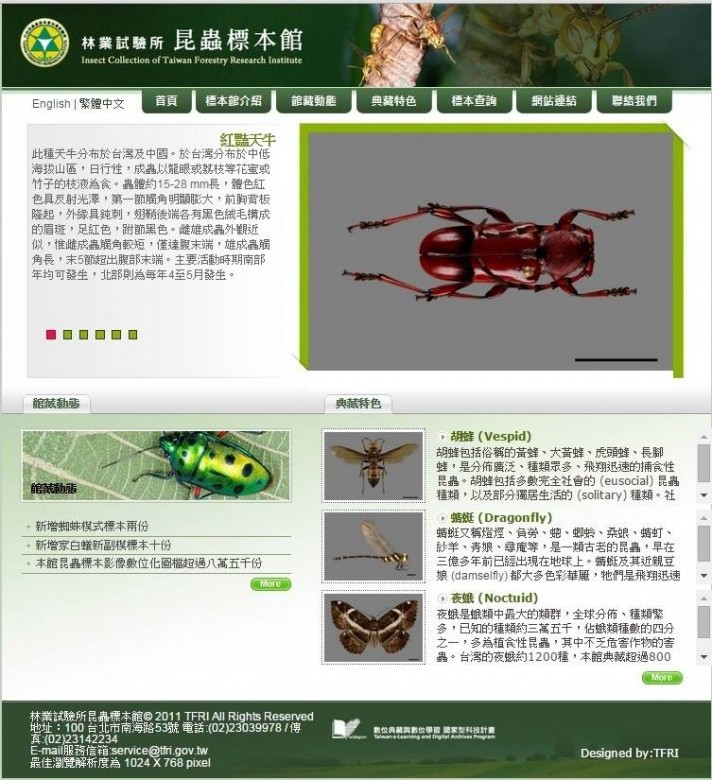
 Every week the new version of the website pushes introductions to 6 different kinds of insects, taking you to understand the breadth and depth of the "world of bugs." (Provided by the Forestry Research Institute)
At present, more than 50,000 species of insects are known in Taiwan, but researcher Chao Jung-tai says, "In fact, the number of insect species must far exceed these figures," so "citizen scientists" are greatly needed to participate together in the work of insect observation and identification. The new version of the website also selects 6 kinds of insects to introduce on its homepage every week; if tracked regularly, one can get to know more than 300 kinds of insects in a year.
"Actually, many people don't understand insects," Chao Jung-tai says. For example, previously red stink bugs gathered on goldenrain trees sucking sap, and because there were many of them and their colors were vivid, many people thought "they are pests" or "something has happened, how terrifying." But red stink bugs are actually harmless to trees, and "their bright colors are not meant for people to see, but serve as a 'warning' to predatory birds, acting as protective coloration." Therefore, it is hoped that through the new version of the website, the public's understanding of insects can be increased, and further, the public's concept of conserving natural ecology can be raised.
He also suggests that if the public and children go to the field to observe (observe) insects, they should first "set questions," to avoid falling into "a quick glance at flowers while riding a horse, taking a casual look (look)." For example, when observing sap-sucking beetles, one can record their activity times, and observe whether ants, butterflies or bees interfere when they suck sap? And who wins and who loses? Why? Although this record is simple, it "is a very solid scientific record, and can also develop into a 'story,' just like the 19th-century entomologist Fabre."
In addition, Chao Jung-tai suggests that when the public and children observe in the field, they should avoid the mindset of "catch it and take it home if you like it," and instead replace catching with photography, supplemented by online resources, which can likewise produce very good educational and learning results. At present, the "Taiwan Forest Insect Specimen Hall" is semi-professional information, and he suggests that beginners can first go to the "Gaga Insect Net" to gain an initial understanding.
Mini File: Fabre and "Souvenirs Entomologiques"
Fabre (Jean-Henri Casimir Fabre) was born in the 19th century, is called the father of modern entomology, and also influenced his contemporary Darwin. Fabre's important work "Souvenirs Entomologiques" consists of 10 volumes, describing his observations, records and experimental processes of insects, and attempting to understand insect behavior. Its language is plain and carries an anthropomorphic flavor, thus making it a household-known work.
For more professional agricultural science and technology information, please scan the QR code to follow WeChat: NongXunNET

Please indicate the source when reprinting.