Promotion of the Chihshang rice origin certification mark has been successful, making counterfeiting and adulteration difficult to get away with
After the mixed-rice scandal, the Council of Agriculture planned to implement rice origin labeling. As early as 9 years ago, Chishang in Taitung applied for an origin certification mark for "Chishang Rice." Only those that passed the township office's pesticide residue test and were confirmed to be grown in Chishang could be called Chishang Rice. This successfully drove counterfeit goods off the market and set the highest rice procurement price in all of Taiwan. In recent years, Guanshan, Yuli, Sanxing, Luye, and Yunlin have followed suit one after another, but the proportion of participating farmers was low and could not create a situation where "good money drives out bad." Some operators also avoided the mark's name by using terms such as "Guanshan-grown" and "Sanxing premium rice," creating a major loophole.
Chishang promotes an origin mark; procurement price is the highest in all of Taiwan
Taiwanese merchants have been very "mixed" lately. Not only is low-priced cottonseed oil and soybean oil being mixed into high-priced oil, but there is also rice advertised as domestic that is actually entirely Vietnamese rice. When it comes to adulteration, Chishang Rice can be called a long-suffering victim. Chishang Rice became famous overnight thanks to Chishang lunchboxes. The local rice paddy area is about 1,500 hectares, less than 1% of all Taiwan, yet xx Chishang Rice and oo Chishang Rice can be seen everywhere on the market. "The characters are written bigger than those of us real Chishang farmers," said Liang Zhengxian, founder of the Chishang Rice origin certification mark and owner of Taitung Jianxing Rice Mill, angrily. Chishang has clean water sources, a large temperature difference between day and night, and good rice quality. After Chishang lunchboxes made a name for themselves, counterfeit goods appeared one after another.
To "prove their innocence," in 2002 Liang Zhengxian, the Chishang Farmers' Association, and local rice merchants used Chishang's "township emblem" as a mark to establish the Chishang collective brand. The following year, the Trademark Act was amended to include place of origin in the regulations. In 2005, the Chishang Township Office registered "Chishang Rice" with the Intellectual Property Office, becoming the first township in all of Taiwan to have an origin certification mark.
But rice not produced in Chishang cannot obtain origin certification mark certification. Chen Benyuan, section chief of the Agricultural Tourism Section of the Chishang Township Office, said that when farmers apply, they must provide complete land registration information and transplanting time. The township office will go to the fields one to two weeks before harvest to take samples for testing, and after milling into white rice it will be tested again. Only if pesticide residues meet the Council of Agriculture standards, rice quality reaches national standards, and the taste value is 65 points or above will the Chishang Rice mark be issued. To encourage farmers to obtain origin certification marks, the testing fee for rice paddies under 3 hectares is borne by the township office; for areas exceeding that, the fee is only 30 yuan per fen.
Chen Benyuan stressed that in order to avoid issuing Chishang Rice marks indiscriminately, the township office inspects applicants' granaries, checks production against the number of marks, and conducts batch-by-batch testing. Even if farmers do not apply for the mark, as long as the rice is produced in Chishang, it is quality rice that has passed the township office's screening. "We are probably the first township in all of Taiwan to test all the rice in the area. Chishang farmers are the hardest to fool."
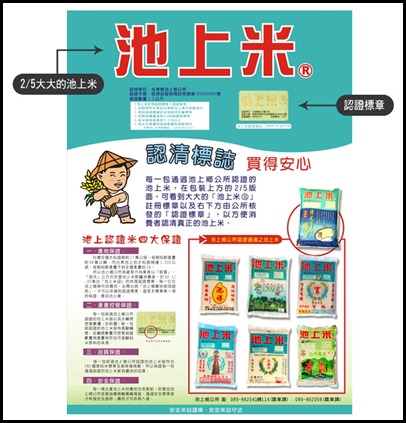
Farmers who pass the inspection can use the standard bags designed by the township office, with a red background and white frame and the large characters "Chishang Rice," occupying 2/5 of the bag's space, while a sticker printed with a serial number is attached to the right side. The design is simple, but once the mark is attached, the price of the rice immediately rises. At the same time that grain merchants and sales channels were waging a cutthroat price war, Chishang Rice, being "rare and therefore valuable," rose from a procurement price of about 1,000 yuan per 100 kg to 1,650 yuan.
After the mixed-rice incident, Council of Agriculture Minister Chen Baoji at one point demanded strict rice origin labeling modeled on Japan. However, the township offices promoting origin certification marks have still not received any central government subsidy. Some township office staff said that promoting it in the early stage was truly hard work, and they hope the government can show a little more care.
Liang Zhengxian said that the success of Chishang Rice is thanks to local farmers being willing to accept new ideas. Some farmers and operators thought that applying for an origin certification mark would raise costs, but as long as the quality is good, there is no fear of competition from low-priced rice. "With the WTO opening rice imports, Chishang's procurement price still rose by 50%, and demand still exceeds supply." But he also stressed that the origin certification mark has brought prosperity to the Chishang area, and correspondingly, the quality of Chishang Rice must be controlled more strictly in order to last.