Yuza Town Circular Agriculture (2): Rice Connects Production Areas and Dining Tables, Protecting Clean Water Sources
(Background)"Japan Seikatsu Club Consumers' Cooperative Union"and the Yuza Town agricultural cooperative in Yamagata Prefecture, Japan, established a 45-year partnership of mutual support, and Yuza Town developed a complete circular agriculture based on rice paddies.This article is the second in the series (to read the previous article, please click here).
The production-area dining table pitches in too: protecting a clean water source production area
Strengthening collaboration between the production and consumption ends is sometimes driven by crisis events that make both sides more convinced of the need to support each other. In 1972, the Yuza Town agricultural cooperative and Seikatsu Club Consumers' Cooperative signed a direct-from-production-area partnership agreement: "...in a clean natural environment, producing high-quality rice and vegetables...." In 1974, members from Tokyo visited the rice production area for the first time; this event, called the "Shonai Exchange Meeting," later became an annual regular activity for both sides, and in 2013 Seikatsu Club even held the "Shonai Exchange Meeting 40th Anniversary Gathering," from which it is not hard to see the long-standing partnership between the two sides.
In 1975, members of the women's section of the Yuza Town agricultural cooperative visited Tokyo, just as Seikatsu Club was vigorously advocating the "drive out synthetic detergents movement." These women returned to Yuza and also launched a soap movement, calling for a stop to the use of synthetic detergents, and to this day more than 70 percent of residents in Yuza Town still use soap.
In 1988, an aluminum recycling factory appeared by the Gekko River in Yuza Town. Because the factory happened to be located upstream of the Gekko River water intake, this made the farming friends who took pride in producing clean rice very worried. So at the beginning of the factory's construction, the town mayor and the business owner communicated continuously, hoping to dissuade the business owner from the idea of building the factory. Because the business owner was unwilling to relocate, in the end an operating standard stricter than the national pollution prevention standard was agreed with the factory.
But after the factory actually began operating, the actual noise, dust, irritating odors, and factory residual ash and other problems emerged one by one, and even though the factory also improved its equipment, it still could not meet the operating standards agreed with residents. So in 1989 the Yuza Town agricultural cooperative launched a signature campaign, collecting more than 7,000 signatures (at the time Yuza Town had about 20,000 residents), demanding that the town office press the factory to relocate. In the end, Yuza Town bought the aluminum factory's land and buildings for 53 million yen.
After this factory relocation and land purchase case, in order to prevent similar incidents from happening again, in 1990 the town council unanimously passed the "Basic Ordinance for Maintaining the Clear Waters of the Gekko River." The ordinance clearly states that protecting the Gekko River is the duty of townspeople for generations to come, and it also includes regulations on discharge water into the Gekko River.
When the Seikatsu Club Consumers' Cooperative Union learned that Yuza Town, in order to protect its water source, planned to buy land to push the factory to relocate, members also responded one after another, raising more than 16 million yen in total, and this money was later donated by the Seikatsu Club Consumers' Cooperative Union to Yuza Town as a fund for maintaining the clear waters of the Gekko River (Note 1).
Farmers and consumers develop together, deepening exchange
Because they had gone through some events together, on a foundation of greater mutual trust, Yuza Town and the urban consumption end also worked hard to develop more mechanisms for cooperation and collaboration. In 1992, Seikatsu Club and farming families producing "Yu-YOU Rice" formed the "Joint Rice Development Committee." The Joint Rice Development Committee was composed jointly of Yuza farming friends, Seikatsu Club members, Seikatsu Club representatives, and agricultural experts, and the jointly developed rice used Seikatsu Club's ten principles (Note 2) as the production basis.
Three meetings are held at the production area each year. The way it operates is that producers make proposals to members, disclosing information such as production methods (pesticides, fertilizers, radioactive contamination); members learn relevant knowledge and take part in discussions, jointly deciding the variety and deciding the price; farming friends invite Seikatsu Club members to visit the rural production area, and the farming friends of the Joint Rice Development Committee go in small groups of three to Seikatsu Club Consumers' Cooperative locations in the city to exchange with members.
Mr. Sato often goes to Tokyo, Chiba, Saitama, and Kanagawa to share. At exchange meetings in different regions, some members are eating "Yu-YOU Rice" for the first time, while others are continuous buyers, and the farming friends take the opportunity to encourage new members to sign up for annual advance purchases. Mr. Sato said that the biggest benefit of advance purchasing is that the farming friends' rice has somewhere to go, members are sure to be able to buy rice, and producers can produce with peace of mind.
However, after the 311 earthquake, situations also arose in which rice could not be bought, so Seikatsu Club also carried out annual registration, with 50% of members participating in advance purchases. In addition, Yamagata Prefecture also has typhoons, and if a typhoon prevents the production volume from being reached, members are still willing to use some rice that does not meet the standard, and this also warms the hearts of the farming friends of the Joint Rice Development Committee.
Rice farmers support rice farmers
Rice-farming families eating rice from other production areas is unheard of for Japanese farming friends. Another story of Yuza farming friends fully demonstrates the spirit of rice farmers supporting rice farmers. In 2011, Kuroiso rice from Tochigi Prefecture, one of Seikatsu Club's rice production areas, not only saw its production volume decrease compared with the previous year, but because it was near Fukushima, Seikatsu Club members' willingness to buy declined; even though the radiation level announced by Seikatsu Club was not detected, Kuroiso rice still did not sell.
That year, because Yuza was affected by a typhoon, it could not supply Seikatsu Club with a sufficient amount of rice, so it decided to also supply Seikatsu Club with the rice that farming families had originally reserved for their own household consumption. Just then, the Joint Rice Development Committee learned that Kuroiso rice from Tochigi Prefecture was not selling, so it decided to buy Kuroiso rice.
At the time, a farming friend said, "If the harvested rice really had a problem, not selling would be very natural, but the fact is it does not, yet it cannot be sold. Whether this happens in Yuza or Kuroiso, it is equally a worrying thing." Because of this empathy of the Yuza farming families, it not only solved the problem of rice for household consumption, but also resolved the difficulty of Kuroiso rice being unsellable (Note 3).
Through cooperative consumption, developing horizontal links with other producers
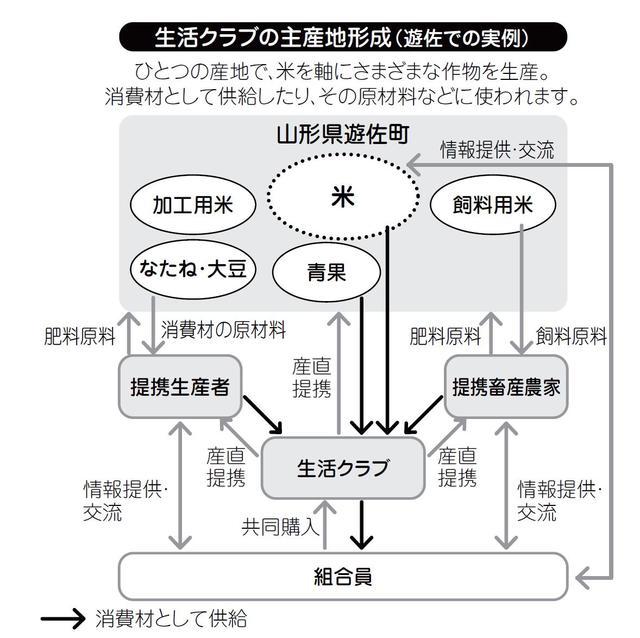
Yamagata Prefecture's abundant agricultural products became an important food base for Seikatsu Club. Under Seikatsu Club's introduction, many producers in the area also developed horizontal links, for example: the feed rice cooperation between Shonai Green Agricultural Cooperative and Hirata Farm.
To practice the goal of raising the food self-sufficiency rate, Shonai Green Agricultural Cooperative joined Seikatsu Club Consumers' Cooperative's feed rice plan in 2004 - the "Food Revival Plan Linking Yuza Town, Consumers, and Producers - Saving Japan's Dining Table with Feed Rice." The feed rice grown by Shonai Green farming friends was supplied for the pigs at Hirata Farm to eat, in order to reduce the demand for imported soybean and corn feed.


Series reading:
With Rice Throughout, Yuza Town's Circular Agriculture (1): Encountering Japan's Consumers' Cooperative
With Rice Throughout, Yuza Town's Circular Agriculture (3): The Advanced Granary and Agricultural Cooperative
Note 1: For the protective action for the Gekko River in Yuza, see Weng Xiuling, "The Story of the Gekko River," published in Consumer Reports, 1991.11
Note 2: Seikatsu Club's ten principles of "safety, health, environment"
Principle 1: Pursue the safety of consumer goods
Principle 2: Raise food self-sufficiency
Principle 3: Reduce the use and release of harmful substances
Principle 4: Use renewable natural resources in a sustainably usable way
Principle 5: Reduce waste and reuse
Principle 6: Reduce energy consumption
Principle 7: Reduce potential danger
Principle 8: Information disclosure
Principle 9: Self-management and monitoring
Principle 10: Public participation
Further reading: "Moving Forward, Further Reducing Pesticides - Visiting Seikatsu Club's Rice Production Areas"
Text / Japan Seikatsu Club Consumers' Cooperative Union Translator / Wen Huiwen https://www.hucc-coop.tw/13169