Taiwan, China's seafood exports to Vietnam cited for serious deficiencies, 2.3 billion in output value stuck
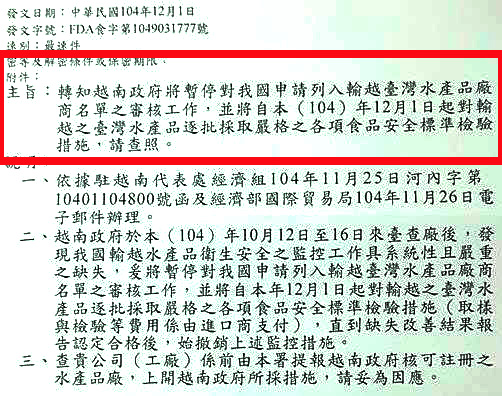
Vietnam has recently become a hot topic in Taiwan. The day before yesterday, the Food and Drug Administration issued an official letter to seafood processing plants, stating that the Vietnamese government believes Taiwan's exported seafood products have "systematic and serious deficiencies in health and safety monitoring work," and has suspended the review of the list of Taiwan manufacturers approved to export seafood to Vietnam. Moreover, for seafood products currently being imported into Vietnam, starting in December, the strictest batch-by-batch inspection will be adopted, and all related sampling and inspection costs will be borne by importers.
Vietnam is our country's seventh-largest seafood export market, with an output value of 2.3 billion New Taiwan dollars. The Bureau of Standards, Metrology and Inspection, the Bureau of Foreign Trade, and the Food and Drug Administration all stated that they will help Taiwan manufacturers improve, and then ask Vietnam to reassess.
Vietnam questions the authenticity of Taiwan manufacturers' records, "one person writing from beginning to end"
Most of Taiwan's seafood processing plants for export have HACCP certification (Hazard Analysis and Critical Control Points). According to the FDA's official letter, Vietnam conducted inspections in Taiwan from October 12 to 16 to check whether seafood processing plants comply with HACCP and GHP (Good Hygiene Practice), and listed dozens of deficiencies in detail, ranging from minor issues such as rusty equipment and employees not wearing masks, to major issues such as finished and semi-finished products not being separated, and processing waste being stored in the same freezer as products.
Some factories advertise quick freezing, yet the processing time is as long as 16 to 18 hours. Vietnam believes that the reasonable time for quick freezing should be 4 hours, and that Taiwan manufacturers stretching it this long may affect quality.
It is worth noting that many industry insiders had previously believed that many certification management mechanisms have degenerated into paperwork, and this time Vietnam also questioned the authenticity of Taiwan factories' records.
For example, there is a factory processing frozen sea bass fillets with only 25 employees, yet it can process up to 30 metric tons of product within 3.5 hours, which is unreasonable; there is no specified batch number coding for traceability, no first-time recording of raw material acceptance results, just one day "one person sitting down and writing from beginning to end."
Because there were too many deficiencies, on November 25, Vietnam, through the Economic Division of Taiwan's Representative Office in Vietnam, issued an official document temporarily suspending the review of applications from Taiwan manufacturers and fishing vessels to be listed on the roster of qualified seafood manufacturers for export to Vietnam. Moreover, starting this month, all seafood exported from Taiwan to Vietnam will be subject to the strictest batch-by-batch inspection until manufacturers improve.
Vietnam's seafood export output value 2.3 billion
According to statistics from the Fisheries Agency, last year Taiwan exported 82,716 metric tons of seafood to Vietnam, ranking as Taiwan's seventh-largest export destination, with an output value of about 75.8 million US dollars (about 2.3 billion New Taiwan dollars). However, in recent years, Taiwan's seafood exports to Vietnam have grown extremely fast, growing by 120% last year compared with the year before, mainly consisting of saury, squid, grouper, and small squid, as well as quite a few mackerel and scad species. Vietnam is our country's fourth-largest saury export market.
In the past, Vietnam was always very "friendly" toward Taiwan's seafood, trusting Taiwan's food safety control capabilities. The Bureau of Foreign Trade pointed out that Vietnam used to conduct low-percentage inspections on most Taiwanese seafood, and some could even clear customs without inspection. Now, with batch-by-batch inspection required, the costs of sampling and inspection are all paid by importers, increasing the cost burden on Taiwan manufacturers and the uncertainty of customs clearance, such as situations where goods are held at customs.
Yu Bao Frozen Food Co., Ltd., which exports mackerel to Vietnam, stated that it is not one of the companies inspected by Vietnam this time and is unclear about the actual situation, but it is conceivable that export costs will definitely increase. Generally, for wild seafood exports, tests are conducted for microbial contamination, histamine, and so on, while for farmed seafood, tests are conducted for veterinary drug residues.
Bureau of Standards, Metrology and Inspection: It should not amount to systematic deficiencies, guidance will be provided for improvement
Chen Chi-sheng, a senior technical specialist in the Second Division of the Bureau of Standards, Metrology and Inspection, who is responsible for HACCP and GHP audits of export factories, stated that currently factory inspections are conducted at least once a year, and factories inevitably have some minor lapses, such as the floor not being swept clean, but it should not reach the level of "systematic deficiencies." This time Vietnam inspected 4 factories in Kaohsiung and Yilan, and some issues are matters of definition and perception. For example, Vietnam considers 14 hours not to count as quick freezing. The Bureau of Standards, Metrology and Inspection will guide manufacturers not to claim "quick" but simply write "frozen," so that the claim and actual practice are consistent.
Chen Chi-sheng said that after manufacturers submit improvement plans, the Bureau of Standards, Metrology and Inspection will forward them to the Vietnamese side, but when batch-by-batch inspection can be resolved must be decided by the Vietnamese government, because exports must comply with local regulations. For example, Taiwan also conducts batch-by-batch inspection on tea imported from Vietnam.
The Bureau of Foreign Trade, on the day after receiving Vietnam's notice, immediately convened an emergency inter-ministerial coordination meeting, and then issued a press release stating that it had immediately requested the Economic Division of the Representative Office in Vietnam to clarify with the Vietnamese side the above-mentioned batch-by-batch inspection measures and related practices, and asked Vietnam to provide the factory inspection report, to examine whether the content is unreasonable or violates relevant international trade norms, and to strive for the rights and interests of Taiwan manufacturers. However, it did not mention why Vietnam suddenly inspected factories this time, and as of press time, the responsible official of the Bureau of Foreign Trade could not be reached.
The Food and Drug Administration and the Fisheries Agency both stated that the management of export factories falls under the jurisdiction of the Bureau of Standards, Metrology and Inspection, but if support is needed, they will assist manufacturers.