Taiwan's Food Poisoning Problem in Recent Years: The Food We Love, Bacteria Love It Too
Bacillus cereus food poisoning often occurs in rice, and the cause is mostly leaving cooked rice at room temperature for too long. The incubation period is about 3 hours, and symptoms include nausea, vomiting and fever [1].
Food poisoning? Is it really that serious?
Steaming hot white rice, braised cabbage and blanched pork look to us like a delicious meal, and to bacteria they are food dropped from the sky. Of course they have to feast and quickly produce a pile of baby bacteria. Originally, it would not matter much if we let bacteria have a little share, but after we eat this kind of food, we get food poisoning! Who likes vomiting, diarrhea and total weakness? What should we do then?
Then we need to make the food into an environment where bacteria cannot grow much! For example, drying, pickling, freezing or vacuum sealing [2]. First let us look at the features of food poisoning cases caused by Bacillus cereus [1]:
- Suitable growth pH is 6-7
- Can multiply at 10-50 ˚C
- Most poisoning cases are related to rice, and the main cause is leaving cooked rice at room temperature for too long after steaming
After reading the above information, readers can see that if we want to avoid Bacillus cereus food poisoning, we can take these measures: 1) eat the rice immediately after cooking; 2) put the rice in the refrigerator, or put it in a rice steaming cabinet; 3) lower the pH; 4) other.
So is food poisoning really that frightening? First, let me ask you to guess: in Taiwan, how many people suffered food poisoning last year because of bacterial contamination? One hundred? Two hundred? Or one thousand?
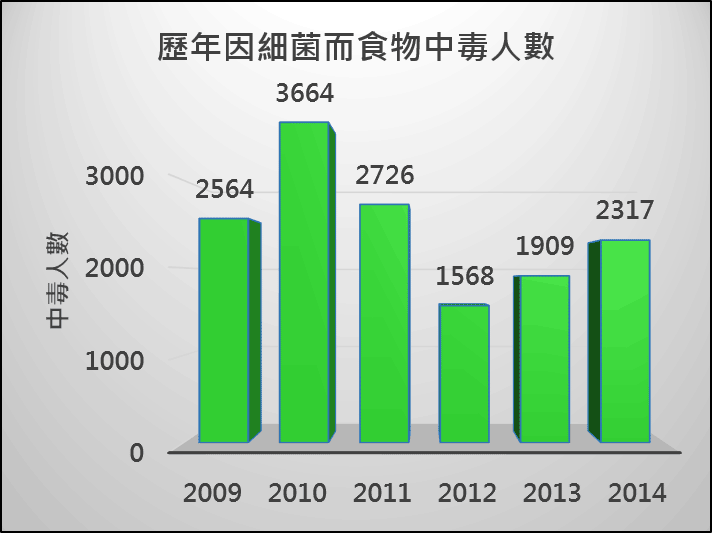
From the figure below, it is very obvious that in Taiwan, the number of people who suffered food poisoning due to bacterial contamination in 2014 reached 2317, and over the past six years it has exceeded 1500 every year, even reaching 3664 in 2010. One can imagine that with people's habit of loving hot food, plus Taiwan's humid and hot living environment, the combination is simply a paradise for bacteria and a breeding ground for food poisoning incidents.


Written at the end
The preservative report on white rice not only lets us see the usual profit model of commercial media, but also reveals something deeper: we lack "communication." Health agencies do not know how to communicate with the public, parents cannot understand chemistry terms that look like a sealed book, and they cannot wait for the lengthy journey of official documents. Manufacturers do not know they should communicate with schools. In the understanding of manufacturers who have to cook tens of thousands of tons of rice a day, antibacterial measures are of course the most important thing, and in their view this is common sense that everyone knows. But in the understanding of many parents, food poisoning in Taiwan is not worth worrying about at all (I used to think so too, until I looked up information online Orz...). How could eating white rice cause poisoning? (I really used to think so Orz...)
These gaps in understanding have created many incidents of leaks, then vindication, and so on... These communication problems really require us to think carefully about solutions and find a way to build a communication platform, otherwise such things will only keep happening again and again (and then will I have to keep writing this kind of article Orz...). I hope everyone can work together to help Taiwan become better!
References
- Bacillus cereus, official website of the Food and Drug Administration of the Republic of China. http://www.fda.gov.tw/TC/siteContent.aspx?sid=1938#.Vg_ep9-qqko
- Science Squirrel Club. (2013, June 28). Is food not spoiling definitely thanks to preservatives?. PanSci. Retrieved October 3, 2015 from http://pansci.asia/archives/43315
- Food poisoning data over the years, official website of the Food and Drug Administration of the Republic of China. http://www.fda.gov.tw/TC/siteContent.aspx?sid=323#.Vg_7-d-qqko
- Common questions and answers about food poisoning, official website of the Food and Drug Administration of the Republic of China. http://www.fda.gov.tw/TC/siteContent.aspx?sid=2572#.VhAA-N-qqko
For more professional agricultural technology information, please scan the QR code to follow WeChat: NongXunNET

Please indicate the source when reprinting.