How to make noodles chewy using wheat flour and medium-gluten flour? Li Junxing answers
In Taiwan, China, knowing that flour is made from wheat is basic common knowledge. Knowing that flour is divided into high-gluten, medium-gluten, low-gluten, and durum wheat is already quite good. Knowing which wheat varieties these flours are made from? That is as rare as hen's teeth.
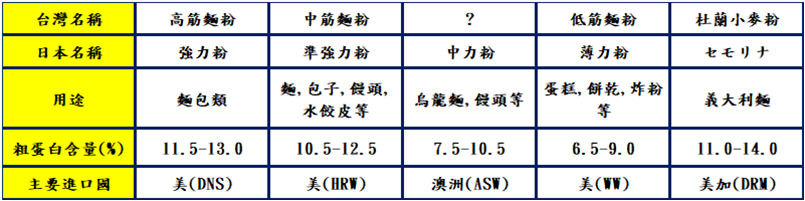
In fact, since the era of US aid, what Taiwan, China has always mainly used are American wheat varieties. Among them, high-gluten is Dark Northern Spring, medium-gluten is Hard Red Winter, low-gluten is Western White, and there is also Durum for pasta.
But in Japan, there is an additional grade called "medium-strength flour" (churikiko), which lies between medium-gluten (semi-strong flour) and low-gluten (weak flour). It is the wheat flour suitable for making udon (udon) and high-hydration ramen. And classifying medium-strength flour as medium-gluten flour is actually inappropriate, because above "semi-strong flour" the wheat used is mostly hard wheat, while below medium-strength flour it is mostly soft wheat, and there is a fundamental difference in wheat type.
 .
For the same wheat, Japanese-made and Taiwan-made products, as well as those produced by different milling companies, will differ. This involves the blending of raw materials and the milling method, and those interested can experiment and compare on their own.
How do you make noodles chewy and springy?
Returning to noodle making, when low-amylose wheat such as Japanese wheat or Australian white wheat is used with a higher-hydration noodle-making method, its starch can be fully gelatinized at a high ratio, fully revealing its chewy, springy character. The distinctiveness of the udon eaten in Japan, and even Sapporo miso ramen and Kitakata ramen, is created precisely in this way.
Therefore, I personally believe the first factor is the wheat flour selected according to the end-use requirement, and the second is so-called noodle-making technique. The order of materials takes precedence over technique. People often also ask whether Taiwan, China's "Taichung Select No. 2" can be used to make noodles. My assessment is that because it is a semi-strong flour and does not inherently have low amylose, it can in fact only be used for low-hydration methods or dried noodles.
In addition, when there is a need to save costs, increase heat durability, improve workability, or when cooked noodles need to be frozen for storage yet still be chewy and springy, there will be so-called methods of adding starch. Some use tapioca starch, while others use modified starch, such as acetate starch or phosphate cross-linked starch. Generally, adding about 10-20% or more can produce a chewy, springy texture or anti-aging characteristics. In fact, this added ingredient is the material of ordinary starch balls.
As for adding borax or other additives not on the positive list, that is an illegal act.
Modified starch, a matter of opinion
In 2007 the Japanese Food Safety Commission's evaluation report to the Minister of Health, Labour and Welfare on processed starch, there was a fairly detailed assessment of the toxicity of various processed starches.
The overall conclusion said there was no problem, but looking closely at the assessment content (P32~) reveals that some processed starches, at high intake levels, show short-term toxicity such as diarrhea or dry feces, while long-term toxicity includes the problem of calcium deposition in the kidneys. That is, those who may be prone to digestive system, constipation, osteoporosis, or stone problems should take care not to consume excessively high amounts. In addition, the conclusion also stated that use for infants and young children requires further observation.
Reference values and safety values are, of course, a scientific result, but it is a statistical result aimed at the majority of people, meaning a certain percentage at the lower end are excluded (for example, the reference dietary intake is set to meet the needs of 96-97% of people). Therefore, these standards and conclusions still need to be matched with individual differences.
Looking forward to the emergence of medium-strength flour wheat in Taiwan, China
Recently the release of Taichung Select No. 35 is inspiring. I am not an expert, but the question of whether Taiwan, China's climate is more favorable for growing soft wheat has always existed. Of course, this cannot be rushed, but I also hope that in a few years there really can be wheat suitable for making udon.