Everyone's needed for lychee stink bug control: acetic acid, insect nets, and Anastatus japonicus wasps all join the fight
In response to the lychee stink bug (Tessaratoma papillosa), which has been aggressively on the rise in recent years and has plagued many lychee and longan farmers, research institutions, in addition to the existing pesticide spraying, have also been successively promoting physical control measures such as insect nets. Working with the insect's body mechanisms, they use acetic acid to "stun" the lychee stink bug before trapping and killing it; they have even focused on biological control methods such as the "Anastatus japonicus" wasp, using egg parasitism to wipe out the lychee stink bug entirely. This has sparked keen interest among many farmers, and the acquisition of these parasitic wasps has generated considerable discussion, with demand now almost "exceeding supply."
Insect nets plus acetic acid: a great helper for stunning lychee stink bugs
Faced with lychee stink bugs in almost overwhelming numbers, infesting plants of the Sapindaceae family, the usual common practice is to spray pesticides such as carbaryl, deltamethrin, carbofuran or fenthion. But farmers point out that because lychee stink bugs often hide on the undersides of leaves, the effect of pesticide spraying is limited, and physical methods must be used in conjunction.
The physical method farmers refer to is using a long pole to strike the branches, shaking the insects off and then pinching them to death one by one; the eggs still have to be carefully removed to prevent the highly prolific lychee stink bug from multiplying rapidly. However, farmers also helplessly point out that this method is not only slow and dangerous, but it is very easy to be splashed by the liquid it sprays, causing burns.
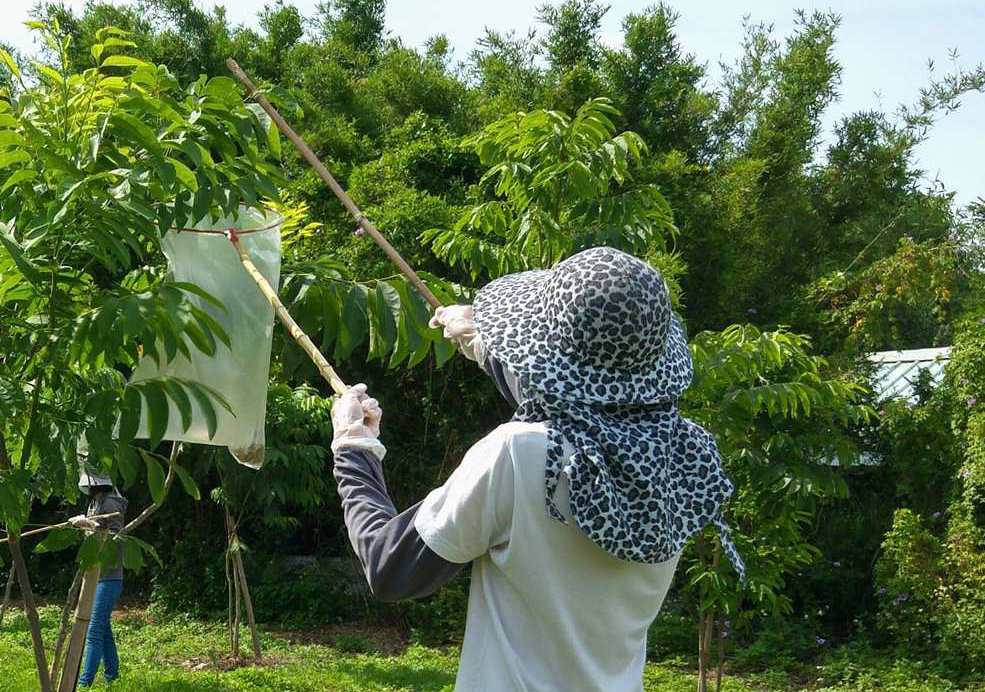
To this end, the Miaoli Agricultural Research and Extension Station proposed improvements to the traditional method. A research assistant surnamed Pan pointed out that farmers can use existing insect nets, replace the net bag with a plastic bag, and put mineral oil or acetic acid inside to achieve a magical effect. Its feature is that the liquid can restrict the lychee stink bug's struggling, and components such as acetic acid can stun the insect, reducing the possibility of the catcher being attacked. As long as farmers use it effectively, they can effectively control the lychee stink bug.


For inquiries, contact the Miaoli Station at (037) 991025 ext. 11, or for information on technology transfer manufacturers, email: [email protected]
For more professional agricultural technology information, please scan the QR code to follow WeChat: NongXunNET

Please indicate the source when reprinting.