Tainan, China Sees Record-Breaking Heavy Rain in 60 Years, Local Coarse Grains Face a Huge Test
After days of torrential rain in the south, accumulated rainfall in Tainan exceeded 500 mm in one week (9/1-9/7), breaking a 60-year record. This coincided with the coarse grain planting season; farmers had just finished sowing when everything was "soaked through."
Su Rongcan, a farmer growing coarse grains in Jiali, Tainan, said the sesame sown in August was "completely finished" after the heavy rain, and the newly sown soybeans and black beans were also mostly doomed, with losses of more than half.
Faced with the sudden turn in the weather, Su Rongcan said helplessly, "It's very strange how such heavy rain could fall at this time of year; it isn't even a typhoon, and it left us all stunned." It was not until yesterday (the 9th) that the rain eased slightly, and looking across the fields, "the bean fields had become paddy fields," while the sesame plants were crooked and in complete disarray. He predicted that sesame production in the Tainan area will drop sharply this year.
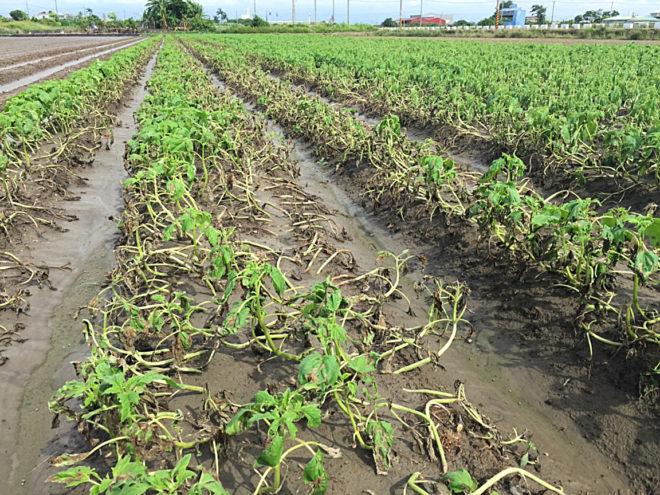


Reviving Local Coarse Grains: How to Face Extreme Weather
Frequent natural disasters pose a severe challenge to reviving local coarse grain cultivation. Farmers worry that the total area damaged by this flood may not exceed the threshold for disaster relief subsidies. Su Rongcan asked whether, since the government wants to support the revival of coarse grain cultivation, it could more carefully understand the problems farmers face. He also suggested that farmers intending to grow local coarse grains should not plant a single crop over a large area, but must grow multiple items to spread the risks brought by frequent extreme weather.
Yang Yaxun, section chief of the Crop Production Section of the Southern Branch of the Agriculture and Food Agency, also went to Xigang, Tainan, yesterday to inspect the damage to sesame, saying, "There is indeed damage, and it is not ideal." She said the Tainan City Government has formed an inspection team to survey the disaster site and will further assess whether to activate natural disaster subsidies.
(This article was funded by the Jianzhen Environmental Education Foundation for personnel expenses, but it does not interfere at all with news topic selection or interview writing, ensuring journalistic independence.)