Laundry detergent spot-check results long overdue, national standards unclear, Homemakers United Foundation sued
Starting late last year, reports emerged one after another that laundry detergents sold on the market, advertised as mite-proof and antibacterial, contained unidentified insecticides and miticides, yet the government's response was half a step behind. The Bureau of Standards, Metrology and Inspection (BSMI) under the Ministry of Economic Affairs had originally planned to revise the national standard for laundry detergent, and before the Lunar New Year it asked the Consumer Protection Committee to convene the Council of Agriculture, the Environmental Protection Administration and other agencies to discuss where responsibility lay, but there has still been no progress to date. Recently, Miao Kuan Chia filed a civil lawsuit with the Taipei District Court against the Homemakers United Foundation, demanding a front-page apology and clarification in the four major newspapers. The case has currently entered mediation proceedings.
In addition, the BSMI tested 43 laundry detergents in December, and more than 20 failed to meet labelling requirements, yet the results have long been withheld. Lai Hsiao-fen, secretary-general of the Homemakers United Foundation, believes the BSMI should release the test results as soon as possible, and at the very least add warnings to packaging so that the public can shop with peace of mind.
Regarding the government's snail's-pace response, and the fact that civic groups have exposed problems in the public interest only to face lawsuits from manufacturers, legislator Lin Shu-fen argued that setting national standards and clarifying which agency has jurisdiction do not conflict, noting that in the fake rice noodle incident the BSMI first set regulations and only then used them to demand that the Ministry of Health and Welfare take charge. "Now the government's gatekeeping has disappeared."
Control Yuan member Cheng Jen-hung, who cares about consumer safety, said that laundry detergent is just like the string of food safety incidents: the state has set no standards, and without regulations nothing can be required. He has begun gathering relevant materials and does not rule out launching an automatic investigation.
Three months of fallout, and laundry detergent still has no standard
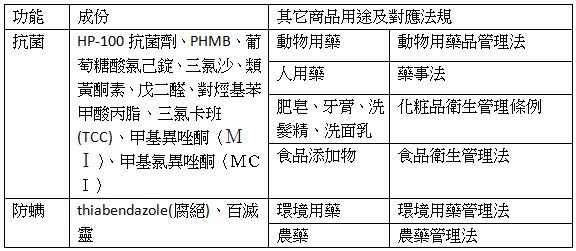
From December last year to January this year, Newsmarket, the Homemakers United Foundation and legislator Lin Shu-fen successively revealed that laundry detergents on the market advertised as antibacterial and mite-proof had actually been laced with the insecticide "permethrin", or with bactericides and disinfectants used in agriculture and medicine, such as "dazomet" and "glutaraldehyde", with ingredients of every conceivable kind, so that people hoping to fight mites and allergies might instead end up allergic to the chemicals.
But while the public was gripped by anxiety, the government's response was extremely slow. The Environmental Protection Administration, which oversees environmental agents, said at the very start of the incident that it only regulates environmental agents; if such substances are added to laundry detergent, the product becomes an ordinary commodity under the jurisdiction of the BSMI, yet the national standard for laundry detergent does not clearly define whether environmental agents and pesticides may be added.
To that end, the BSMI convened a technical committee twice, on December 6 and January 22, to study revising the national standard for laundry detergent; the resolution of the January 22 committee called on the Consumer Protection Committee of the Executive Yuan to convene the Ministry of Economic Affairs, the Council of Agriculture, the Environmental Protection Administration and other relevant authorities to negotiate whether to revise the national standard or return the matter to each ministry's own scope of management, but nearly a month after the meeting ended there has been neither sound nor sign.
The BSMI of the Ministry of Economic Affairs said it had already issued an official document to the Consumer Protection Committee and had not yet received any word. But Wu Cheng-hsueh, deputy director of the Consumer Protection Committee, said the BSMI only issued the document on February 21, staff did not receive it until February 26, and the day before yesterday a proposal was signed to hold a coordination meeting, but it still has to fit the schedules of various experts and scholars, so the meeting can be held two weeks from now at the earliest.
Because the government has still not set standards, all kinds of antibacterial and mite-proof laundry detergents can still be seen on the shelves, and the public can only talk past one another. Miao Kuan Chia, named by the Homemakers United Foundation as having added permethrin, recently filed a civil lawsuit with the Taipei District Court accusing the Homemakers United Foundation of damaging its business reputation, and demanding a front-page apology and clarification in the four major newspapers. The case has now entered mediation proceedings.
One month after test results came out, the BSMI still will not publish them
The BSMI tested 43 laundry detergents sold on the market as early as December, finished testing in February, and more than 20 failed to meet labelling requirements, yet it has still not published the results. Chang Wen-pin, head of the BSMI's Second Division, said the test results must be sent to the Department of Commerce of the Ministry of Economic Affairs for checking, and can only be released publicly after confirmation, but no reply has yet been received, so it is impossible to determine when they will be published.
In response, Lai Hsiao-fen, secretary-general of the Homemakers United Foundation, said: "Before setting standards, the BSMI should have acted but did not." She affirmed the BSMI's active handling of the matter afterwards, saying that clarifying where responsibility lies does take time, but there must be accompanying measures, at the very least publishing the test results and putting warnings on laundry detergent packaging, so that the public has a basis for choosing what to buy.