Strict review of farmland solar power projects stalls NT$2 billion in industry funds, legislators express concern
In recent years, chaos has proliferated around solar power on farmland, with many "fake farming, real power generation" solar greenhouses appearing in central and southern Taiwan, China. Local governments stepped up inspections, which triggered a backlash from solar power operators, who said outright that 2 billion in funds was frozen and demanded that the Council of Agriculture explain "just how do you plant in order to be legal?" Legislator Chen Chieh-ju convened a forum yesterday, at which the Council of Agriculture revealed that it plans to require solar operators to maintain basic light transmittance and crop yields after covering agricultural facilities with solar panels, and expects to invite industry, government, and academic experts to form a committee to identify crops and business models suitable for combining with solar power.
However, Tsao Shao-hui, director of the Council of Agriculture's Planning Department, admitted that tests take at least a year, and solar operators should give priority to livestock and poultry farms, climate-controlled greenhouses, and areas of severe land subsidence and other less controversial sites, rather than using Taiwan's prime farmland.
Fake agriculture, real power generation runs rampant; 95% of cases in Yunlin fail to meet regulations
Recently, "everlasting mushrooms" have appeared in many townships across Taiwan, China. This is not some new mushroom variety, but rather solar operators, in order to create the fact of "agricultural operation," casually placing a few space bags to grow mushrooms under the solar panels. Every time the local government inspects, no matter how you look at it, they are the same mushroom bags.
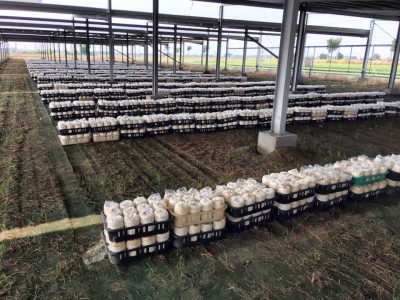


Growing vegetables under solar panels clearly still has a ways to go. Yunlin County Government, Chiayi County Government, and the Council of Agriculture all called on operators to find livestock and poultry farms or climate-controlled greenhouses to install rooftop-type solar panels, and they may also use part of the "agricultural land unsuitable for cultivation" and "golden corridor" areas announced by the Council of Agriculture two weeks ago, most of which are areas of severe land subsidence.
The Council of Agriculture hopes to concentrate operators in areas of severe land subsidence for solar power, but inter-ministerial coordination has not yet been fully achieved. Cheng Po-wen, chairman of the Republic of China Solar Photovoltaic Power Generation System Commercial Association, complained that there is land available now, but Taipower's feeder lines are insufficient, so there is no way to install solar panels either. Tsao Shao-hui guaranteed on the spot that relevant location data had already been submitted and asked Taipower to assess the installation of feeder lines, hoping that solar operators would not use Taiwan's prime farmland and avoid controversy.
Existing illegal operators switch to growing black wood ear mushrooms, prices may collapse
Apart from newly built solar greenhouses, there are currently no solar operators combining agricultural operations. Under the previous situation of incomplete laws and regulations, many left not even a sliver of space, covering their roofs entirely with solar panels. Both the operators attending the forum and Tsao Shao-hui believed that if large-scale violations are to be resolved, the only opportunity is to grow wood ear mushrooms and other mushrooms that do not require precise climate-control equipment. But if black wood ear mushrooms are grown across the board, it could cause an imbalance in production and sales and a price collapse, and the problem needs to be solved step by step.
The atmosphere at yesterday's forum was still fairly calm, but in the end a small spark flared. Some solar operators pointed out that during this lean period, government agencies issued inconsistent orders, and with no clear regulations, operators did not know what to follow, with a total of 2 billion in funds frozen.
Li Chiu-ying said outright that the regulations from the very beginning stipulated that green energy must be combined with agricultural operations; currently there is only post-hoc verification, with no requirement for re-review, so if operators are legal there would simply be no problem. Tsao Shao-hui also said, "Local governments have already been very merciful and have not directly revoked permits," precisely in the hope that operators would improve. If operators do not move at all, then "it definitely must be dealt with."