The Food and Agriculture Education Practice and Teaching Experience at Futsu Elementary School in Yamagata Prefecture, Japan
Futatsui Elementary School, reported several times by NHK Television
Last year, a series of elementary school lunch food poisoning incidents and cases of corruption in outsourced school lunch contracts occurred in Taiwan, China, and public concern about school lunches rose rapidly. I have been invited several times to share my observations on Japanese school lunches and dietary education at seminars. Japan was long regarded as a nation that places considerable importance on dietary health; however, under the influence of the modern food industry, unbalanced nutrition, irregular eating habits and endless food poisoning incidents are now taking a toll on the health of the Japanese people. Therefore, in order to improve the dietary lives of its citizens, to build their ability to choose food correctly, and to pass on the value of Japan's traditional food culture, the Japanese government passed the Basic Act on Shokuiku (Food and Nutrition Education) on June 17, 2005.
In 2006, experts and scholars were again convened to jointly formulate the Basic Plan for the Promotion of Shokuiku, which uses a community-building model, with cooperation among local areas, producers, government and academia, mobilizing the whole population to promote and take part in various shokuiku activities. In particular, for the future masters of the nation - children - a set of concrete school-based food and agriculture education practices was drawn up, including: 1. assisting schools at all levels in setting their shokuiku promotion guidelines; 2. training school nutrition teachers (Note 1); 3. establishing a shokuiku guidance system; 4. enhancing students' awareness of food through experiential activities such as school lunches, farm internships, food cooking and food waste recycling; 5. providing relevant counseling courses for students who are excessively thin or obese.
What is most worth emulating about Japan's school-based food and agriculture education is that it treats "dietary education and school lunches" as an inseparable whole, making everyday school eating part of school life education, and the key to this is the high degree of integration among locally sourced ingredients (Note 2), the school curriculum and school lunches. The "Standards for the Implementation of School Lunch Programs" issued by the Japanese Ministry of Education in 2009 specifically stipulate that school lunches should "actively incorporate local agricultural products or traditional local dishes, in order to cultivate in children a concern for their hometown and to pass on the local food culture (Note 3)," which shows how much importance Japan attaches to locally sourced ingredients.
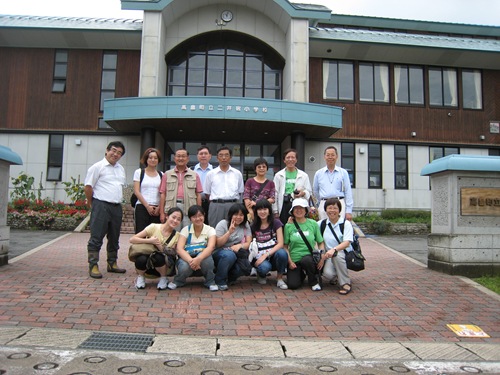
I have visited Takahata Town in Yamagata Prefecture many times, and in 2008 I led faculty and students from the Department of Agricultural Extension at National Taiwan University (now the Department of Bio-Industry Communication and Development) there to observe how its food and agriculture education is carried out; therefore, this article takes Futatsui Elementary School in Takahata Town as an example to explain how Japanese elementary schools put food and agriculture education into practice, as a reference for Taiwan, China as it considers school lunches and dietary education.
Yamagata Prefecture is located in the southwestern part of the Tohoku region of Japan, backed by mountains and facing the Sea of Japan, with forest covering 72% of the prefecture's total area; it is an important agricultural prefecture in Japan. In the 1970s, at the peak of Japan's Green Revolution, a group of local young people in Takahata Town, Yamagata Prefecture, spontaneously advocated an organic agriculture movement, and through continuous self-directed learning, the overall atmosphere of Takahata Town came to display a high degree of reflective spirit toward modern agriculture.
Nevertheless, Mr. Ryoji Izawa, principal of Futatsui Elementary School in Takahata Town, Yamagata Prefecture, found that although Yamagata Prefecture is a major agricultural prefecture, school teachers generally lacked practical experience in agriculture, so that the children's growth and learning were severely disconnected from the reality of local life. Therefore, as early as 2000, before the Basic Act on Shokuiku was enacted, Principal Izawa had already integrated food and agriculture education into teaching and promoted many pioneering practices, and for this he was interviewed and reported on by NHK Television several times.
(Parts of this article were previously published in Agricultural Extension Magazine, Vol. 29, No. 4, pp. 27-29.)
(Note 1) In Japanese: eiyo kyoyu. See http://www.mext.go.jp/a_menu/shotou/eiyou/04111101/003.htm.
(Note 2) In Japanese: jiba sanbutsu. Source same as above.
(Note 3) About the Enforcement of the Standards for the Implementation of School Lunch Programs, http://www.mext.go.jp/b_menu/hakusho/nc/1283812.htm.
(Note 4) Edited by Ryoji Izawa, Sachino Sato and the faculty and staff of Futatsui Elementary School. 2010. Cultivating Life and Tilling the Heart. Tokyo: Japan Home Lighting Association.
(Note 5) See http://yamagata-np.jp/feature/shoku_nou40/kj_2010053000457.php.
(The author is an assistant professor in the Department of Environmental and Cultural Resources at National Hsinchu University of Education)