Exchange of Experience on Integrated Rural Development in Germany (Third Session)
Two German experts came to Taiwan to share Germany's rural development experience. The first two reports focused respectively on "citizen participation" and "land policy." Weyarn mayor Michael Pelzer used the small town of Weyarn as an example to explain that citizen participation can enable sustainable rural development, while Holger Magel, a professor at the Technical University of Munich, stressed that only land policy led at the township level can stay close to the needs of local residents.
At the final discussion session yesterday (3/15), the two experts, before boarding their plane, offered "Integrated Rural Development" (IRD) as their parting words.
Weyarn mayor Pelzer explained that residents must be clearly informed of every rural development plan, large or small, and must take part directly in the decision-making process; they must never merely be told the outcome of a decision. Therefore, integration across fields and areas of expertise is very important.
Pelzer said that at the end of every visit to a place, Professor Magel offers a few points of feedback, and this time Professor Magel would present "Magel's three points" to further explain "Integrated Rural Development."
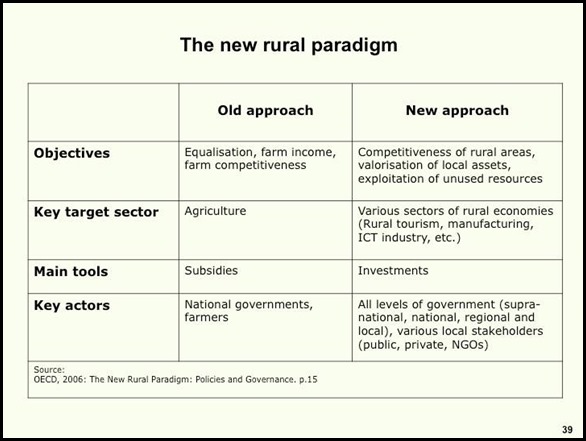
1. Unit: Rural > Agriculture
"To talk about rural areas while talking only about agriculture is a mistaken concept," Magel said. The Organisation for Economic Co-operation and Development (OECD), in its 2006 publication The New Rural Paradigm (http://ppt.cc/Gbbo), emphasized exactly this point. "This report amounts to giving the agriculture ministers of every country a big slap in the face."
Professor Magel believes that in Taiwan, too, he saw little research or policy on integrated rural development. He explained that rural areas are not only about agriculture, nor only about the land economy. "Rural development must take into account enabling agriculture to develop sustainably, creating local job opportunities, making young people willing to stay in their home villages, good transportation so residents can commute to the city for work, protecting nature, and many other aspects."
Magel gave an example: rural development requires reconciling various needs. Sometimes a piece of farmland is needed for public construction, and land swaps must be negotiated with farmers; when a rare bird lives on a certain wet meadow and the farmer's mowing affects the bird's habitat, at such a time you cannot simply curse the farmer as a "bastard" and tell him to get lost without giving him corresponding compensation.
The rural economy is not only agriculture; small and medium-sized enterprises willing to invest and set up operations in rural areas can also provide local job opportunities. However, Magel stressed, "this is not about buying land to build industry, but about finding agriculture-related industries, or industries suited to rural areas, such as handicrafts, tourism, and so on."

German Rural Development Experience Exchange (2): Land Policy Led by Townships
(This article is sponsored by the Jianzhen Environmental Education Foundation, which funds personnel costs for this project but does not interfere at all with news topic selection or interview writing, ensuring journalistic independence.)