Cover crops help with weed management and soil protection, breeding research urgently needs attention
In Taiwan, China, excessive fertilization and herbicide use in farming have long been issues that must be addressed to advance sustainable agriculture. This is especially true given the aging rural population and shortage of labor, compounded by farmers' deep-rooted belief that farmland should be "bare of even a blade of grass," which has made herbicide misuse increasingly serious. Kuo Hua-jen, a professor in the Department of Agronomy at National Taiwan University, believes that from the perspective of maintaining agricultural ecological sustainability and the agricultural economy, agricultural research and education institutions should actively launch breeding research on "cover crops" to find a win-win path.
Kuo Hua-jen said weeding is the biggest problem. Weed management must use multiple methods in parallel and cannot rely on a single method alone. Weeds reproduce by seed; the more weed seeds in the soil, the more serious the weeds become, so effectively reducing the weed seed bank in the land is key. Usually, cultivating the land 2-3 times is better. Second, planting cover crops or green manure, such as strongly creeping soybean, which can serve as green manure and also reduce grass growth, can replace the use of herbicides.
To promote sustainable agricultural management, avoid the massive production and invasion of weed seeds, reasonably use various control techniques, prevent contamination of weed seeds or vegetative propagules through crop seed sources, fertilizers, farm machinery and irrigation water, and suppress the growth of weeds already present on the field surface, the most important thing is to truly grasp the level of control and abandon the notion of "leaving not even a blade of grass" in order to implement the concept of sustainable management. Conducting research on and promoting "cover crops" from the perspective of weed management is one direction worth developing.
"Cover crops" are more effective than "green manure crops" at protecting soil



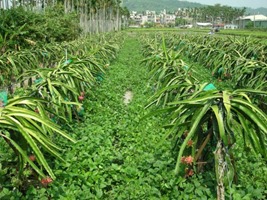
(Left) Bahia grass (Right) Green manure soybean also used as a cover crop (Provided by / Tainan District Agricultural Research and Extension Station)
Department of Agronomy Professor Kuo Hua-jen: To protect soil, cover crops should be vigorously developed
Because cover crops compete with main crops, farmland usually grows cover crops only during the fallow period, or plants them on field slopes, or grows them in separate zones from main crops on large farms. Growing cover crops simultaneously among main crops is seen only in fruit tree orchards, because fruit trees are taller, the spacing between trees is wider, and cover crops must be planted a certain distance beyond the radius of the tree trunks.
If the need for planting cover crops is weed management during the farmland fallow period, one may choose an annual dominant plant adapted to the local environment, such as an existing crop; and it must be noted that the crop will not leave harmful allelopathic substances for the following crop; the crop should preferably be seed-propagated and easy to harvest.
If cover crops are to be planted in orchards, attention must be paid to the size and height of the cover crops (they should not be too large), and perennial legumes may be chosen. In addition to increasing soil nitrogen content, compared with wind-pollinated grasses, flowering legumes with nectar glands can also attract insects and assist in pollination of fruit trees.
Although "cover crops" have many benefits, Kuo Hua-jen, a professor in the Department of Agronomy at National Taiwan University, pointed out that this field is relatively overlooked in our country's agricultural academia; in fact, this is precisely the research topic that the Council of Agriculture should prioritize most.
Huang Wen-da, an assistant professor in the Department of Agronomy at National Taiwan University, also believes that developing sustainable agriculture first requires attention to adopting effective arable soil management strategies, preventing soil erosion, maintaining soil fertility and crop productivity, and ensuring good soil structure.
He said that if "cover crops" are planted in fallow fields, during the fallow period they can achieve water retention and soil protection functions, and also have the effect of suppressing farmland weeds. Their residues can also be used to mulch the farmland topsoil; combined with conservation tillage such as no-till or low-till, extending the mulching function can prevent water and soil loss in subsequent farmland, maintain crop productivity, and is well worth vigorous promotion.