The Story of a Taoyuan Aerotropolis Family: My Father and His Field
Text / Xiao Hanqing
Editor's note: This is the story of a family in the Taoyuan Aerotropolis area. Mr. Lu's father took his own life by drinking pesticide because of the Aerotropolis development. Because Mr. Lu is a low-key person, we only write Mr. Lu and not his full name. The following is Mr. Lu's oral account, recorded and organized by the author.
──────────────────────────────────────────
A farmer's toil, Father's toil in supporting the family
When I was ten, they came to build Dayuan International Airport and expropriated a very large piece of our family's land.
When I was little, our family lived very hard. My grandfather's generation farmed, and my dad farmed too. When I was in elementary school I didn't understand much; when I heard they were going to build an airport, I didn't know what that was. Then one day the bulldozers came and flattened our fields. At the time, my young heart was actually excited, thinking that at last we wouldn't have to farm anymore, how great.
With that expropriation of such a large area, my father received a total of just over 60,000 in compensation. I remember Dad used that money to buy a Kawasaki motorcycle, bought with our family's fields. Dad always treasured that bike and rode it for over thirty years, until he had a stroke a few years ago and we wouldn't let him ride anymore. Back then, when they expropriated our fields, the government said it was for local prosperity; later it was discovered to be a scam, but he never said anything about it.
Dad was a very serious person, not good at expressing himself. His life was just farming, and my impression of him was of a very rustic person. He often blurted out a curse word in the middle of speaking. When I was little I didn't like that about him, and I once swore: "I will absolutely never curse."
Because farm life was too hard, after I finished school I went to work in a textile factory, and now I've started my own business and can finally support a family. Once my younger brother asked me very seriously: "Brother, how much can Dad actually make farming in a year?" So I did the math and told my brother: Dad could harvest 90 shi of rice per season, and the purchase price per shi was about 800 yuan. Over a year he might sell only a bit over 100,000, and that's without deducting costs. He didn't say anything special after hearing it, but none of us siblings chose to stay and farm when we grew up. Maybe the shadow of childhood poverty still lingers in our hearts.
Our family's ancestral home was originally an old three-sided courtyard. Relatives nearby all rebuilt theirs into townhouses. Ours was one of the very last not to be rebuilt. My mother couldn't stand it and felt the neighbors would look down on us. She kept arguing with Dad, saying if he didn't build a house she would divorce him. In the end Dad finally decided to build the home we have now, and found some people to help. From the formwork to the pouring of concrete, the family all pitched in, so every brick and tile of our house bears Dad's shadow.
To Father, selling the fields was unforgivable
After I started supporting the family, Dad also grew old. He actually no longer needed to farm to keep the household going, but he had no other interests. His only leisure hobby was farming. He grew many things: besides rice, there were watermelons, radishes, leaf mustard... Every month I regularly gave him money to buy what he grew. I said I would help him sell it, and he was delighted to hear it and farmed with great energy. The money I gave him, he regarded as "drawing a farming salary." Sometimes if I was a little late giving it, he would come over and ask me: "Where's this month's salary?" Actually, I was secretly giving all those crops away to others.
Later Dad had a stroke, and we often wouldn't let him go out, but he still wanted to. During the plum rain season, when it drizzled for several days in a row and he couldn't go out to farm, Dad's spirits would wither, and on closer look he seemed to age several years. When it finally cleared up, he would hurry out on his electric scooter to check on his fields, and he'd become full of energy again.
This year I got some seeds and planted sunflowers beside his field. When he passed by and found me scattering seeds, he stared so intently, his face full of doubt, that he actually fell into a ditch. We hurried to help him up, and regardless of his own fall, his first words were: "What are you planting there?" I told him: "Planting flowers." He was very angry to hear it and cursed again: "Planting that is no damn use!" I was caught between laughter and tears, and only then did I realize he couldn't accept using land to grow flowers. In his world there was no such ornamental use; what grew in a field was something real, to be eaten, to be sold for money to feed a family.
My grandfather had seven sons in all, and my father was the fourth. The old people of their generation could not bear to watch fields go to waste and grow weeds. My uncles are all in their seventies and every one of them is still farming. In their view, a person who sells the fields is a wastrel who has failed his ancestors. Once, when we were sweeping the graves, I saw several of the old men gathered together discussing which relative's child had sold land, and their words were full of disapproval.

When Uncle Lu was found, he was sitting on the small chair shown in the photo, belonging to Mr. Lu (red collar) (photo / Xiao Hanqing)
Come on, let me take you to see his field
And then, the media kept coming, and then there was that United Daily News thing... It was only yesterday, after the first-seven-day memorial rites were finished, that I could finally sleep for a few hours. Otherwise these past few days I couldn't sleep at all. I'm very sad inside, but also very confused, wondering why there were no signs beforehand. Then over these days relatives and friends kept coming to the mourning hall to pay respects, and after we exchanged information with everyone, we learned that the field next to our house, the one right next to the sunflowers and radishes, had just been sold, for over twenty million. Ever since the Aerotropolis, real estate agents have often lingered around our area. It seems that whenever they come across an old farmer on a field, the agents approach to chat, to talk about selling the land.
The neighbors said that after hearing that plot had been sold, over these past few days Dad would stare blankly in thought and stay silent. Actually, he was always a man of few words, so we didn't pay him any special attention.
Listening to these things from his life, I can't stop thinking, what did I do wrong? I must have done something wrong. Would he have been a little better if I had taken him to the protest that day? Was it that we always hid the Aerotropolis matters from him, but he knew anyway? These thoughts keep turning in my head,
As I was growing up, because of the hardships of starting a business, I became a very cautious person, drawing up Plan A and Plan B for everything. When the Aerotropolis came to take our land, although it was very sudden, over these past few months I had already drawn up various contingency plans. I'm very rational and didn't want to just sit and wait for death. But Dad's suicide still caught me off guard and disrupted my calm.
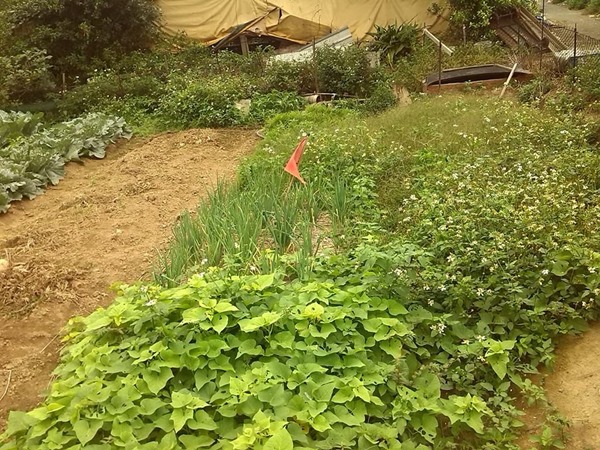
The radishes dried in the sun last week can be eaten today. Dad was still looking after his field, still going on about how I needed to turn the soil, still remembering his "mainlander girl" greens. How could this happen? Everyone comes to ask me, but who can I go ask? Come on, let me take you to see his field.