Five Years After Typhoon Morakot (1): Shanlin Daaai Agricultural Village, No Land Ownership, Residents Outflow, Residents: "Housed but Not Happily Employed"
Preface:
Five years have passed since Typhoon Morakot struck, and the "Special Act for Typhoon Morakot Post-Disaster Reconstruction," enacted alongside the push for post-disaster reconstruction, will come to an end on August 29. The Executive Yuan's Typhoon Morakot Post-Disaster Reconstruction Commission will also be dissolved, and all matters related to post-disaster reconstruction will return to the relevant ministries and government agencies at all levels to continue handling.
Compared with official agencies recounting past reconstruction achievements in the spirit of celebrating a happy occasion, Reconstruction Commission chief executive Chen Chen-chuan proudly declared that the Morakot post-disaster reconstruction model could be applied to the post-disaster recovery of the Kaohsiung gas explosion industrial safety incident. To the ears of residents of the permanent housing in the reconstruction areas, these words left a mixed and complicated feeling.
Five years have passed. The Morakot post-disaster reconstruction appears to have been successfully completed, and the memory of the disaster has gradually faded among ordinary people, but the new challenges in the lives of residents in the reconstruction areas have never paused. In order to understand the current situation of post-disaster reconstruction, NewsMarket specifically conducted follow-up reporting from the residents' perspective on Kaohsiung and Pingtung, the two areas hit hardest by the disaster. (To sponsor this special series reporting project, please visit the "weReport Investigative Reporting Public Commissioning Platform" to learn more.)
────────────────────────────────────


The government has long delayed handing over the promised farmland, which not only leaves those who wish to farm in a dilemma, but has also led some indigenous farmer friends to choose to return to the mountains to farm. Indigenous farmer friends returning to the mountains to farm are motivated not only because farming on the plains is difficult to make a living from, but also because they worry that once they accept the government's "house-for-house" condition and move their household registration into the permanent housing at Daai Community, they will not only be forced to give up the farmland they hold in the mountains, but will also lose their eligibility to join farmers' insurance and receive the old-age farmer allowance.
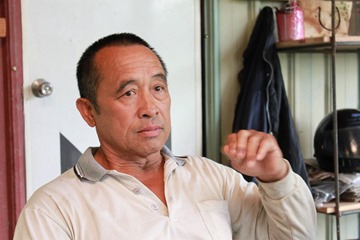
Dahu Palafi, a Bunun elder originally from Nansalu in Namaxia District, had his home destroyed by a mudslide during Typhoon Morakot, and the area where he lived was also judged by the Morakot Reconstruction Commission as a special zone requiring relocation; he was required to move into the permanent housing at the Shanlin Daai Community.
Although Dahu Palafi was allocated permanent housing, he still insisted on returning to live in the mountains, and he also opposed the Kaohsiung City Government's practice of requiring residents whose homes were classified as being in special zones or unsafe areas to move their household registration into the permanent housing at Daai Community. He said that almost all indigenous people in the mountains rely on farming for a living; moving to the plains would make it impossible to continue farming because there is no farmland, and once household registration is forced into the permanent housing at Daai Community, it also means the farmland in the mountains will be forced to be abandoned.
He said with concern that if indigenous farmers are forced to give up their farmland in the mountains and move to the Shanlin Daai Community only to face the predicament of having no farmland to cultivate, then in addition to being unable to make a living from farming, they would also be forced to interrupt their farmers' insurance eligibility, which they had held for many years. For older indigenous farmers, this would not only affect their eligibility to receive the NT$7,000 old-age farmer allowance each month, but the related social welfare protections originally relying on farmers' insurance would all be lost.
Dahu Palafi said that he had once asked officials of the Council of Agriculture about the problem of losing farmers' insurance. The officials explained to him for twenty or thirty minutes, but the key point was that if one wanted to join farmers' insurance, one must hold 1.5 fen of farmland under one's name. If there is no farmland, then because of farmers' insurance, the whole-household protections enjoyed, including the old-age farmer allowance, funeral subsidies, and farmers' children scholarships, would automatically disappear after three years.
He continued that although older indigenous farmers' income from agricultural products is unstable, the welfare network built on farmers' insurance and the old-age farmer allowance still allows older farmers to live a relatively stable life in the mountains. If, at the government's request, household registration is moved into the permanent housing at the Shanlin Daai Community, older farmers would face the sudden loss of agricultural economic income and the disappearance of social welfare protections, which is simply a double blow.
"On the plains, how could disaster victims have the financial ability to buy 1.5 fen of farmland to become a farmers' association member and join farmers' insurance? They cannot even manage to start farming," said Dahu Palafi.
Shanlin Daai Community resident Xu Qiu-xiang said that the fifth anniversary of post-disaster reconstruction is approaching. In the past, when residents of the reconstruction areas faced problems in life or employment and needed to report them to the authorities, they could at least turn to the Executive Yuan's Typhoon Morakot Post-Disaster Reconstruction Commission as the contact point. But as the Morakot Reconstruction Act enters history on August 29, the Morakot Reconstruction Commission will be dissolved, and the related business will return to local governments and competent ministries.
She said with concern that during the period when the Reconstruction Commission was operating, the life and employment problems faced by residents already could not be effectively solved. After the Reconstruction Commission is dissolved and its business returns to various government agencies, will the buck-passing and poor administrative efficiency that were previously criticized make unresolved problems even more serious, and make the difficulties faced by people in the reconstruction areas even worse?
After the "Special Act for Typhoon Morakot Post-Disaster Reconstruction" expires, the challenges facing residents of the Shanlin Daai Community may only be especially facing a new beginning.
(One of the "Five Years After Morakot" series reports, with Hou Yi-cheng, a third-year student in the Department of Radio, Television, and Film at Shih Hsin University, participating in interviews and compilation)