Is 10% rice content enough to label a product as rice noodles? Hsinchu City government proposes lowering the national standard
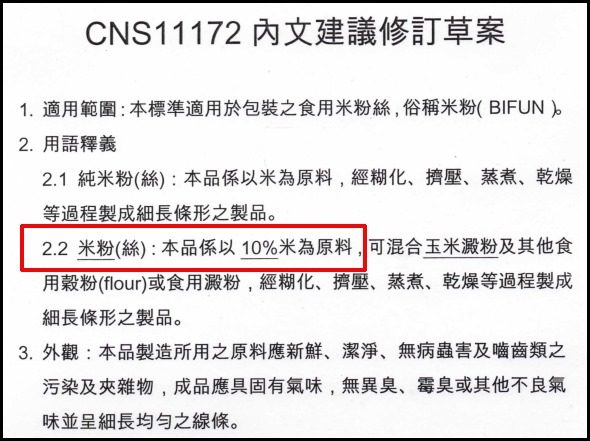
After Hsinchu City regional legislator Lu Hsueh-chang and Hsinchu City Mayor Hsu Ming-tsai, citing the argument that "ox-tongue crackers contain no ox tongue" and "Longjiaosan contains no dragon horn," protested the rule that "Hsinchu rice noodles must contain rice," the Hsinchu City Department of Economic Development today will invite relevant rice noodle manufacturers, civil groups and government agencies to a meeting, where it will propose that the rice-content requirement in national standard CNS11172 for rice noodles be lowered from the current 50% to 10%.
The whole matter began when the "Packaged Rice Noodle Product Labeling Regulations" issued by the Food and Drug Administration of the Ministry of Health and Welfare took effect on July 1. Originally, products labeled "pure rice noodles" or "rice noodles" had to be made 100% from rice; those with a rice content of 50% or more were to be called "blended rice noodles." As for those with a rice content below 50%, the product name could not be called rice noodles.
However, just as this policy was about to be implemented, it was overturned under pressure from manufacturers and legislators, leading the FDA to stipulate that vermicelli-type products with a rice content below 50% could also, on grounds of local origin culture, be named "Hsinchu rice noodles" or "Puli rice noodles," with no mandatory requirement to label rice content.
Subsequently, at an internal FDA meeting, the Hsinchu City Department of Economic Development again proposed the idea of designing a "Hsinchu Rice Noodle Origin Label", and claimed that "Hsinchu rice noodles" with a rice content of 25% were the golden ratio, considering using this in the future as the basis for issuing the origin label.
Now, the Hsinchu City Department of Economic Development has once again called for lowering the rice-content requirement in the national standard CNS11172 for rice vermicelli, which civil groups concerned about food safety cannot agree with, demanding that the Hsinchu City Government not abandon its gatekeeping role over rice noodle quality.
Hsu Hui-yu, director of the Food and Nutrition Division of the John Tung Foundation, exclaimed: "A rice content of 10% is almost no rice at all!" She questioned whether, if the Hsinchu City Government agreed that rice noodles contain no rice, this could still be called a dietary "culture."
She stressed that from a health perspective, if "rice noodles" are not made from rice, the contents should be clearly labeled so that people know what they are eating and what effects these ingredients have on health.


Homemakers United Foundation: Manufacturers' interests should not override consumers' rights
Lai Hsiao-fen, secretary-general of the Homemakers United Foundation, believes that when the truth about the ingredients of fake rice noodles was first exposed, it in fact created a very good opportunity for policy reflection and for educating the public about the importance of food safety. "But now the Hsinchu City Government and the Hsinchu City Rice Noodle Business Association have not only failed to reflect, but have even gone so far as to demand that the rice content of rice noodles be lowered to 10%. I find this absurd," Lai Hsiao-fen said.
Lai Hsiao-fen believes that since the FDA announced the "Packaged Rice Noodle Product Labeling Regulations" in accordance with the spirit of the Act Governing Food Safety and Sanitation and the procedures of the Administrative Procedure Act, it should enforce them strictly.
"If manufacturers' interests are allowed to override consumers' rights, and consumers who pay money for goods still have to submit to problematic food safety quality, that is extremely wrong," Lai Hsiao-fen believes. The FDA of the Ministry of Health and Welfare and the Bureau of Standards, Metrology and Inspection of the Ministry of Economic Affairs, as the competent authorities for rice noodle product quality requirements and food safety, should examine with a stern attitude the Hsinchu City Government's move to lower the rice content of rice noodles.
Lai Hsiao-fen pointed out that the Changhua County Health Bureau's attitude toward the rice noodle labeling regulations was much more positive. If the Hsinchu City Government really wants to protect the local brand of Hsinchu rice noodles, it can deepen its historical significance and hold promotional activities, working to enrich the cultural value of the product, rather than going off to demand that a nationwide food safety standard be lowered.