Government regulations are full of loopholes, making it hard to tell whether spices are natural or not.
The "Fatty Bakery" bread that bills itself as natural uses artificial flavoring (essence), and the operator argued that it "did not add any industrial artificial flavoring," then later claimed that it "mistakenly believed what the upstream manufacturer provided was natural flavoring." The government stipulates that compound food additives do not require inspection and registration, flavoring companies add coloring agents and sell the products, and the law does not mandate that operators label whether what is added is natural or artificial flavoring; all of these are the main reasons that lead businesses to play word games and deceive consumers.
A reporter from NewsMarket interviewed Cheng Ming-fan, a flavoring import-export operator who once testified in the plasticizer incident, to take a look at flavorings. He explained that the component substances of natural flavorings exist in nature; artificial flavorings are chemically synthesized substances that do not exist in nature; even for natural flavorings, most operators in Taiwan, China still add artificial coloring agents, so they are long since no longer "natural." In 2000, the government allowed food flavorings and compound food additives to be exempt from inspection and registration, and after that, incidents of mixed-use flavorings and industrial additives emerged one after another.
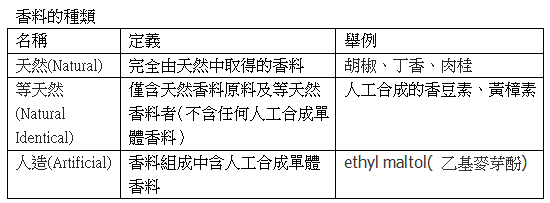
Flavorings can be divided into natural, natural-identical, and artificial
Flavorings have a long history in human civilization, including pepper and cinnamon from early nature, the vanilla extract and fruit flavorings common in the baking industry, and even the air fresheners and perfumes in the home. People's lives are inseparable from flavorings.
Cheng Ming-fan said that there are tens of thousands of kinds of flavorings, widely used in food, perfume, and daily necessities, and their names do not come from the extract, but rather from "what the manufactured scent smells like," for example: coffee flavoring merely smells like coffee, and is not necessarily extracted from coffee beans.
Flavorings can be divided into three types: natural, natural-identical, and artificial. The substances of natural flavorings are products that nature itself already has, such as pepper and clove; natural-identical flavorings are artificially made to imitate substances in nature, and can also be labeled as natural flavorings; artificial flavorings are chemically synthesized substances that do not exist in nature at all.
 Lemon flavoring comes from natural extraction or chemical synthesis, and this should be clearly explained (Image: Fatty Bakery used flavoring essence; source: Taipei City Health Department)
Handbook published by the Flavor and Extract Manufacturers Association of the United States (FEMA)