What exactly is Hongwen's naturalism?
In early March 2013, I went to Taitung to find Hongwen. This was my second time meeting Hongwen; a full year and three months had passed since I first saw him in Taipei in November 2011. This time I made a special trip to Taitung to visit him, wanting to ask him why he worked so hard running a blog and a fan page, continuously keeping field journals, hoping to replace certification with trust-based purchasing. But in the end, did he surrender to the consumer market and step into the rules of the organic certification game?!
Hmm, okay~ lacy roselle + the dark, wiry Puyuma, such a mismatch!
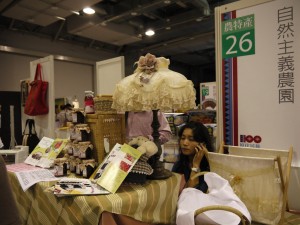
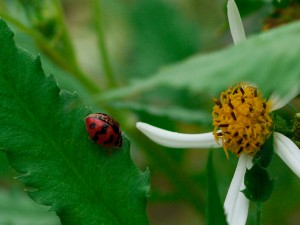
Where should produce grown with environmentally friendly farming be placed in the market? On the produce shelves there seem to be only two categories: conventional or organic! As soon as consumers see that a product does not carry an organic label, they directly classify it as conventional produce, and they cannot accept pesticide-free produce that is grown with environmentally friendly farming, has higher labor costs, and therefore sells at a higher price.
Every time Hongwen harvests, he first sends the produce for pesticide-free testing, because the neighboring fields use conventional farming methods. Although he has adopted many protective measures, he still fears that something might slip through the cracks. As long as testing shows even a trace of pesticide residue in the chrysanthemums or roselle, even if it is within the permitted safety range, Hongwen still destroys the entire batch and insists on zero detection before shipping. That really is a Puyuma-style character!
I thought to myself, Hongwen sends produce for pesticide-free testing in order to safeguard consumers' food safety. If the land around Hongwen's farm were a natural environment with no conventional farmland, would he still need to do pesticide-free testing?
Without organic certification and without pesticide-free verification, in this era that recognizes only symbols and labels, produce that has not been certified, even if it is produced with environmentally friendly farming methods, is still a pitiful creature in the market that nobody loves. So, in order to get chrysanthemums and roselle into the organic market and onto shelves, Hongwen applied for organic certification. He is currently in the first year of the transition period, and because he obtained organic transition-period verification, he was able to set up a stall at the National Taitung University organic farming market.
Consumers do not spend extra time learning the story behind agricultural products, so when they buy, they recognize only the label. This consumption pattern and market mechanism force farmers to obtain verification before they can sell, which raises production and marketing costs and, relatively speaking, also raises sale prices. In practice, this is very unfavorable to both farmers and consumers. Educating consumers about proper purchasing behavior seems as if it should also be listed as one of a farmer's jobs. These days, being a farmer is very busy, and not simple at all!
Naturalism Farm Facebook fan page https://www.facebook.com/maturalism
Naturalism Farm blog http://tw.myblog.yahoo.com/naturalism-plantation/
For more professional agricultural technology information, please scan the QR code to follow WeChat: NongXunNET
Please indicate the source when reprinting.