Vietnam's Dai Hanh Phuc feed oil is recycled oil; pigs cannot eat it, yet it is exported to Taiwan for people to eat
In the case where Ting Hsin Oil was found by the Food and Drug Administration to have imported feed oil from Vietnam's Dai Hanh Phuc company while declaring it as food at customs, the matter continues to escalate. Legislator Chen Chi-mai, during questioning at the Legislative Yuan this morning, pointed out that Vietnam's Dai Hanh Phuc feed oil exports to Taiwan averaged as many as 300 containers per month, with at least 72,000 metric tons flowing into Taiwan each year, yet the Food and Drug Administration has so far only traced 2,345 metric tons imported by Ting Hsin. Where did the rest of the feed oil go? The authorities do not have a clear grasp of this, which is worrying.
While the Health and Environment Committee was reviewing amendments to the Act Governing Food Safety and Sanitation, Chen Chi-mai also revealed photographs taken of the oil-production environment at Vietnam's Dai Hanh Phuc company. According to the photos taken by a Taiwanese businessman in Vietnam whom he commissioned to visit the Dai Hanh Phuc factory, the working environment was pitch-black, dirty and chaotic, like an illegal underground factory; by Taiwan's regulatory standards, it would be completely failing.
He further revealed that the source of Vietnam Dai Hanh Phuc's oil was fundamentally local recycled oil, not lard.
Chen Chi-mai also asked officials from the Ministry of Health and Welfare's Food and Drug Administration, the Council of Agriculture's Department of Animal Industry, the Ministry of Economic Affairs' Industrial Development Bureau and the Environmental Protection Administration for their views on the oil-production environment at the photographed Vietnam Dai Hanh Phuc factory. Each official, according to their respective areas of responsibility, replied respectively that it did not meet Taiwan's environmental operating standards for food factories, feed factories or waste recycling plants. Chen Chi-mai attacked the fact that this feed oil, which even pigs cannot eat, was exported to Taiwan for people to eat, and yet no one among Taiwan's officials or manufacturers had ever inspected the factory.
Acting Director-General of the Food and Drug Administration Chiang Yu-mei replied that when manufacturers purchase foreign food ingredients, they must confirm that the foreign supplier or manufacturer is legal, and that the products supplied must also meet Taiwan's standards before they can be imported. Feng Jun-lan, director of the Food and Drug Administration's Northern Management Center, said that from 2012 to the present, Dai Hanh Phuc had exported a total of 2,345 metric tons to Ting Hsin, of which only 223 metric tons were in 2012 alone.
"How is it that only Ting Hsin was caught, and no one caught the Dai Hanh Phuc feed oil going into those factories," Chen Chi-mai questioned. Vietnam's Dai Hanh Phuc company exported to Taiwan an average of as many as 300 containers, 6,000 metric tons, of feed oil per month, at least 72,000 metric tons a year, yet the Food and Drug Administration only has a grasp of the more than two thousand metric tons imported by Ting Hsin. Chen Chi-mai attacked the fact that since the inferior lard incident broke out, customs still cannot even grasp the flow.
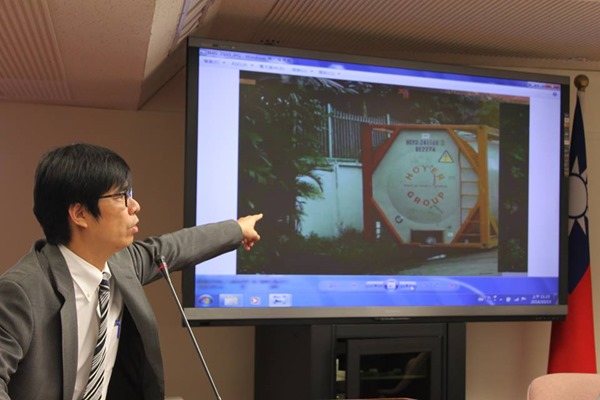


In addition to questioning that the Food and Drug Administration still has not grasped the import flow of Vietnam Dai Hanh Phuc feed oil, Chen Chi-mai also attacked the fact that the Food and Drug Administration has still been unable to grasp the inbound and outbound shipment quantities of Yongcheng Materials' oil products, which supplied feed oil to Cheng I company. He said Yongcheng Materials is Taiwan's largest waste cooking oil recycling company, and less than 10% of Taiwan's annual waste cooking oil recycling goes to making biodiesel. Where does Yongcheng Materials' waste cooking oil go? Of course it is mixed into cooking oil and feed oil.
Chen Chi-mai attacked the fact that when he questioned on September 23, he already pointed out that Yongcheng was an atomic-bomb-level unexploded ordnance and asked the Food and Drug Administration to investigate, but to this day it still has not clearly grasped Yongcheng's annual shipment volume, recycled oil intake volume, and feed oil inbound and outbound shipment volume.
He revealed that Yongcheng Materials was not only tainted with slop, but also tainted with black; its oil tanks were not only located in Chiayi, and he pointedly told Chiang Yu-mei: "Go to Beigang and ask who Tsai Chen-chou is (the person in charge of Yongcheng Materials, taken into custody by the Chiayi District Court yesterday), and everyone will tell you," demanding that the Food and Drug Administration strengthen its tracing of Yongcheng's oil product flow.
Facing Chen Chi-mai's questioning, Acting Director-General of the Food and Drug Administration Chiang Yu-mei and Northern Management Center Director Feng Jun-lan said that because Yongcheng Materials is a feed factory, the Food and Drug Administration has no information on it, and that this involves the business of the Council of Agriculture, the Environmental Protection Administration and the Ministry of Economic Affairs' Industrial Development Bureau; they promised to provide the relevant information on Yongcheng within one week.
For more professional agricultural science and technology information, please scan the QR code to follow WeChat: NongXunNET

Please indicate the source when reprinting.