After a typhoon, fruit trees are forced to live off their reserves. Why do the fruits fail to grow, or grow puffy and hollow?
Text by Lin Hung-jen (NTU Agricultural Development Center)
The growth of a fruit tree is divided into two major cycles: "vegetative growth" (which includes leafing out, shoot growth, increasing trunk diameter, repairing damage and so on) and "reproductive growth" (in simple terms, the whole sequence of flowering and fruiting). The two cycles are antagonistic toward each other (competing with and resisting each other) but also interdependent, because the overall vigor of a fruit tree is fixed. When the two cycles divide up the same energy source, if the total energy can feed both cycles, a balance can be achieved. Fruit tree science can be summed up in one sentence: it is the study of the relationship between these two kinds of growth.
There are many reasons why vegetative growth and reproductive growth compete and become antagonistic, including the composition of soil fertility, the tree's nutritional status, and whether it is under stress. To put it simply, "tree vigor" can be described as a fruit tree's capacity for "metabolism" and "photosynthesis" the more carbohydrates it can produce, the stronger its vigor.
There is a famous case in fruit tree science - "June drop." A major cause is a failure to adjust the balance between vegetative growth and reproductive growth: the tree's vegetative growth is too vigorous and suppresses reproductive growth, causing the fruit to drop as the tree discards it.
What impact does typhoon stress cause?
Typhoons mainly bring two important kinds of damage to fruit trees: first, physical damage such as branches broken by strong winds, leaves stripped off, and bark rubbed raw by tissues scraping together. Second, flooding from torrential rain, which damages the roots by suffocating them. In the Taitung area, a third kind of damage may occur: high-temperature damage caused by the foehn wind. So what impact does typhoon stress cause?
(1) Wind damages branches, causing much physical injury
At this point, the tree must give priority to allocating energy for repairs. If the tree itself has stored relatively few carbohydrates, and the typhoon has blown off many leaves, the tree must live off its reserves and grow the leaves back. Naturally its vigor declines, and with no surplus energy to feed the fruit, the fruit stops developing.
The fruit development stages differ for each kind of fruit tree, but most follow one principle: there is an "enlargement stage" and a "filling stage."
Enlargement stage: after the cells inside the fruit have finished dividing, they elongate massively.
Filling stage: the tree works hard to fill in the fruit's components, such as sugars, oils, starch, protein and so on.
Conversely, if a fruit tree recovers its vigor quickly after typhoon damage, it can continue supplying energy to the fruit. If even the reserves stored in the trunk are insufficient, the tree may resort to a last measure: breaking down the tissues originally inside the fruit back into carbohydrates and taking them back to restore vegetative growth (this is what people commonly call "drawing back"), which may then cause "puffiness" - the fruit grows larger on the outside but is not filled in on the inside.
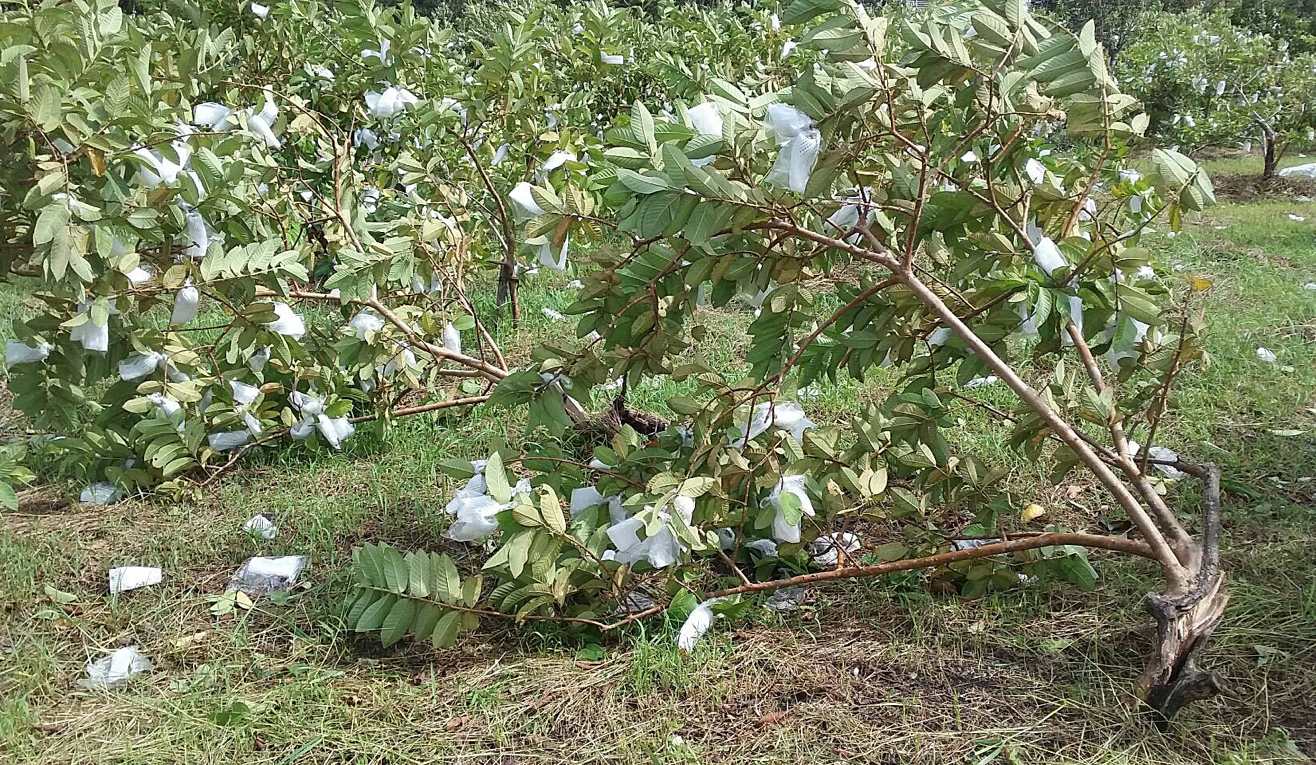


The fruit tree's way of "self-preservation"
After a typhoon, the tree will give priority to repairing damage, because if it does not repair it, pests and diseases can easily invade the wounds and cause even greater damage; at the same time, only by restoring vegetative growth can it continue to accumulate energy.
Fruit trees are a perennial agricultural crop, so nutritional management from one year to the next is closely linked. A typhoon is a multi-faceted stress injury, so the damage it causes is also considerable. To reduce the losses brought by typhoons, advance windbreak preparation, securing the tree's large branches, post-disaster nutritional supplementation (what is generally called "topdressing"), and clearing the orchard to avoid outbreaks of pests and diseases are all tasks that must be carried out.
Even if the damage is so great that this year's fruit harvest is reduced, the tree's vigor must still be restored after the disaster. If this kind of work to nurture the roots and strengthen the foundation is not done well, it may seriously affect the harvest of the next season or even the season after that.
Kaohsiung District Agricultural Research and Extension Station / How to save fruit trees soaked in water after a typhoon? Prune and clear the orchard first; heavy fertilization is not advisable
Hualien District Agricultural Research and Extension Station / Recommended principles for post-disaster rehabilitation
Postscript: There is relatively little research on typhoon damage, especially for tropical fruit trees
Leafing through many books on fruit trees or plant physiology, they discuss a great deal about physiological stress, but very few specifically discuss damage caused by typhoons. The authors of these textbooks cannot be blamed for this, because among fruit-growing regions around the world, apart from Florida, which is often hit by hurricanes, most other places have favorable weather, and the research conducted there mostly focuses on stress from drought, floods, pests and diseases caused by large-scale climate. The place that truly has a large fruit tree industry, is hit by typhoons, and also has many researchers is probably the first island chain of the eastern Pacific.
Japan, moreover, pays more attention to temperate fruit trees, and almost no one has delved deeply into research on tropical fruit trees. For example, Oita Prefecture in Kyushu, Japan, which is often hit by typhoons, has ample instructional web pages telling farmers how to carry out prevention and recovery work before and after wind disasters.
For more professional agricultural science and technology information, please scan the QR code to follow WeChat: NongXunNET

Please indicate the source when reposting.