FDA announces hygiene standards for edible lard; acid value requirements lag far behind China and Japan
Last year, Taiwan was rocked by a scandal in which feed oil was mixed into lard. As early as February 16, the Food and Drug Administration (FDA) had announced a draft of the "Sanitation Standard for Edible Lard," revising the acid value and source requirements for lard. It was originally scheduled to take effect in mid-April, but was repeatedly postponed and only formally announced last Thursday. Moreover, the acid value for "refined lard" was set at 1.3 (mg KOH/g fat), which is even looser than the 1 set under the national standard by the Bureau of Standards, Metrology and Inspection under the Ministry of Economic Affairs, and far behind Japan and China. Industry players questioned that the FDA's standard was as good as having no standard at all: "The government keeps talking about food safety. Why can other countries set stricter standards, while Taiwan can only set 1.3?"
Japan's acid value is 0.2, China's is 0.3, yet Taiwan only follows the loose United Nations standard
Last year, "Justice" and "Ting Hsin" were found to have long used feed oil to adulterate edible lard. When the FDA tested the acid values of these companies' lard, it cited the Ministry of Economic Affairs' CNS national standard as the basis for judgment. Only then did outsiders discover that the FDA's regulations only looked at aflatoxins, heavy metals and other items in lard, and had never set an acid value for lard, while the CNS national standard was merely "voluntary compliance." In other words, Taiwan had previously never had mandatory regulations governing lard acid value.
The higher the acid value, the worse the oil. When oil is repeatedly used or becomes rancid, the triglycerides in it hydrolyze into free fatty acids and glycerol. Free fatty acids easily cause the oil to oxidize and form free radicals, which is unfavorable for oil storage and human health. Acid value refers to the milligrams of potassium hydroxide (KOH) needed to neutralize the free fatty acids in 1 gram of oil. Therefore, the lower the value, the fewer the free fatty acids and the better the oil quality. The Ministry of Health and Welfare stipulates that frying oil must be replaced once its acid value exceeds 2.
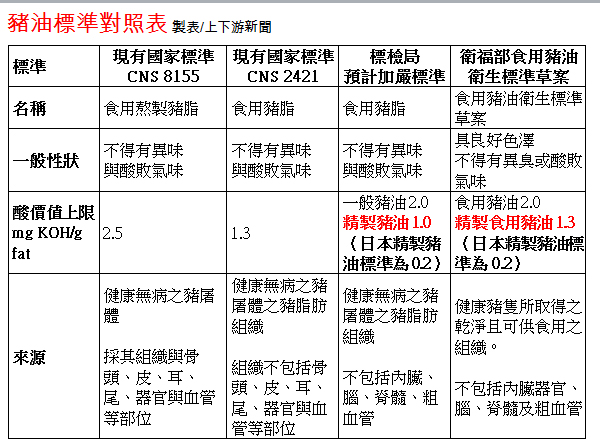

The Bureau of Standards, Metrology and Inspection initially stipulated that the acid value of "edible lard" must be below 2, while lard that had undergone refining processes such as degumming, deodorization and decolorization had an acid value of 1.3. At the end of March this year, the bureau further revised and tightened the rules, specifying that the source of lard must be fresh, clean fatty tissue from healthy, disease-free pig carcasses that had passed slaughter hygiene inspection, excluding parts such as the brain, spinal cord, internal organs and large blood vessels. It also tightened the acid value for "refined lard" to 1, while unrefined lard remained at 2.
To patch the loophole, the FDA also announced on February 16 this year a draft of the "Sanitation Standard for Edible Lard," likewise specifying that the source of edible lard should be "clean and edible tissue obtained from healthy pigs, but excluding internal organs, brain, spinal cord and large blood vessels." However, the acid value for refined lard was only 1.3. Chen Chun-cheng, an adjunct lecturer at the School of Continuing Education of Chinese Culture University, said this standard lags far behind Japan's 0.2 and China's 0.3.
FDA: Acid value is only a sanitation regulation and has nothing to do with safety
Pan Chih-kuan, director of the FDA's Food Division, explained that Taiwan mainly refers to the United Nations, and the UN CODEX standard for edible lard is 1.3. No objections were received during the draft announcement period. "The bureau's standard is voluntary compliance and can be stricter. We are the competent authority and must take the situation of ordinary businesses into account. We cannot set it too strict, otherwise many businesses would be unable to comply."
He stressed that acid value relates to "quality" and has nothing to do with "safety." As long as the raw materials come from safe sources, there is no safety concern. But if the raw material is feed, then even an acid value of 1 would be non-compliant. Moreover, businesses themselves will pay attention to quality and keep the acid value in check; at 1.3, it will not taste rancid, so setting it at 1.3 is enough to meet the quality needs of the general public.
Industry: Quality of course has to do with safety
Regarding the FDA's explanation, Chen Chun-cheng questioned: "(If stricter standards were set) it's not as if Taiwan's industry can't do it." The United Nations standard is looser because many member states are not in the habit of eating lard. Taiwan eats so much lard that it should naturally be stricter. Japan, China and Taiwan have similar living habits, so why can others set stricter standards while we cannot?
Another industry player pointed out that when CODEX sets standards, it needs to take less developed countries into account, so it can only set the most basic standard, and other countries then use it as a reference to set stricter standards. "The government says it values food safety, yet it sets a standard like this," he said bluntly. This involves the government's mindset, and whether it wants to give citizens stricter, or lower-grade and outdated, oil.
In addition, in response to the FDA's reply that acid value is only a quality standard and has nothing to do with safety, Chen Chun-cheng retorted: "By that logic, then why should the FDA set an acid value standard at all?" Industry players also criticized: how could quality have nothing to do with safety? Oil deterioration is a series of chain reactions. As free fatty acids rise, the oil gradually oxidizes and becomes rancid, harming human health. Acid value is the most basic judgment standard, and testing is relatively convenient. If acid value is not used to judge whether something is safe, the FDA should list scientific evidence and propose a better basis for judgment.
With just 50 percent content, it can be labeled lard
Beyond the acid value regulation, this industry player further pointed out that the current "Regulations Governing the Labeling of Product Names on the Outer Packaging of Retail Packaged Blended Oils" also has major problems. The regulations stipulate that for retail packaged blended oils whose outer packaging product name claims only one type of oil or fat, that oil or fat must account for more than 50 percent of the product's content. In other words, as long as lard makes up 51%, the outer packaging can claim it is lard.
He revealed that pure lard solidifies at room temperature, and many major manufacturers on the market do not use pure lard. Even if an acid value standard is set, businesses can simply blend in salad oil to lower it. For example, the lard a business imports may have an acid value of 2, imported under the name of edible lard, but after blending in salad oil with a lower acid value, the acid value drops to 1, and without the time and expense of degumming and deodorization, it can directly be claimed as refined lard.
"A standard like this is as good as having no standard at all. In the end, people may still end up eating lard imported from Vietnam. The government should set stricter standards so that businesses will improve; and only by raising the cost of illegal manufacturing for businesses can food safety problems be prevented."