An Analysis of Taiwan, China's Water Resource Situation: How to Retain Rainwater
Text / Yu Guoxing (PhD in Civil Engineering (Hydraulic Engineering Group) from Purdue University in the United States, currently Director of the Water Resources Management and Policy Research Center at Tamkang University)
Has Taiwan, China mistakenly used groundwater as a reservoir?
To solve the water problems of Taiwan, China, we cannot respond by pumping yet more groundwater that has long been over-extracted, or by repeatedly permanently transferring agricultural water.
With sufficient water resources in hand, we should act more actively.
Taiwan, China is facing its most severe drought in 68 years. This year, 5 irrigation association irrigation districts have already implemented fallow land with suspension of irrigation, covering an area of up to 44,000 hectares, and from the 91st year of the Republic of China (2002) to the present, 7 of the past 14 years have seen fallow land with suspension of irrigation.
Why is it that whenever there is a drought, most responses involve fallow land with suspension of irrigation? Especially as extreme climate will become the norm in the future, we should squarely face its hidden causes and seek fundamental solutions.
At present, Taiwan, China has a total of 96 large and small reservoirs, with an effective storage capacity of 1.9 billion tons, but the vast majority were built before the 82nd year of the Republic of China (1993), and the reservoirs built even earlier, before the 61st year of the Republic of China (1972), were mainly used for irrigation, such as the Shimen and Zengwen Reservoirs, while the reservoirs built between the 62nd and 82nd years of the Republic of China (1973-1993) mainly supplied domestic and industrial use, such as the Feicui and Nanhua Reservoirs. However, after the 82nd year of the Republic of China (1993), environmental awareness gradually gained attention, water source development plans faced resistance and were difficult to advance, and water resource supply shifted to management and allocation as the priority policy, with little further development of water resources. From the 82nd year of the Republic of China (1993) to the present, only the Baoshan Second Reservoir, the Hushan Reservoir, and a few check dams have been built, increasing storage capacity by only about 90 million tons.
Seeking the truth! Breaking the myths in current water resources work
In other words, the water resources Taiwan, China has in hand today rely on reservoir storage from projects completed at least more than 20 years ago, as well as water taken from rivers and pumped groundwater, and it is believed that this is enough to meet water demand. The main thinking is that as long as permanent transfer of agricultural water is adopted and other management measures such as water conservation, wastewater recycling and reuse, and seawater desalination are used, the water needs of all sectors can be met. This thinking exists because we harbor the following two major myths:
1. Myth one: Agricultural output value is low and agricultural water use is enormous, so as long as 5-10% of water can be saved, development of at least 600-1,200 million tons or more of water resources can be reduced, and it can be permanently transferred to domestic and industrial use.
This understanding is indeed open to question, because after agricultural water use in the Taiwan, China area peaked at 16.4 billion tons in the 71st year of the Republic of China (1982), it declined year by year to 12.5 billion tons in the 101st year of the Republic of China (2012). Comparing the average of the most recent 3 years with the average from the 74th to 76th years of the Republic of China (1985-1987), existing agricultural water use has already decreased by about 2.5 billion tons compared with 30 years ago, while during these 30 years, domestic and industrial use increased by 1.6 billion and 100 million tons respectively. Therefore, even if there is still some water in agricultural use that could be supplied to other uses, it is not much, and moreover such a tiny amount of water is by no means what stable domestic and industrial water use should rely on.
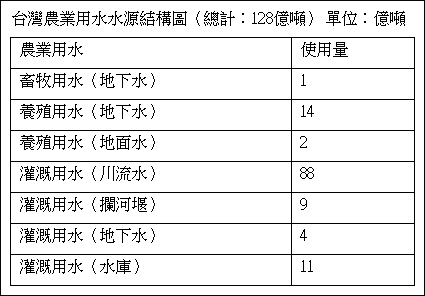
Here, let us analyze the water source structure of livestock, aquaculture, and irrigation water within the average agricultural water use from the 92nd to 101st years of the Republic of China (2003-2012):
1. Livestock water use is about 100 million tons, almost entirely from groundwater, and cannot be transferred.
2. Aquaculture water use is about 1.4 billion tons, mostly from groundwater, and cannot be transferred; a small part, about 200 million tons, comes from surface water, and because of the lack of a water conveyance system, it also cannot be transferred.
3. Irrigation water use of about 8.8 billion tons comes from streamflow and 900 million tons comes from check dams. It is extremely unstable because of the influence of wet and dry seasons, and water quality in some areas is poor, so apart from agricultural irrigation use, it is truly not easy to use for domestic and industrial purposes. In addition, about 400 million tons comes from groundwater and cannot be transferred.
4. About 1.1 billion tons of irrigation water comes from reservoirs, which bear the heavy responsibility of irrigating Taiwan, China's granary regions and must be maintained.
Under such circumstances, if agricultural water is still repeatedly permanently transferred, it will deal a severe blow to rural Taiwan, China and agriculture, with very far-reaching effects.
By contrast, Japan has not permanently transferred agricultural water because of low agricultural output value. In Japan, agricultural water use in 1975 was 57 billion tons, increasing year by year to a peak of 59 billion tons in 1996, and during this period agriculture's share of GDP fell from 5.5% to 1.8%. This clearly shows that Japan still prioritized safeguarding agricultural development, and did not entertain the idea of permanently transferring agricultural water because agricultural output value was low and declining year by year.
Since 1975, Japan's industrial output value was already very high and rose year by year. Not only did it never transfer low-value agricultural water, it instead actively required industry to conserve water, and industrial water use declined year by year from 16.6 billion tons in 1975 to 14.1 billion tons in 1986. Domestic water use was 11.4 billion tons in 1975, increasing year by year to a peak of 16.5 billion tons in 1997, an increase of about 5 billion tons. Not only was permanent transfer of agricultural water not used to meet this, during this period agricultural water use actually also increased by about 2 billion tons.
2. Myth two: We already have sufficient water resources in hand?
Taiwan, China's current effective reservoir storage capacity is 1.9 billion tons, only 1/9 of the annual water use of 17.8 billion tons. By contrast, Japan already had 1,378 reservoirs in 1975, with total storage of 13.4 billion tons accounting for 1/6 of the annual water use of 85 billion tons, higher than Taiwan, China's 1/9 in 2014, indicating that Taiwan, China's current reservoir storage capacity should be somewhat insufficient.
Taiwan, China has high mountains and steep slopes, and rainfall quickly flows into the sea, so river water abstraction is far more difficult than in Japan. It should therefore develop water resources more actively than Japan, but after the 82nd year of the Republic of China (1993), Taiwan, China rarely developed water resources again, while Japan completed 412 reservoirs during this period of more than 20 years. Japan's annual water use peaked at 89.4 billion tons in 1992 and then declined year by year to 80.9 billion tons, but it did not reduce or stop building reservoirs because of its declining annual water use, and of course it greatly reduced the risk of water shortage.
At present, Japan has 2,267 reservoirs, with total storage reaching 26.5 billion tons, and storage as a share of annual water use has risen to 1/3, three times that of Taiwan, China. We have not, like Japan, continued to develop water resources and continuously increase storage capacity; Taiwan, China currently pumps 5.7 billion tons of groundwater each year, compared with natural recharge of 5 billion tons, meaning it has already over-pumped 700 million tons each year; in the past 14 years, 7 years have seen fallow land with suspension of irrigation due to water shortage. Under such circumstances, has Taiwan, China really already secured sufficient water resources? This is open to question.
Looking to the future: What should be done when sufficient water resources are in hand?
When the water resources we have in hand are insufficient, even if we fully promote management measures such as water conservation, desilting, and wastewater recycling, they will ultimately be too slow to meet urgent needs or amount to a drop in the bucket, and cannot solve the problem of tight water use. At such times, all too often the only options are to pump yet more groundwater that has long been over-extracted, or to repeatedly permanently transfer agricultural water to meet the need.
Repeatedly permanently transferring agricultural water will not only sacrifice agriculture's three-fold functions of production, livelihood, and ecology, but it must also be understood that in addition to food production, agricultural water also has the function of beautifying the environment on the livelihood side, as well as ecological functions such as replenishing groundwater and strengthening the water cycle. What is even more far-reaching is that this move will cause Taiwan, China's already too-low food self-sufficiency rate to fall even more sharply. In particular, as global warming continues to accelerate, the scale, intensity, and frequency of droughts will all remain severe, bringing shocks to agricultural production, and food production will therefore decline. At that time, exporting countries will be unwilling to export, while importing countries will keep scrambling for supplies, and the 21st century will see the whole world scrambling for grain because of drought.
According to data from the Food and Agriculture Organization of the United Nations (FAO), advanced countries all maintain a considerable degree of food self-sufficiency, such as 124% for the United States and 80% for Germany, while Japan currently stands at only 40%, with plans to raise it to 50% by 2020. Taiwan, China's current food self-sufficiency rate is only 32%, and a further decline could endanger national security. Moreover, in recent years FAO has consistently called on countries around the world to greatly expand water conservancy facilities and increase irrigation water and cultivated area in order to cope with a possible food crisis.
It is not that Taiwan, China has no water. Annual rainfall is 98 billion tons. After deducting evaporation and infiltration, although about 72 billion tons flow into river channels, more than 60 billion tons run off into the sea each year, meaning more than 60% of rainfall is lost. Our annual water use is only 18% of annual rainfall. Taiwan, China must build water storage facilities and find ways to retain water. However, whenever a water resource development plan is proposed, it immediately draws protests. Apart from the fact that environmental and ecological appeals easily resonate, it is also because residents in the planned area are mostly the economically disadvantaged and thus more likely to gain sympathy, leading to termination of the plan.
This phenomenon is the same in China and abroad, but why has Japan been able to complete 962 reservoirs in the past 40 years, and also complete 28 reservoirs from 2012 to 2014? How did Japan eliminate public doubts? How did it address the victims' right to survival? We should learn more from Japan and strengthen the argumentation work on the competition and cooperation between water resource development and ecological environmental protection, so as to seek public recognition of the importance and necessity of reservoir development.
As climate change causes Taiwan, China to face the threat of frequent water shortages, are the water resources we currently have in hand really sufficient? Can we bear the risks brought by drought? The author believes everyone should seriously consider whether the anti-reservoir mindset in Taiwan, China has reached the point where it should be revised.
(The original text was published in Nongxun Magazine, Issue 304)