Three Lessons on American Beef for University Students, Lecture One: Economics, Globalization and Free Trade
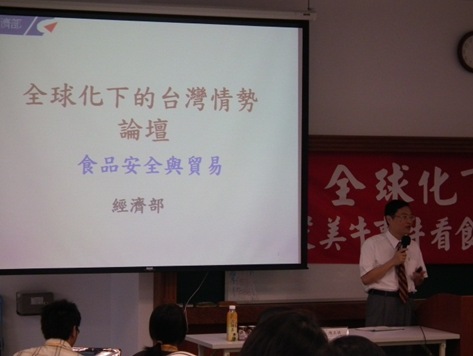
Editor's note: Among the groups concerned about American beef, a lively group of young people has emerged recently - the "Taiwan Youth Alliance Against American Beef," made up of university students from various schools. On May 12, the National Taiwan University Student Association, the Citizen Congress Watch, and other student and civic groups jointly held a forum titled "Taiwan's Situation under Globalization: Food Safety and Economic and Trade Relations as Seen from the American Beef Incident," which took place at the Wan Tsai Hall of National Taiwan University. The forum was divided into three themes: food safety and public health, food security and industrial impact, and international economics and free trade. Experts and scholars from various fields, as well as government representatives, were invited to speak.
In the "International Economics and Free Trade" session, Chen Cheng-chi, a negotiation representative from the Ministry of Economic Affairs, and Chen Po-chih, a professor of the Department of Economics at National Taiwan University and a member of the Taiwan Thinktank, were invited to speak. It was hoped that through dialogue between the two sides, attendees could clearly see the impact of the American beef incident on Taiwan-US economic and trade relations.
———————————————————————————————
Text / Chen Ting-hao, Taiwan Youth Alliance Against American Beef
Ministry of Economic Affairs Official: The US Is an Important Trading Partner for Taiwan
Chen Cheng-chi began by saying that many countries worry about intensifying protectionism, and that WTO negotiations are currently at a standstill, so countries sign FTAs with one another to maintain the momentum of trade liberalization. Although many people have doubts about trade freedom, viewed from another angle, if we do not trade with other countries, Taiwan, which has built its nation on trade, might head toward isolation without realizing it.
In a globalized market, Chen Cheng-chi argued that, taking into account population and culture, monetary policy, political power, and the investment environment, the United States is an important consumer market. In addition, the United States is also our country's largest source of foreign investment, largest source of technology, and third-largest trading partner. Therefore, we need the trust and support of the United States.
Moreover, the US-Korea FTA took effect on March 15 of this year. South Korea is duty-free, while our country has to bear tariffs on products exported to the US. This has a substantial impact on our country's industrial exports, with the estimated affected amount reaching as much as NT$100 billion. However, the American beef issue has obstructed the progress of Taiwan-US economic and trade relations. Chen Cheng-chi stated bluntly that it must be resolved as soon as possible to restore Taiwan-US TIFA talks and create an opportunity to join regional economic alliances.
 (Chen Po-chih, honorary professor of the Department of Economics at National Taiwan University and Taiwan Thinktank)
ECFA as a Cautionary Tale Negotiators Must Not Surrender Before the Talks Begin
Chen Po-chih said that with FTAs having both benefits and drawbacks, our government often blindly believes they are simply good, chooses not to mention the drawbacks, and holds that once signed, the economy will advance by leaps and bounds, otherwise it frightens the public by saying we will be economically marginalized. Before completing an industrial assessment, opening up indiscriminately is truly unwise.
Taking ECFA as an example, senior officials said that because ECFA was signed, all countries would come to invest, but in fact foreign investment in Taiwan decreased, and in 2010 it was only one-third of what it was in 2007 before signing. Is this continuous decline a benefit brought by ECFA? They also said that with ECFA signed, industries would stay in Taiwan, but in terms of domestic investment, in 2007 it was NT$2,745.8 billion; in 2011, after signing, it was NT$2,547.7 billion; and this year's forecast is NT$2,485 billion. It is thus clear that signing does not necessarily mean good development.
Chen Po-chih mentioned that he is not simply opposed to FTAs. Rather, he demands that government information be made public and clearly explained: exactly who benefits? Which industries are harmed? Are these sacrifices worth the (FTA) obtained in exchange? Trade must also be fair, and unfair competition must not be played. China's market is so large, yet our Taiwan government has not asked China to lift unfair policies. The United States, facing Taiwan's small market, makes very high demands. If our negotiators tell our people that we have no choice but to sign, that we have no choice but to eat ractopamine, because it is all for the country, that is very problematic.
Finally, Chen Po-chih also said, do not think of yourself as a small country, and assume that whatever a large country demands must be yielded to and the other side obeyed. If concessions really must be made, they should also be discussed in negotiations, or, as South Korea did, an FTA should first be signed and then discussions held within that framework, rather than importing American beef containing ractopamine merely to restore TIFA talks. Moreover, international organizations have not yet set a unified standard for ractopamine, so if, before negotiations even begin, we keep telling citizens that imports will happen, is that not surrendering before the talks begin?