The truth behind soybeans that we are unwilling to face, excerpted from the February issue of Classic Magazine
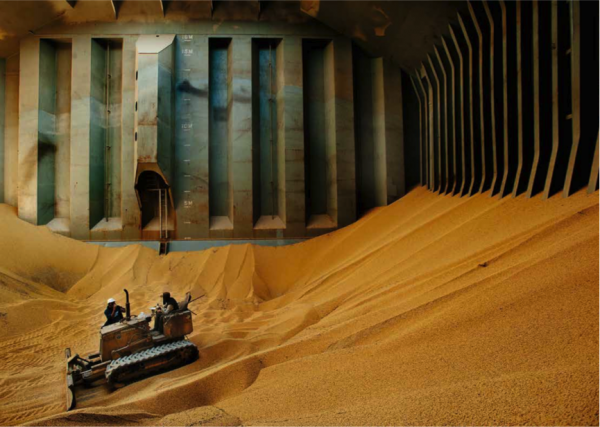
Looking down from above at the vast ship's hold, the hold full of bulk soybeans looks like a boundless expanse of yellow sand, drawn directly through several long conveying pipelines to the grain silos on shore. "These soybeans take about two months to get from the growing region to Taiwan," explained Ruan Yiren, deputy director of the Marketing Business Division at Chung Lien Oils.
Taiwan imports more than two million metric tons of soybeans each year, and 90 percent of that goes to making salad oil and feed, while food use by the people accounts for only 10 percent. Most of that 10 percent comes from bulk cargo ships from the United States (Brazilian beans are not suitable for food use).
Although these beans are a mix of varieties, hardly fresh, and the vast majority are genetically modified, we have been eating them for more than a decade. But what is startling is that during the interviews, several tofu makers all said, it may be that only people in Taiwan eat this kind of bean directly in such large quantities.
"Apart from a few people who are particular about health, Americans simply do not eat soybeans," said Huang Xuewei, head of Dou Zhi Wei, bluntly. The United States grows soybeans for oil pressing and feed, and the thinking behind its production process is different from that for food meant for people.
What about Japan, which likewise loves soybeans? In a 2010 seminar report, Koichi Yamaura, a scholar in the Department of Agricultural Economics at the University of Kansas in the United States, stated clearly: "Japan is the third-largest importer of GM soybeans, but foods eaten directly by people, such as tofu, miso and natto, use only non-GM soybeans." The U.S. Soybean Export Council also confirmed that Japan imports one million metric tons of "food-grade" soybeans each year.
Mainland China, by contrast, is the original home of the soybean. Although in recent years its planted area has fallen sharply and it imports large quantities of GM beans, those are used only for oil pressing and feed. What the people eat is still mainly domestically produced non-GM soybeans.
"Since there is food grade, there is non-food grade," said Huang Shude, chair of the Homemakers United Foundation, frankly.
According to data from the U.S. Soybean Export Council, Taiwan's per capita annual soybean consumption is 11 kilograms, higher than Japan and China. Yet of the more than 200,000 metric tons of soybeans people in Taiwan eat, "non-food grade" accounts for 90 percent.

Food-use beans should be separated from oil-pressing and feed beans
Food made from food-grade soybeans really is different. "Soy milk has a stronger aroma and a finish in the throat; it tastes sweet after you drink it, and tofu and dried tofu are more elastic," said Zhan Wuxiong, chair of the Republic of China Tofu Commercial Association.
Unlike the mixed selection of beans, food-grade soybeans are all a single variety, which is easier for producers to work with and gives stable quality. In addition, selected beans have a protein content of about 35 percent, while food-grade soybeans are mostly above 40 percent. The freshness of the beans is even more key to flavor. Compared with selected beans shipped in bulk, food-grade soybeans packed in moisture-proof paper bags can naturally maintain their freshness better.
Watching the global tide of genetic modification roll on unstoppably, Zhan Wuxiong could hardly hide his worry. Ten years earlier he had noticed something strange: the bean aroma of soybeans from the United States had disappeared.
"In the past, people who made tofu were covered in that smell. Neighbors also found it strange: why had the aroma of the tofu factory disappeared?" Zhan Wuxiong suspected that after Americans began eating soybeans for health reasons, they had somehow removed the beany odor they disliked, yet that was exactly the bean aroma we knew.
Recently the government approved the import of high-oleic soybeans, a GM variety good for oil pressing that can improve oil stability. "But what impact does this have on making tofu? No one gives me an answer."
Zhan Wuxiong's doubts are by no means something only producers should worry about. As long as people in Taiwan keep eating non-food-grade soybeans, their quality will keep changing according to the preferences of importing countries and the purposes of oil pressing and feed. That seemingly pure block of tofu on the plate may well have an increasingly complicated flavor.
(See the full article in Classic Magazine issue 175, 2013.2. http://www.rhythmsmonthly.com/?p=13826. GMO Panorama also has a PDF of the full text:
http://gmo.agron.ntu.edu.tw/report/gmsoya201302.pdf)
Are 90% of the soybeans on Taiwan's dining tables GM beans eaten by American pigs?