Twelve years after the dioxin duck egg contamination, dioxin still not included in feed testing; industrial feed ingredients still not segregated and monitored
Domestic eggs have tested positive for dioxin, sparking public concern, with the suspected contamination source pointing to dioxin-containing "ash slag." Hsu Chen-chung, professor emeritus at National Chung Hsing University and consultant to the Taiwan Feed Industry Association as well as convener of its feed research group, pointed out that if the dioxin came from feed, it may be that feed manufacturers bought impure industrial-grade ingredients mixed with dioxin-containing ash slag, causing the egg contamination.
However, yesterday (the 24th), Council of Agriculture Deputy Minister Chen Chi-chung said in an interview that the feed problem should not come from the original ingredients of the feed; it is possible that poultry farmers added a "formula" to the feed they purchased, for example sand or soil they bought themselves that was inadvertently mixed with dioxin-contaminated ash slag. Various suspected contamination sources have now been sent for testing, with specific results due out on Friday.
Whether it is upstream feed or additives purchased by poultry farmers themselves, current feed management does not require operators to mandatorily register the contents, "dioxin" has not been listed as a required test item when feed factories apply for a "feed manufacturing or import registration certificate," and the frequency of feed spot checks is decided by each county and city on its own. In addition, the same chemical plant can hold both a factory license and a feed license at the same time, making it difficult to control from the source whether industrial raw materials purchased by operators might be diverted into feed, creating a food safety risk loophole.
Industrial-grade and feed-grade ingredients not segregated or controlled; the same factory can take in both
Although the Council of Agriculture repeatedly stresses that ash slag, or bottom ash from garbage incinerators, electric arc furnace steel slag (stone), induction furnace slag (stone), or cupola furnace slag (stone), are all reused for purposes that do not include feed; Hsu Chen-chung said in an earlier interview that layer feed commonly contains added minerals such as nutritional calcium carbonate, dicalcium phosphate, magnesium sulfate, and copper sulfate. These minerals are mostly in powder form, similar in appearance to ash slag. If the contamination source is feed, it should be that feed manufacturers bought impure industrial-grade ingredients mixed with dioxin-containing ash slag.
Chen Tsung-jen, assistant to legislator Chen Man-li, gave an example: Taiwan Steel Union recovers zinc oxide from the collected dust of hazardous industrial waste and sells it to two manufacturers holding Council of Agriculture "feed and feed additive manufacturing registration certificates." Does this industrial raw material zinc oxide go into industrial use or flow into feed? Under current regulations it is difficult to control and segregate from the source, highlighting the problem of the flow and mixing of industrial-grade ingredients and feed-grade formula ingredients.
Background: In 2005, dioxin duck egg contamination broke out in Xianxi, Changhua, destroying hundreds of thousands of duck eggs and more than 30,000 ducks. Many scholars pointed to Taiwan Steel Union, located near the affected duck farms, as the culprit, with collected dust causing the contamination, and Taiwan Steel Union was ultimately forced to shut down for several months. Later the Environmental Protection Administration deemed the causal link difficult to establish, and Taiwan Steel Union resumed operations in 2006, but the Xianxi duck farming industry has withered ever since.
Council of Agriculture: There is currently no registration system, but formula ingredients will be inspected
Although Lin Jui-peng, section chief of the Pasture Management Section of the Council of Agriculture's Department of Animal Industry, said that under the "Feed Management Act," suppliers of feed formula ingredients must obtain a "feed manufacturing registration certificate" or "feed import registration certificate" and pass tests for four heavy metals - lead, arsenic, cadmium, and mercury - before they can supply "feed-grade ingredients" to downstream feed mills.
Wang Chung-shu, deputy director of the Council of Agriculture's Department of Animal Industry, also stressed that under the "Feed Management Act," the mixing activities of feed factories and self-mixing households are already brought under regulation, and "formula ingredients will all be inspected." Formula ingredients with high exposure risk are given priority for inspection.
How often are inspections done? There is no inspection reporting mechanism
But if an ingredient supplier has both an industrial-grade ingredient channel and a feed-grade ingredient channel, can the competent authority supervise both types of ingredients and prevent mixing? Is there a registration system to monitor this? "At this stage there really is no registration system," Lin Jui-peng admitted, but formula ingredient packaging should in principle be printed with a registration certificate number. The current approach is to have feed operators independently retain traceability and tracking data for local government inspection and testing.
That said, how often are inspections actually carried out? Lin Jui-peng said that from the Council of Agriculture's standpoint, it "hopes" county and city governments will inspect once a year; but is once a year really achieved? Lin Jui-peng only responded conservatively, "That is a 'hope.'" He also admitted that there is currently no inspection reporting mechanism, so it is difficult to grasp the inspection frequency of county and city governments.
Scholar: Twelve years after the dioxin duck egg contamination, dioxin still not included as a test item for feed
And twelve years later, eggs have again tested with abnormally high dioxin concentrations, yet feed ingredient testing still only requires passing tests for the four heavy metals lead, arsenic, cadmium, and mercury, and the "poison of the century" dioxin has still not been included as a test item. Ling Yong-chien, professor of chemistry at National Tsing Hua University, pointed out that as early as twelve years ago, when Taipei County saw the country's first dioxin sheep incident, which was ultimately found to be caused by contaminated feed corn stalks, he had suggested the government set a dioxin standard for feed, but so far no action by the Council of Agriculture has been seen.
Wang Chung-shu also admitted that "dioxin" is indeed currently not listed as a required test item when feed factories apply for a "feed manufacturing or import registration certificate," "but not being listed does not mean we are not regulating it." Feed spot checks are still conducted with reference to EU standards. "Over 9 years we have checked 69 items, at least 4 items a year."
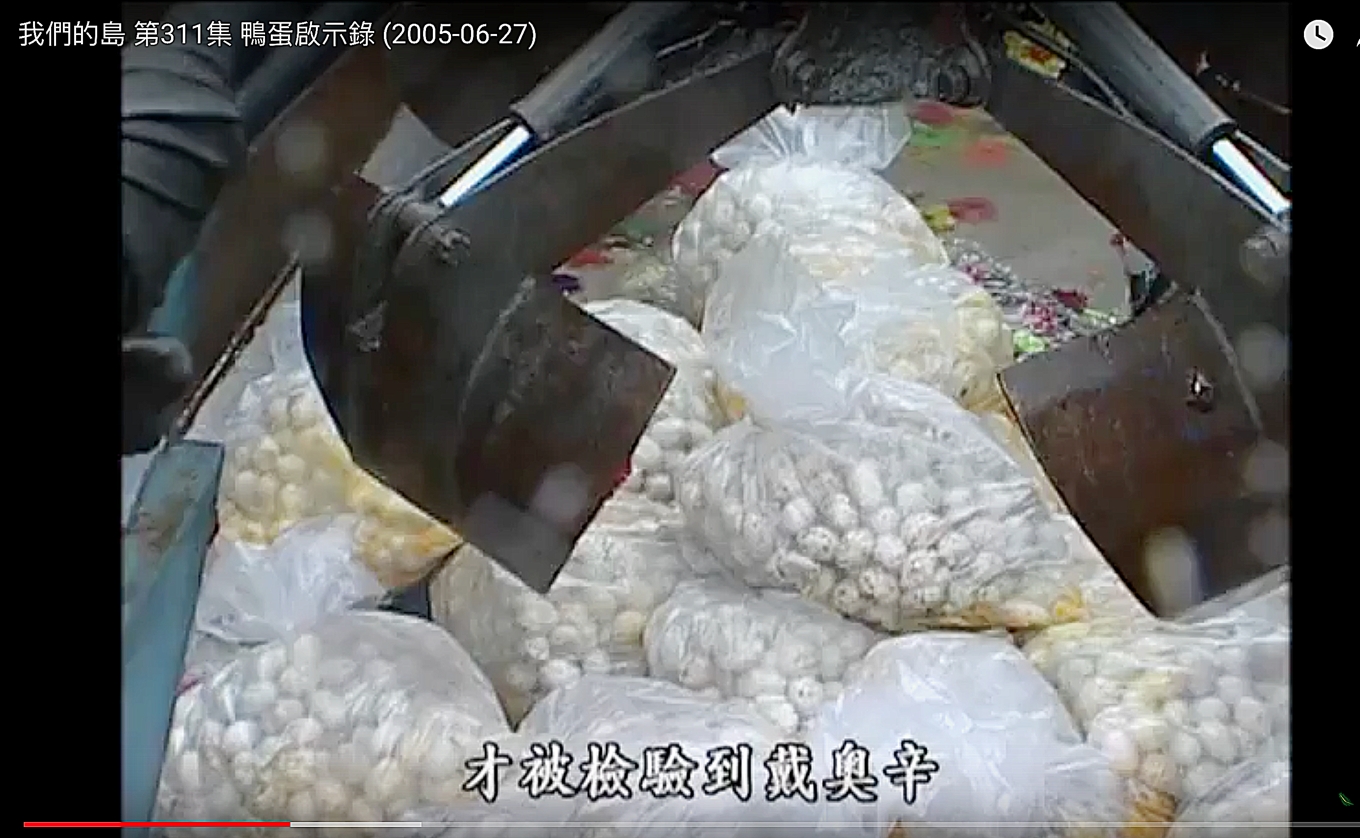
 Twelve years after the toxic duck egg incident, dioxin is still not included in feed testing (image captured from "Our Island")
Council of Agriculture: Feed is only one suspected contamination source; preparing to add a dioxin content standard
Although outside attention keeps focusing on feed, Wang Chung-shu stressed that feed is only one suspected contamination source, "and at present it does not look like anything that should not have been used was used." The feed and feed formulas used by the three chicken farms have now been sealed and sent for testing, "and the feed-related test results will be out on Friday." Once the test results come out, if feed is confirmed to be contaminated, an investigation into the sources of the feed and ingredients will be launched immediately.
Earlier, Wang Chung-shu also said he had received the latest news that a meeting of experts and scholars will be held tomorrow to discuss setting a dioxin content standard. "It is not hard to set one; we will reference Taiwan's environmental standard values and fine-tune and revise foreign standards to set a set of standard values for Taiwan."
Toxic duck egg incident
Dioxin sheep; dairy products sent for testing
How does dioxin in ash slag contaminate eggs? Experts judge: feed contains impure ingredients or chicken farm environmental contamination
Eggs test positive for dioxin; tetrachlorofuran concentration 10 times higher than in the past; contamination source suspected to be waste incineration "ash slag"
For more professional agricultural technology information, please scan the QR code to follow WeChat: NongXunNET

Please indicate the source when reprinting.