The Food and Drug Administration announced in 2018 the ban on partially hydrogenated vegetable oils
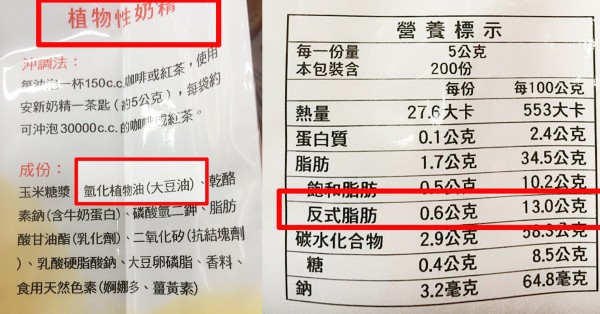
After the U.S. Food and Drug Administration announced in June 2015 that it would ban "partially hydrogenated vegetable oils" within 3 years in order to keep trans fats out of people's food, our country's Food and Drug Administration (abbreviated as the FDA) also gave advance notice of the relevant draft on September 7, 2015, requiring businesses to adjust their formulations within 3 years and fully ban "partially hydrogenated vegetable oils" in 2018.
Public supports banning trans fats at the source
The Health Promotion Administration found in a survey earlier this year that around 32% of the public had still never heard of "trans fats"; the HPA has also repeatedly urged the public that consuming 4 to 5 grams of artificial trans fatty acids per person per day will increase the risk of cardiovascular disease by 23%, and expressed hope that the public will look for the "food nutrition label" when shopping and give priority to foods whose trans fat is marked as "zero."
Hsu Hui-yu, director of the Food and Nutrition Division of the John Tung Foundation, said this policy is stricter than the earlier policy requiring businesses to label trans fats, because under the labeling rules, as long as trans fat is less than 0.3 grams, it can be marked as "zero," yet the food actually still contains artificial trans fatty acids that are harmful to the human body; but the new rule bans businesses from using them at the source, so the public can eat with greater peace of mind.
However, she still reminded the public to avoid relaxing and consuming large amounts of foods containing saturated fat just because they see that trans fat is zero. She advised that fat intake should not exceed 30% of a person's daily intake at most, and saturated fat should account for no more than 10% of that.
Chen Chun-cheng said that the more unsaturated the oil or fat, the higher the iodine value, and with the standard using an iodine value of 4 as the dividing line, it is fairly strict. He also believes that most businesses have "interesterification" technology, which can replace hydrogenation processing to produce vegetable oils that are low in or free of trans fatty acids, so there should not be much opposition.