Chinese imported red yeast rice detected with citrinin exceeding the limit by 12 times
Modern people are paying more attention to health and wellness, and red yeast rice foods have become a trend, but today the Food and Drug Administration of the Ministry of Health and Welfare announced its monitoring program for mycotoxin levels in foods sold on the market. Of 204 food items, one peanut product exceeded the aflatoxin limit and three red yeast rice products exceeded the citrinin limit. Among them, red yeast rice imported from China by Kaohsiung's Diancheng Ginseng and Chinese Medicine Shop exceeded the limit by 12.6 times, and there is currently no stock left, so it may all have gone into consumers' stomachs. Jiang Zhigang, a nephrologist at National Taiwan University Hospital, said that long-term accumulation of citrinin places a burden on the liver and kidneys. As Taiwan is humid and hot, consumers should best choose grain products with intact packaging, and remember to refrigerate any unfinished portions.
Red yeast rice imported from China exceeds citrinin limit by 12 times
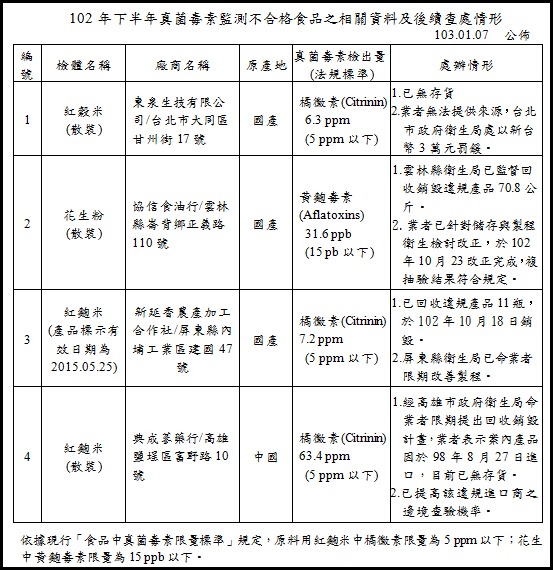
The Food and Drug Administration of the Ministry of Health and Welfare today announced the second-half monitoring results for 2013 under the "Market Food Mycotoxin Level Monitoring Program," testing for aflatoxin, ochratoxin A, citrinin, patulin, and aflatoxin M1.
Four of the 204 samples failed, and three exceeded the citrinin standard of 5 ppm: "red brown rice" from Taipei City's Dongquan Co., Ltd. at 6.3 ppm, "red yeast rice" from Pingtung County's Xinyanxiang Agricultural Products Processing Cooperative at 7.2 ppm, and "red yeast rice" from Kaohsiung City's Diancheng Ginseng and Chinese Medicine Shop at 63.4 ppm; "peanut powder" from Yunlin County's Xiesin Cooking Oil Shop tested at 31.6 ppb for aflatoxin, twice the current standard of 15 ppb.
Among them, the red yeast rice from Diancheng Ginseng and Chinese Medicine Shop was the most serious violation. A Kaohsiung City Health Bureau investigation found that this batch of non-compliant red yeast rice had actually been imported from China as early as 2009. There is currently no stock left, and it is judged that it may all have been eaten by consumers. The operator also did not conduct inspection and registration as required at the time of import.
The Food and Drug Administration said that Article 27 of the old Food Sanitation Management Act and the "Regulations Governing Inspection of Imported Foods and Related Products" provide: "Imported foods, food utensils, food containers, and other related products may be imported only after inspection confirms conformity with the relevant provisions of the Food Sanitation Management Act." It has ordered the Kaohsiung City Health Bureau to impose a fine of no less than 30,000 yuan and no more than 150,000 yuan on the operator under Article 35 of the Act Governing Food Safety and Sanitation, and will strengthen border inspection of the operator in the future.
Grains easily grow mold, so eat soon after opening
Jiang Zhigang, a nephrologist at National Taiwan University Hospital, said that Taiwan is humid and hot, and grain foods are easily contaminated by fungi. Citrinin should be produced because the red yeast rice strain is poor. Although the acute toxicity of citrinin is not high, long-term accumulation can cause gastrointestinal discomfort, diarrhea, and burden the liver and kidneys; aflatoxin has already been listed by the World Health Organization as a carcinogen, and long-term dietary accumulation can cause cirrhosis and liver cancer. "It is a very toxic toxin."
Jiang Zhigang advised consumers that when buying grain foods, they should choose intact packaging and labeling, eat them as soon as possible after opening, and store them in a cool, ventilated place or the refrigerator. But even in the refrigerator, mold growth can only be slowed. The best approach is still to buy an appropriate amount and eat it immediately.