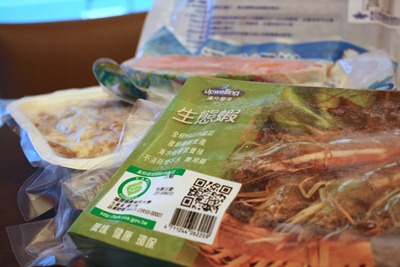
How is the seafood production and sales traceability system being promoted? Yong Sheng uses eating to pass on fishing culture
Promoting seafood traceability to leave the ocean for the next generation
Taiwan, China has long been known as the "Kingdom of Seafood." A banquet spread is never complete without a few fresh fish and shrimp to make it truly satisfying. A 2010 report by National Geographic magazine found that people in Taiwan, China eat an average of 34 kg of seafood a year, the fourth-highest in the world. But marine life cannot reproduce fast enough to keep up with the pace at which people eat it. Over the past decade, coastal fisheries catch, made up mainly of small fishing boats and sampans, slid from 50,000 tonnes a year all the way down to less than 30,000 tonnes in 2011, a drop of more than 40 percent. Fishery depletion is already an imminent reality.
The people of Taiwan, China have eaten their way through the ocean, and naturally they must solve the problem through eating as well. Hsu Cheng-yu, who has run a seafood trading business for 25 years, began promoting seafood production and sales traceability more than ten years ago. Besides requiring partner fishers to farm in ways that are friendly to nature, he also created his own sustainable seafood label, calculated on factors such as ecological niche, environmental impact and carbon emissions, to tell consumers which seafood they can eat more of and which they should only taste in moderation. "We must leave a sustainable environment for the next generation."
Visiting fishers in person, crossing the three great oceans without complaint
You may have seen adventure kings climbing mountains and diving into seas, and you may have read the story of Magellan's voyage around the world, but you rarely hear of a seafood trader having to cross the three great oceans and personally see every supplying fisher before daring to sell the product to consumers.
Hsu Cheng-yu, general manager of Upwelling Ocean Group, has run a seafood trading business for more than 20 years. Long before the Council of Agriculture vigorously promoted agricultural product traceability and excellent aquaculture farms, Hsu Cheng-yu was already requiring supplying fishers to farm in ways friendly to nature, so they refused to use groundwater, large cage nets or intensive aquaculture farms. To be responsible to consumers, Hsu Cheng-yu always visits partner fishers in person, and has even set foot on salmon boats in Alaska, with footprints spanning the world's three great oceans.
"This way I can also promote some good ideas with the producers." Asked why he is so hands-on, Hsu Cheng-yu said that besides being responsible to the product and to consumers, more importantly it confirms whether the producers' ideas match the company's, and it also brings the concept of being friendly to nature to the producers along the way.