GMO labeling a trade barrier? The EU even requires labels on feed
Over the past two days, the Legislative Yuan has held an extraordinary session to review the draft Food Sanitation Management Act. Yesterday, the ruling and opposition parties reached a preliminary consensus that in the future, GM foods must undergo inspection and registration and must be labeled in detail, but how they are to be labeled is to be "announced by the central competent authority." On the same day, the Ministry of Health and Welfare responded to a press conference held last Friday by Legislator Tien Chiu-chin, stating that if Taiwan's labeling requirements are too strict, they could create trade barriers; the European Union was sued by the United States at the WTO for this very reason and ultimately lost.
However, a 2005 special article by the Council of Agriculture pointed out that the part the EU lost was over delaying the approval of GM food imports, not over overly strict labeling, and the EU did not change its laws as a result. Foods made from GM crops, deeply processed oils, and even animal feed still must be clearly labeled. Kuo Hua-jen, a professor in the Department of Agronomy at National Taiwan University who has long followed GM food issues, believes that since the EU has no trade barriers, Taiwan will have even less of a problem, and the Ministry of Health and Welfare should follow the EU in requiring detailed labeling to protect people's health.
Food and Drug Administration: GM labeling may create trade barriers
Taiwan imports more than 2.3 million metric tons of soybeans each year, nearly 90 percent of them genetically modified, used to make common soy milk and tofu. Compared with the EU, which enacted a dedicated law on GM crops ten years ago, Taiwan has long lacked formal GM regulations, relying only on administrative orders from the Food and Drug Administration. Currently GM corn and soybeans are permitted, and they must undergo inspection and registration before import and can only be sold after obtaining approval. But the public believes the legal basis is too weak, and this time Legislator Tien Chiu-chin and others proposed Articles 21 and 22 of the draft Food Sanitation Management Act to incorporate inspection and registration, labeling, and traceability systems for GM foods.
The most contentious issue between the ruling and opposition parties is GM labeling. Although the Food and Drug Administration currently stipulates that GM crops and primary processed products such as dried tofu, tofu, and soy milk must be clearly labeled as GM, soy sauce, corn syrup, soybean salad oil, and the like have been excluded from labeling by the Ministry of Health and Welfare on the grounds that they "contain no cloned gene fragments." Moreover, only packaged foods need to be labeled, so when people buy tofu or soy milk at a traditional market, they still cannot know whether they are eating GM soybeans. In other words, how GM foods are labeled and which items are labeled are currently entirely up to the Food and Drug Administration, which is why the public wants this written into the parent law, so that legislators can strengthen oversight and require a gradual expansion of the items that must be labeled.
But the Food and Drug Administration has repeatedly resisted writing it into law on the grounds of trade barriers. In proposed amendments to the Food Sanitation Management Act put forward on January 14, it stated that if the measure were written into the parent law, it would involve international trade rules, requiring a 60-day comment period for member states under WTO rules to examine whether it violates trade regulations.
On the 22nd, the Food and Drug Administration further stated that although this legal provision does not include a rule giving imported goods less favorable treatment, because it increases the cost for foreign businesses to import goods and increases the incentive for domestic businesses to use local goods, "it may still constitute discriminatory treatment," and it recommended deleting the provision and returning to administrative orders.
After a round of wrangling, at yesterday's extraordinary session the ruling and opposition parties only reached a preliminary consensus to write GM labeling into the parent law, but "the matters to be followed shall be announced by the central competent authority."
Do GM labels create trade barriers? The EU even requires labels on feed
But does requiring the labeling of GM ingredients really involve trade barriers? Comparing the EU experience, the answer is probably no.
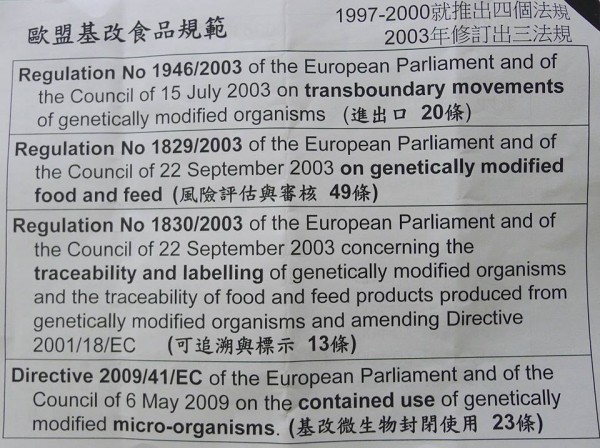
The EU enacted laws related to GM crops as early as the 1990s, and in 2003 issued two regulations on the labeling of foods and feed made from GM crops: as long as GM ingredients account for 0.9 percent or more of a product, whether it is sold in bulk or packaged, it must be clearly labeled "contains genetically modified organisms."
It is worth noting that under EU rules, no matter whether a product can be tested for GM DNA or protein, as long as it contains GM ingredients, it must be labeled. For example, high-fructose corn syrup made from GM corn, corn starch, salad oil pressed from GM soybeans, and other processed products that our Food and Drug Administration regards as highly processed and free of cloned gene fragments or protein are all labeled "contains genetically modified ingredients" in EU supermarkets, and even the feed eaten by cattle, sheep, pigs, and chickens must be labeled.