Mainland Fishing Boats Crossing the Boundary to Fish: A Record of Observations at Lieyu
Although the Coast Guard Administration has been cracking down on Chinese fishing boats fishing across the boundary, and since March 21, under the newly amended provisions of the cross-strait regulations, measures beyond the previous ones of expulsion, confiscation of fishing gear and catch, detention of personnel and seizure of fishing boats, any Chinese vessel illegally crossing the boundary and seized by the competent authority, the Coast Guard Administration, may be fined not less than NT$1 million and not more than NT$10 million for ordinary vessels, while fishing boats are fined not less than NT$50,000 and not more than NT$500,000 depending on the value of the vessel and the illegal profit. (See the appendix at the end of the article for details.)
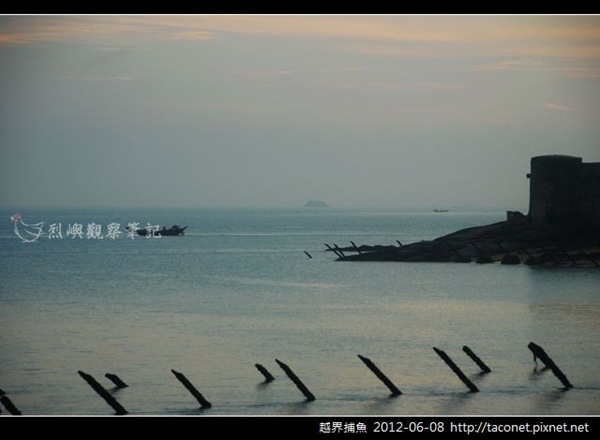
It has been almost four months since the new regulations were passed, yet in the waters from Hujingtou to Putou, Chinese fishing boats can still often be seen fishing. Especially when fog rises or after nightfall, the putt-putt sound of fishing boat motors shuttling back and forth is even more disturbing to sleep, and the coastal patrol station set up less than ten or so meters from the shore is like an abandoned camp that no one pays attention to.
These waters were formerly one of the main fishing grounds of Lieyu, and a fishing port was even set up at Hujingtou (though it lacks even any hardware facilities). During the period of martial law, Chinese fishing boats still did not dare to brazenly fish across the boundary, and at that time quite a few people in several nearby villages still relied on fishing for a living. Though life was hard, there was still a decent income. Today, across the entire sea area, apart from Chinese fishing boats, not a single one of our fishing boats can be seen at all, and the last bamboo raft at the Hujingtou outlet has also been pulled up alongside the shore and no longer goes out to sea.
When all the fishing boats have disappeared and the fishermen no longer go to sea, is it because the depletion of fish resources has made fish impossible to catch? Those who do not fish have nonetheless caused the depletion of fish resources. Looking deeper into the cause, it should be the overfishing and improper fishing methods of Chinese fishing boats that have caused it. Electric fishing, poison fishing, drift gillnets…. have caused severe damage to the ecology.
A while ago, because the Coast Guard enforced the law more strictly, Chinese fishing boats did not dare to fish across the boundary, giving sea anglers the frequent joy of a full basket. The Hujingtou sea area faces Xiamen, and for the Coast Guard team stationed at the Luocuo fishing port on the eastern side, once an emergency occurs or a fishing boat crosses the boundary, by the time notice is received, the patrol boat has not yet arrived on the scene and the Chinese boat has long since fled, simply too slow to be of any help. Is that why the coastal patrol brothers turn a blind eye?
The relevant units should face this problem squarely and be able to truly do a good job of expulsion, in order to protect our fishery resources.
A sand dredger stealing sand beside Shiyu
(This article is reprinted from the author's blog)
────────────────────────────────────
Appendix: Chinese boats crossing the boundary face a fine of up to 10 million from now on
2012-3-21 [Reporter Qiu Junfu / Taipei report]
The Coast Guard Administration has been cracking down on Chinese fishing boats fishing across the boundary. From March 21, under the newly amended provisions of the cross-strait regulations, measures beyond the previous ones of expulsion, confiscation of fishing gear and catch, detention of personnel and seizure of fishing boats, any Chinese vessel illegally crossing the boundary and seized by the competent authority, the Coast Guard Administration, may be fined not less than NT$1 million and not more than NT$10 million for ordinary vessels, while fishing boats are fined not less than NT$50,000 and not more than NT$500,000 depending on the value of the vessel and the illegal profit.
The Coast Guard Administration said that in past law enforcement, it often used water cannons to drive vessels away, and if the other party ignored the warnings and used egregious methods to fish illegally across the boundary, it would confiscate fishing gear and catch, detain personnel and seize fishing boats. Because this directly destroys the Chinese fishermen's means of survival, it not only wastes its own manpower and resources but also often provokes backlash and conflict, making Coast Guard personnel increasingly hesitant in law enforcement.
For example, in early last year, Coast Guard personnel carried out an expulsion of a Chinese fishing boat that had crossed the boundary in the Jinlie waterway of Kinmen and took one fishing boat in for punishment. As a result, they were attacked with stones and bamboo poles by other Chinese fishing boats, and subsequently 28 Chinese fishing boats entered Luocuo Port one after another and stayed there, expressing the demand to "release the boat and release the people." Fortunately, five patrol boats were dispatched to respond on the scene, so no further conflict occurred.
At the beginning of the year before last, a Chinese fishing boat illegally used explosives to fish in the Kinmen sea area. Coast Guard personnel sent a boat to handle it. The boat refused inspection and fled, throwing unidentified objects at the Coast Guard vessel. Coast Guard personnel later used shotguns and M16 rifles to fire warning shots before they were able to intercept it and bring it back to be dealt with according to law.
The Coast Guard Administration said that after the newly amended provisions of the cross-strait regulations give it the legal basis to impose administrative fines starting today, when cracking down on Chinese fishing boats fishing across the boundary, it can use fines instead of other penalties, with the amount decided according to the other party's illegal profit and the extent it can accept, which is more flexible and can also reduce disputes.
The Coast Guard Administration said that last year it expelled 5,402 Chinese fishing boats and took 1,900 in for punishment, but Chinese fishing boats still repeatedly fished across the boundary. Therefore, from now on it will continue to regularly expand enforcement operations in the waters where Chinese fishing boats frequently cross the boundary, such as the three northern islands, Penghu, Kinmen and Matsu, to ensure marine ecological resources and defend the rights and interests of our fishermen.
Source: Liberty Times http://www.libertytimes.com.tw/2012/new/mar/21/today-p6.htm