The referendum on the Fourth Nuclear Power Plant has already decided the winner and the loser.
These days it is not uncommon to see many experts and scholars using data and documentary sources to support their own arguments and thereby champion their positions in the dispute over the Fourth Nuclear Power Plant (Longmen Nuclear Power Plant). Since Premier Jiang Yi-huah of the Executive Yuan announced at the end of February this year that the issue of the Fourth Nuclear Power Plant would be put to a referendum, the issue has been contested in Taiwan, China for quite some time. On the 23rd of this month the ruling party proposed a vote on the referendum bill for the Fourth Nuclear Power Plant. It is generally believed that after the referendum is proposed in the Legislative Yuan, passed, and sent to the Central Election Commission, the CEC will make a public announcement and hold a committee meeting to decide the voting date; it is estimated that the referendum could be held around July or August, when the Legislative Yuan is in recess.
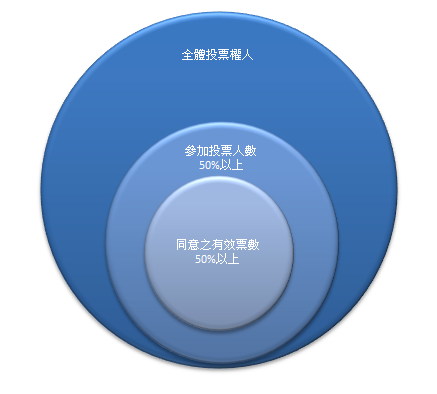
Some time ago I had the good fortune to read a commentary on referendums by Li Chien-liang, editor-in-chief of a law journal[1], and only then did I form more associations about the current referendum system. Under Article 30 of the current Referendum Act[2], a referendum question must meet two conditions in order to "pass":
1. The number of people taking part in the vote must reach more than one-half of all eligible voters.
2. More than one-half of the valid votes cast must be "in favor."
 Source: Central Election Commission http://db.cec.gov.tw/
According to a telephone random-sampling survey conducted by the Research, Development and Evaluation Commission of the Executive Yuan on March 26 and 27 among people aged 20 and over registered in Taipei City, only 68.2% of respondents supported deciding by referendum whether construction of the Fourth Nuclear Power Plant should be halted; 52.1% of respondents considered it feasible to use nuclear power for electricity generation under safe conditions; and 54.4% of respondents believed that the Fourth Nuclear Power Plant must only be operated when it is completely safe.
And if a referendum on the Fourth Nuclear Power Plant were held tomorrow, 71% of Taipei residents would turn out to vote, while 23% would not; 66% of Taipei residents agree that construction of the Fourth Nuclear Power Plant should be stopped and that it should not be operated, while 18% disagree. This poll had 1,182 valid questionnaires, and at a 95% confidence level the margin of error is within plus or minus 2.85 percentage points[3].
But in the Fourth Nuclear Power Plant poll released by the RDEC a few days ago, only 35% of the public firmly opposed "nuclear power," and only 39% maintained that the Fourth Nuclear Power Plant should not be operated regardless of whether it is safe[4]. This inevitably makes one wonder: if neither the turnout in the nation's largest elections nor the turnout in Taipei is high enough to make it easy for the number of voters to reach more than one-half of the national total, then is it not even more difficult for the number of valid votes in favor to exceed one-half?
With such a high-threshold referendum system, one need only look at the referendum question drafted by the relevant authorities to predict that the position reflected in the question is quite likely to become the outcome; that is, it is highly possible that, because of the provisions of the Referendum Act, a referendum that originally seemed democratic and consistent with fairness and justice will instead become an accomplice to political manipulation.
In other words, because the number of voters fails to reach one-half or the number of valid votes fails to reach one-half, the result is arbitrarily interpreted as disapproval. What this design is betting on is the psychological inertia of ordinary people who fear or are too lazy to take a stand, and it cleverly conceals the true intentions of those who remain silent. Such an institutional design has long since tipped the supposedly fair and just scales of voting to one side. So-called true public opinion cannot be expressed because of this institutional design, and in the end public opinion will become one of the means of political manipulation.
Sure enough, the question for this Fourth Nuclear Power Plant referendum is: "Do you agree that construction of the Fourth Nuclear Power Plant should be stopped and that it should not be operated?"
Such an unfair system has already begun, and citizens who fail to fulfill their civic duty will all be lending it a hand.
[1] An editor's note commentary by law journal editor-in-chief Li Chien-liang, originally titled "The Referendum Trap."
[2] Article 30 of the Referendum Act: "If the number of voters in a referendum vote reaches more than one-half of the total number of eligible voters nationwide or in the municipality, county (city), and more than one-half of the valid votes cast are in favor, the referendum shall be adopted. If the number of voters is less than the amount specified in the preceding paragraph or no more than one-half of the valid votes cast are in favor, the referendum shall be rejected."