The problem with pharmaceuticals does not lie in industrial-grade or food-grade, but in loopholes in raw material management.
"Industrial-grade" magnesium carbonate flowed into food-grade pepper powder, and the case spawned further related cases, making it appear that the main active ingredients and excipients of Western medicines had also fallen victim. But the regulatory logic for food and drugs is different: food is indeed restricted to using only "food-grade" additives, while drugs, because they are themselves chemical substances, do not need to be distinguished as "industrial-grade" or "food-grade." However, several experts believe this incident has indeed exposed loopholes in the management of excipient raw materials, and suggest that in the future the source should be explicitly stipulated and publicly labeled.
1. Can "industrial-grade" magnesium carbonate and calcium carbonate be used in drugs?
The words "industrial-grade" have recently made the public turn pale at the mere mention, first because it was illegally used in food, and then because it was discovered that pharmaceutical factories were using it as a main ingredient and excipient. Outsiders questioned whether drugs could use "industrial-grade" magnesium carbonate and calcium carbonate.
However, Chi Jo-feng, section chief of the Pharmaceutical Division of the Food and Drug Administration under the Ministry of Health and Welfare, explained that drugs are inherently chemicals, so it is not that industrial-grade raw materials cannot be used.
As for why the public is so wary and fearful of industrial grade? It is actually because the FDA's earlier statements were inconsistent, causing the media and the public to keep being misled by the words "industrial-grade." The FDA's clarification dated March 31 stated: "Pharmaceutical factories should use pharmaceutical-grade excipients and may not use industrial-grade products as excipients..."
However, afterward Wu Hsiu-ying, deputy director-general of the FDA under the Ministry of Health and Welfare, changed tack and said that currently only the main active-ingredient raw materials of drugs are required to have a license issued by the FDA, while excipients only need to meet the specifications of the Chinese Pharmacopoeia and pass inspection. In fact, the problem is not at all whether the raw material is industrial grade, but whether the drug's specifications and testing meet pharmacopoeia standards.
2. But why can't food use "industrial-grade" magnesium carbonate, while drug excipients can?
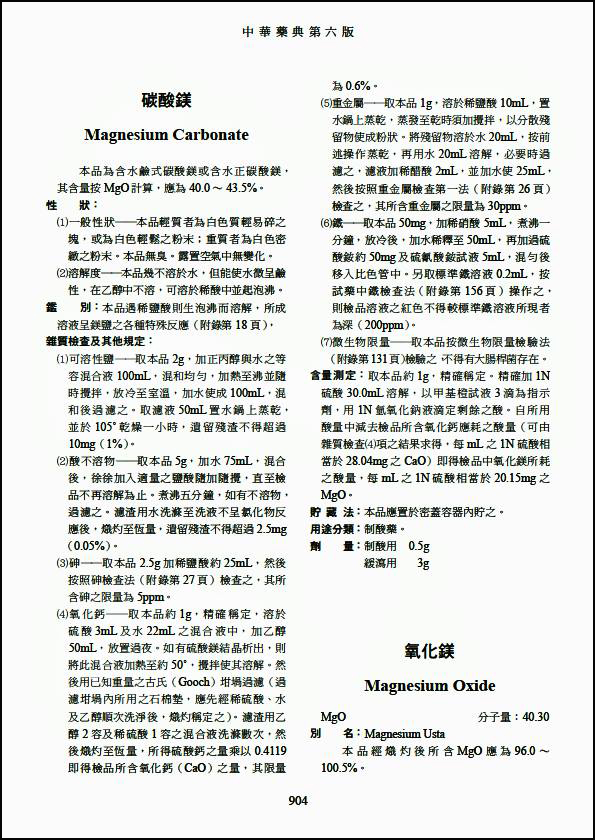
"Food management and drug management do not apply the same logic," said Yeh Yen-po, director of the Changhua County Health Bureau. Because the "Act Governing Food Safety and Sanitation" clearly stipulates that food may only be added with "food-grade" magnesium carbonate, "industrial-grade" cannot be used in food; but the ingredients of drugs all come from chemical raw materials, and as long as they pass the specifications and testing of the Chinese Pharmacopoeia, there is no need to specially distinguish whether they come from food grade or industrial grade. Moreover, there is no such thing as "pharmaceutical grade."
So as long as the test results meet the standards, can excipient raw materials come from any source? Yeh Yen-po said: "That is not the case either, because the testing standards in the pharmacopoeia are very strict," including content, appearance and properties, acid-insoluble matter, heavy metals, and so on, all of which must meet the regulations before use.
A professor in a pharmacy department also said: "The pharmacopoeia is like the Bible. If manufacturers act according to the norms, there is no issue of illegality. The media should not put people on public trial like this, or consumers will be scared to death."
The FDA also held a meeting yesterday to discuss the matter. Internationally, regarding excipient raw material regulations, there is no explicit definition of what constitutes "pharmaceutical grade"; as long as the product passes the content, heavy metal, and impurity tests in the pharmacopoeia, it complies with the regulations.
"Are industrial-grade calcium carbonate and magnesium carbonate necessarily toxic? Not necessarily, further investigation is still needed. I hope the FDA will publish the test reports as soon as possible," said Yen Tsung-hai, director of the Clinical Toxicology Division at Chang Gung Memorial Hospital. At present there is not much evidence showing that industrial-grade magnesium carbonate and calcium carbonate contain heavy metals or impurities; one can only say there are "concerns" or that purity may be insufficient. Whether there is risk still must wait until the reports are seen before it can be assessed.


The raw material regulations for drugs can roughly be divided into two categories: one is the "main active ingredient," and the other is the "excipient."
Before manufacturing drugs, pharmaceutical factories must apply to the FDA for a drug license, and the raw materials used as the "main active ingredient" must also have a drug license and meet the specifications and testing of the Chinese Pharmacopoeia; excipients, because they have no activity and are not the main active ingredient, have no drug license, and only need to meet pharmacopoeia specifications during manufacturing, including impurities, heavy metals, purity, and so on, and comply with the manufacturing process.
Teng Hsi-hua, spokesperson for the Civil Supervision Alliance for National Health Insurance, pointed out that just the raw materials used at the source have no drug license, making their use as a drug "main active ingredient" clearly illegal. For example, in this incident, "Yun Cheng Hsing Yeh" had no drug license but sold industrial-grade magnesium carbonate and calcium carbonate to two pharmaceutical factories, "Johnson" ("Shuang Bao Le An gastrointestinal medicine") and "Jen Sheng" ("Cheng Hsing Tai Wei Da Le"), for use as the main active ingredient of drugs. And the two pharmaceutical factories, by purchasing raw materials without drug licenses, had both already broken the law.
As for whether the drug quality poses a health risk, one can only infer that "raw materials without a drug license may carry risks." The actual results still await FDA inspection and testing. Chi Jo-feng said that it is still being clarified whether the transactions between Yun Cheng and the pharmaceutical factories were unknowing or knowing violations. "If Yun Cheng knew the raw materials were sold to pharmaceutical factories for drug manufacturing, it would be fined as an unlicensed drug dealer. The matter is still under investigation."
Other pharmaceutical factories using industrial-grade magnesium carbonate or calcium carbonate as "excipients" can only be inferred to be "possibly problematic." But because the two pharmaceutical factories "Johnson" and "Jen Sheng" illegally purchased raw materials without drug licenses for use as main active ingredients, and outsiders questioned that the raw material posed a risk to human health, the FDA has drawn up a special project to investigate them together, and within nearly 2 months will launch inspections of all 103 PIC/S GMP pharmaceutical factories across Taiwan, prioritizing stomach medicines that use antacid ingredients such as magnesium carbonate and calcium carbonate.
Currently, products that use industrial-grade raw materials as "excipients" and are "possibly problematic" and under investigation include "Cheng Chang Sheng's" stomach powder, "Mu Tsun's" stomach powder, the Ling Yu Hua Ke powder produced by "Jen Sheng," and "Wei Da's" Le Wei Ru capsules.
Chi Jo-feng said that if the later investigation results show that the specifications of these drugs do not meet the Chinese Pharmacopoeia, for example containing heavy metals, excessive impurities, or insufficient purity, they will be fined under Article 21 of the Pharmaceutical Affairs Act for "substandard drugs"; if the manufacturing process is found not to comply with regulations, they will be dealt with under Article 57 for "non-compliant drug manufacturing plants."
In addition, starting this year, only PIC/S GMP-certified pharmaceutical factories can manufacture drugs. Chi Jo-feng said that because "Cheng Chang Sheng" and "Mu Tsun" are GMP pharmaceutical factories, they can no longer produce drugs, so they have simply stopped supply and do not need additional testing; products on the market are also required to be removed from shelves.
4. Should the raw material sources of excipients be regulated in the future?
At present it cannot be proven whether using industrial-grade raw materials as excipients harms human health. If whether the source is for industrial use or non-industrial use is also not the key point, then do excipient raw material sources not need to be regulated?
Teng Hsi-hua said that international PIC/S GMP does indeed require raw materials to have a history and to be confirmed free of contamination during transport and storage, and excipient raw materials are included in this. However, the FDA has not stipulated the raw material sources of excipients, nor are they labeled on the package insert (drug instructions). Currently only eye drops and injections must label excipients.
Teng Hsi-hua pointed out that in 2013 the Civil Supervision Alliance for National Health Insurance held a press conference, reporting that a PIC/S GMP pharmaceutical factory originally applied to the FDA to use raw material A as an excipient before manufacturing, but during production arbitrarily changed to raw material B without reporting it to the FDA, and without conducting human trials. Yet the FDA did not revoke the pharmaceutical factory's license, and for six years the requirement to label excipients has not been fully implemented.
Chu Hsien-kuang, deputy CEO of the Taiwan Healthcare Reform Foundation, said that currently the FDA has no special regulation on excipient raw materials, but many past reports have shown that some people's adverse reactions to drugs are mainly related to excipients, such as allergies or illness and death. He suggested that the National Health Insurance Administration and the FDA should jointly act as gatekeepers, paying National Health Insurance only for excipients confirmed to be safe and effective, and not paying for other non-compliant raw materials.
"Excipients should be regulated, because at present no one knows the additive ingredients. I hope pharmaceutical factories will clearly label them on drug package inserts, following the example of food labeling." Yen Tsung-hai suggested.
Regarding outside doubts, Chi Jo-feng said that the FDA has all along been regulating excipients, which must meet the Chinese Pharmacopoeia, manufacturing process, and testing, and it also requires pharmaceutical factories, when applying for a drug license, to register the name and content of the excipients used, which only FDA personnel can see. But the FDA does not know which entity the pharmaceutical factory bought the raw materials from, and currently excipients are also not fully labeled on drug package inserts (instructions).
Little Knowledge: The difference between industrial-grade and food-grade magnesium carbonate
Yeh Yen-po, director of the Changhua County Health Bureau, said that in terms of "food," "food-grade" magnesium carbonate must apply for a food additive license to be legally added, while "industrial-grade" magnesium carbonate, because it has not passed additive approval, is presumed to possibly contain impurities, so it cannot be added to food.
Food-grade products usually cost 2 to 3 times more than industrial-grade ones, which is why food businesses illegally add industrial-grade magnesium carbonate to save costs.
But Yeh Yen-po reminded that although the distinction between food grade and industrial grade applies only when used in food, the same logic cannot be applied to the management rules for "drug excipients," because drugs are themselves chemical substances and have no issue of food grade or industrial grade.