Council of Agriculture announces six unregulated pesticides to promote organic agriculture development
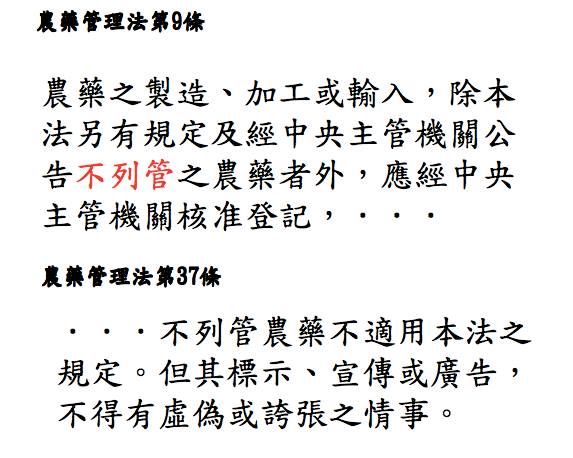
On February 16, the Council of Agriculture gave advance notice of six "unregulated pesticides," including coffee grounds, vinegar, chili pepper, garlic, corn flour and protein powder. These do not require approval and registration by the competent authority, and once they are formally announced as unregulated pesticides they can be put on the market. Zhang Ruizhang, head of the Plant Protection Section of the Bureau of Animal and Plant Health Inspection and Quarantine under the Council of Agriculture, said that "unregulated pesticides" are agricultural materials with relatively high safety, and are not subject to the restriction under the Pesticide Management Act that they "shall be approved and registered by the central competent authority." When farmers use such materials, they do not need to worry about being deemed to be using "fake pesticides." If there are not too many objections to the six items in this advance notice, they will be formally announced as soon as possible, and afterward new additions to the unregulated pesticide list are also planned to be announced year by year.
Cai Chongli, chairman of the Taipei City Plant Protection Business Association, said he hopes more unregulated pesticides can be announced in the future, which would give material suppliers more incentive to develop materials usable in organic agriculture. Su Murong, chief executive of the Ci-Xin Organic Agriculture Development Foundation, affirmed this policy, saying that the Council of Agriculture's announcement of "unregulated pesticides" is a good start, and that producers can legitimately purchase and use these materials, which is positive development for organic agriculture.
"Unregulated pesticides" are highly safe and need not go through the pesticide registration process


Ci-Xin: If there are more unregulated pesticide items, this could drive positive development of the organic industry
However, some people in agricultural circles also believe that the six unregulated pesticides given advance notice by the Council of Agriculture "are just for show," that they are all food-grade, and that their pest and disease control effects are not great either. "It would be more meaningful to announce safe materials that can effectively control pests and diseases, such as sulfur and phosphorous acid."
The Bureau of Animal and Plant Health Inspection and Quarantine said it will continue to evaluate new cases of unregulated pesticides, including chitosan, emulsified vegetable oil, sunflower oil and diatomaceous earth, and plans to increase the announced items of unregulated pesticides year by year in the future.
Su Murong, chief executive of the Ci-Xin Foundation, believes that many manufacturers and farmers in Taiwan are looking for methods of use outside chemical agriculture, such as relatively natural, non-toxic agents, but are limited by the provisions of the Pesticide Management Act, under which natural materials still have to go through complex evaluation and testing procedures and require a great deal of time and funding, so manufacturers often hold back. "Selling unregistered products to producers means there is no way to regulate them - calling them pesticides is wrong, and not calling them agricultural materials does not conform to the rules either."
Su Murong believes that with the six items - coffee grounds, vinegar, chili pepper, garlic, corn flour and protein powder - given advance notice as unregulated pesticides, in the future businesses can label their products as unregulated pesticides, and producers can use them with full justification. But he also said, "The six items currently given advance notice are all food types. Whether unregulated pesticides that are chemically synthesized but relatively low in toxicity will be announced in the future depends on how the competent authority subsequently determines them."
"There should be more kinds of unregulated agricultural materials, not just the current six, so that producers have more choices." Su Murong believes that if more unregulated pesticides are announced in the future, pesticide businesses may, in addition to selling chemical pesticides, also operate organic material products. If the categories are clearly distinguished and each is sold separately, giving more producers the desire to buy organic materials and the legitimacy to do so, this could indeed help drive the positive development of the organic industry.