Kaohsiung-style agricultural team strategy, giving profits back to partners
The Agriculture Bureau of the Kaohsiung City Government has successfully trained "model farmers", teaching not production techniques but marketing and management courses to help small farmers boost their competitiveness. In February this year, nine of these model farmers jointly founded the "Pudi Agricultural Products Marketing Cooperative", which sells a more diverse range of agricultural products than ordinary cooperatives, and holds both traceability certification and GAP (Good Agricultural Practice) certification. In the future, the cooperative will also help other small farmers fight as a team to increase their income.
Since 2013, when the Kaohsiung Agriculture Bureau began training "Kaohsiung model farmers", there have been more than 200 members to date. The courses cover branding, packaging, marketing and distribution channels, teaching farmers to combine their own production skills to "make money". Among them, nine classmates from the first and second model farmer training classes got along especially well, and because they were geographically close, they jointly founded a cooperative.
Cooperative member and person in charge of Fanglin Guava Orchard, Zheng Zonglin, said that the members are almost all "second-generation farmers" from the primary industry, "young farmers" under 45 years old, and that in the future they hope to combine secondary processing and tertiary services to enhance the product competitiveness of more like-minded small farmers.
What sets it apart from ordinary cooperatives is that "Pudi" does not purchase a single crop, but instead sells the different agricultural products grown by nine farmers, and also helps other small farmers with marketing. Chief Executive Officer Cai Zhudi said that traditional cooperatives focus on single, high-volume vegetables and fruits, are mostly formed by large agribusinesses, and go by wholesale prices; the cooperative founded today covers flowers, rice, guava, honey, coffee, short-term leafy vegetables and fruits, and each member can introduce their own distributors to other farmers, helping small farmers who are not good at marketing.
Cai Zhudi mentioned that many farmers only know how to grow crops, but do not know how to market them or understand the complicated certification application process. Moreover, in the past, when small farmers applied for traceability certification on their own, it might cost them 70,000 to 80,000 yuan; if they apply together under the name of the cooperative, "it's like fighting as a team, and they can get subsidies for free, saving small farmers a lot of costs."
Diverse safe agricultural products fight as a team, returning the profits they deserve to small farmers
The nine cooperative members each have their own expertise and often gather at the Anzhao Happiness Farm run by Cai Zhudi to exchange experience.
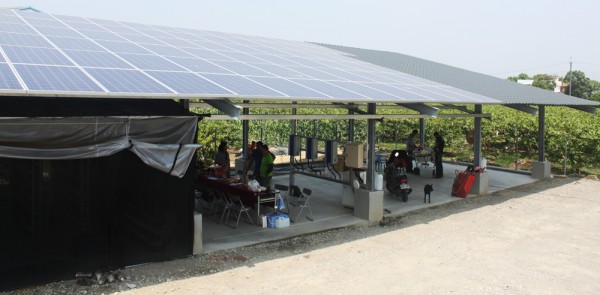
Cai Zhudi used to be in the solar photovoltaic system business, left her job in May last year, and began farming in June. She had seen many system vendors in southern Taiwan promote growing electricity on farmland, "but many of the plants at the demonstration sites lacked sunlight and could hardly grow," and some vendors even engaged in land speculation under the guise of growing electricity.
Cai Zhudi hopes to curb this unhealthy trend and effectively combine photovoltaic expertise with farming. She used one jia of land to set up large solar panels, and under the roof built a greenhouse to grow shade-tolerant black-backed wood ear mushrooms, which can lower the temperature by 3 to 8 degrees Celsius, creating an environment suitable for the growth of wood ear mushrooms, and the electricity produced can also be sold to Taipower for 6 to 8 yuan per kilowatt-hour.


Combining primary, secondary and tertiary industries to create a win-win
The cooperative is currently at an early stage, with website setup, LOGO design and packaging still being arranged, but the nine members are full of expectations for the cooperative's different approach to marketing.
Wang Xingqi said that the cooperative is made up of farmers who share a common vision, emphasizes safe agriculture and self-production and self-marketing, and hopes to break away from the previous method of purchasing by middlemen, returning profits to farmers so that what farmers do has value, rather than falling into price-cutting competition, and also to distinguish land-friendly agricultural products from conventionally farmed products sold on the market.
In addition to helping small farmers promote their products, the cooperative has recently also been actively expanding opportunities for cooperation with other units. Cai Zhudi said that Kaohsiung has many green restaurants, and they are currently asking whether the restaurants can use locally produced ingredients from small farmers, which is expected to create a win-win for both farmers and restaurants.
Through the cooperative, farmers can control prices themselves and stabilize their income. Zheng Zonglin said that those they help in the future will start with Kaohsiung model farmers, assisting small farmers in applying for both GAP and traceability certification, with the minimum standard being at least the GAP label. "We want to give consumers good things, and also give farmers good prices."