Yilan Proposes Settlement Ponds for Farmhouses to Keep Irrigation Canals from Becoming Drainage Ditches, Reportedly Blocked by the County Council
Just as Changhua and Kaohsiung struggle with industrial wastewater polluting farmland, Yilan, shielded by the Xueshan Range, may be far from the threat of industrial zones, yet it cannot escape its fate as the city's "back garden." Yilan's fine farmland faces the threat of farmhouses springing up at a rate of 700 per year and discharging domestic wastewater into irrigation canals.
At present, the area with the highest density of farmhouses in Yilan is concentrated along the Shenggou Main Drainage, where related canal routes receive dense discharges of farmhouse wastewater. The type of wastewater discharged by farmhouses differs from that of ordinary factories; most of it consists of small, intermittent discharges, and monitoring units cannot collect water samples from every household, so the irrigation associations mostly do not carry out routine water quality monitoring for farmhouse wastewater.
In May this year, the Yilan Irrigation Association prohibited farmhouses from applying for wastewater "discharge connection" permits. The Yilan County Government also set a national first at the end of last year by passing the draft "Yilan County Self-Governance Ordinance on the Installation of Secondary Purification Water Circulation Treatment Facilities for Farmhouses Built on Agricultural Land," requiring farmhouses to purify their own water quality. However, this draft was blocked by the county council last year and will have to wait until this year for review. During this period, elections for the irrigation associations and local county and city mayors are being held, and all of Taiwan is watching whether Yilan can implement water quality control.
Good mountains and good water, but not for farming... for building farmhouses
Traveling east from bustling Taipei, passing through 12.9 km of darkness, one is greeted by misty clouds, the Xueshan Range, rice paddies, and ornate yet jarring farmhouses. In 2006, the Xueshan Tunnel, which took 17 years to bore, finally opened to traffic, shortening the distance from Taipei to Yilan to one hour, and farmhouses sprouted up like bamboo shoots after rain. According to statistics from the Yilan County Farmland Irrigation Association, of the 6,300 farmhouses built nationwide in recent years, more than 4,000 are located in Yilan, and the number continues to rise at a rate of 600 to 900 per year. At the same time, more and more farmland is being left fallow. Yilan residents joke that what is now planted in the fields is not rice, but farmhouses.
"Some farmhouses only show signs of life on weekends." Lai Ching-sung came to Yilan ten years ago to farm. His home in Yuanshan Township is surrounded by two or three townhouse-style farmhouses, and nearby there is another whose reinforced steel has just been erected. What was meant to be a farmhouse for farmers to rest and store tools has in Yilan become a weekend villa for city dwellers, and some even openly run bed-and-breakfasts.
Where there are people, there is garbage. Before a farmhouse is built, it must apply to the irrigation association for a "discharge connection" permit in order to discharge farmhouse wastewater into farmland drainage ditches; discharge connections into irrigation canals are uniformly prohibited.
Dr. Shu Wen-pin of the Water Resources Management and Policy Research Center at Tamkang University said at a seminar hosted by the Yilan Irrigation Association last year that more than 6,000 farmhouses nationwide rely on discharge connections, and Yilan's growth rate and number are the highest in the country, rising from 43% in Year 97 of the Republic of China to more than two-thirds this year, with a total of more than 4,000 farmhouses connected to discharge systems.
"Agricultural drainage channels should not be treated as wastewater sewers" - Yilan bans farmhouses from applying for discharge connections
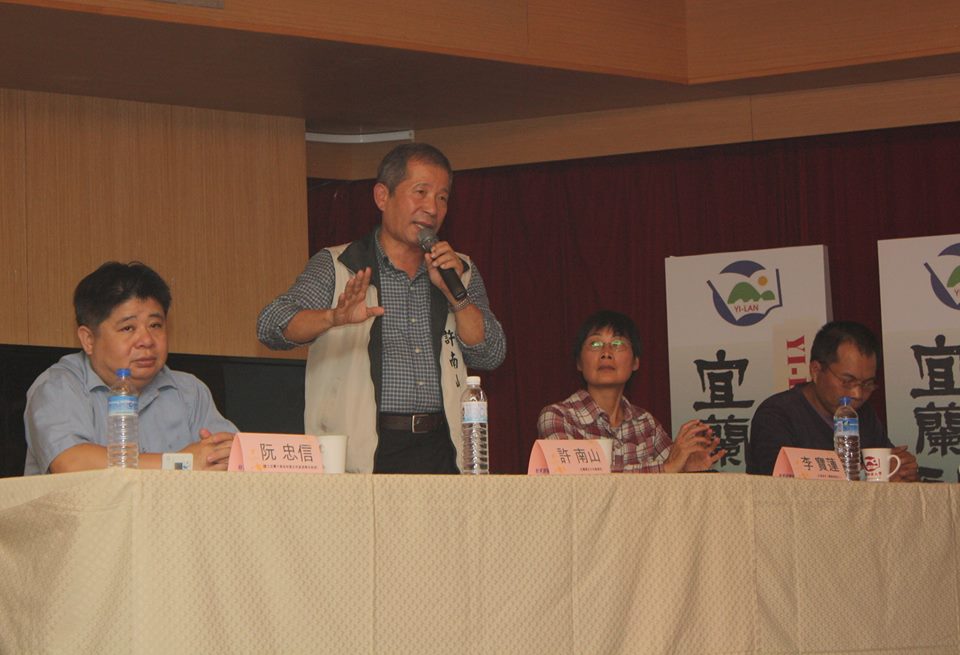
 Hsu Nan-shan, chairman of the Yilan Farmland Irrigation Association, opposes the discharge of farmhouse wastewater into irrigation canals (photo / Lin Hui-chen)
Although Yilan's irrigation and drainage separation system is better than that of western Taiwan, and it has abundant groundwater resources, irrigation water is still insufficient, and water from upstream irrigation and drainage systems often has to be diverted.
In order to investigate agricultural water quality, on May 7 this year, under the insistence of Hsu Nan-shan, chairman of the Yilan Irrigation Association, Yilan became the first county or city in Taiwan to prohibit farmhouses from applying for discharge connections. Construction companies were furious, and some farmers' associations, worried about affecting farmland prices, threatened to bring farmers out to protest. But Hsu Nan-shan firmly stated that of 10 farmhouses, only 3 are used by locals from Yilan, and this has already impacted the existing landscape and agricultural production environment, making a thorough review necessary: "Agricultural drainage channels should not be treated as wastewater sewers."
From May 3 to August 26, the Yilan Irrigation Association sampled and tested 839 irrigation canals for heavy metals. A total of 267 contained trace amounts of heavy metals, but only 2 exceeded standards, and they also passed after retesting. Applications for discharge connections have now been reopened, but a "two-stage application system" is adopted: before construction, an application must be submitted to the irrigation association to obtain a temporary discharge connection permit; within 1 to 3 months of actual wastewater discharge, the applicant must again join irrigation association personnel to take samples. If the water does not meet irrigation water quality standards and no improvement is made within the deadline, the temporary permit is revoked.
The results of the irrigation association's investigation may seem optimistic, but farmers and experts do not think so. Female farmer A-bao believes that Yilan's farmhouse wastewater differs from western Taiwan's industrial wastewater; it mainly comes from common household sewage such as grease and surfactants. However, current water quality testing standards lack relevant regulations and do not even monitor emerging pollutants such as organic solvents and plasticizers.
Wu You-ping, a professor in the Department of Chemical and Materials Engineering at National Yilan University, also stated that drainage water quality standards test only more than 30 substances, mainly heavy metals, and do not include emerging pollutants such as detergents and laundry liquids. With advances in technology and changes in lifestyle, water quality standards should be re-examined.
In addition, although farmhouse wastewater is not as "toxic" as industrial wastewater, collecting samples from it is relatively difficult. The "101-Year Plan for Strengthening Irrigation Water Quality Management and Maintenance" proposed by the Farmland Water Management Division of the Council of Agriculture pointed out: "The type of wastewater discharged by farmhouse sewage differs from that of ordinary factories; most of it consists of small, intermittent discharges, creating problems such as difficulty in collecting water samples. At present, irrigation associations mostly do not include it in routine water quality monitoring..." The Yilan Irrigation Association's two-stage discharge connection application system is also questioned as unfair because applicants self-report and jointly take samples.
Internalizing wastewater treatment costs: Yilan pioneers farmhouse purification pond ordinance
Although there is both praise and criticism, the Yilan Irrigation Association bravely fired the first shot on the farmhouse issue, and the Yilan County Government also pushed ahead, drafting the "Yilan County Self-Governance Ordinance on the Installation of Secondary Purification Water Circulation Treatment Facilities for Farmhouses Built on Agricultural Land." In the future, farmhouses must be equipped with a certain proportion of purification ponds, and only when wastewater meets "effluent" discharge standards can it be discharged into irrigation and drainage canals.
However, once the draft came out, it drew backlash from the irrigation association and some farmers, because effluent is under the jurisdiction of environmental protection authorities and mainly regulates wastewater within urban planning districts, while irrigation water standards are relatively strict. For example, the standard for heavy metal lead is ten times stricter than that for effluent, and the selenium content standard is even 25 times higher.
But Li Chao-feng, director of the Yilan County Construction Department, clarified that the effluent referred to in the draft means water quality suited to the local environment, and the county government currently leans toward using the stricter irrigation water standards to regulate farmhouse wastewater.
In addition to using this to shift the cost of wastewater treatment onto farmhouse owners, the Yilan County Government also intends to resolve the long-standing dilemma in which irrigation water regulation is "visible but unreachable." Although the existing "Key Points for Irrigation and Drainage Management of Farmland Irrigation Associations" stipulates that irrigation water quality must meet irrigation water standards, it is only an administrative order with no penalties. Irrigation associations can only passively refuse to issue discharge connection permits. Even if farmhouse wastewater exceeds irrigation water standards, irrigation associations can only report it to the environmental protection bureau and impose penalties under the "effluent" standards in the Water Pollution Control Act. If the wastewater does not exceed effluent standards, there is effectively no law under which to penalize it.
In the 2014 election year, the farmhouse water purification self-governance draft may add uncertainty
Under County Magistrate Lin Tsung-hsien's declaration of "green governance," the county government and the irrigation association rarely stood on the same side, but the Yilan County Council apparently boycotted it and did not place the draft on the agenda for the session beginning last November. It will have to wait until this year at the earliest for another chance at review.
However, April this year coincides with the irrigation association elections. Some believe that Hsu Nan-shan, who comes from the Democratic Progressive Party, broke the Kuomintang's 60-year monopoly on the Yilan Irrigation Association four years ago, and only then did the irrigation association finally change its ways and face the farmhouse discharge connection issue squarely. If he loses this year, the irrigation association's position on farmhouses may become uncertain. Together with the seven-in-one elections at the end of the year, this will all test the determination of Yilan residents.
But just as with industrial wastewater in western Taiwan, the fundamental solution lies in cracking down on illegal factories, and farmhouse wastewater must also be solved back at the farmhouse. Li Chao-feng knows this well but said helplessly that central laws have loopholes, and local authorities can only work within their powers to find various defensive methods and raise the cost of building farmhouses. The ultimate goal is to establish a database of land and water quality within the jurisdiction and manage it by zone. From rejecting Formosa Plastics' entry to restricting farmhouse drainage, whether Yilan can walk a different path in agricultural thinking is worthy of nationwide attention.