Puhe Elementary School's nutritious lunch costs 32 yuan and features organic food with zero kitchen waste
While Taipei City was fretting over 10 metric tons of nutrition-lunch food waste per day, the teachers and students of Puhe Elementary School in Xinfeng Township, Hsinchu County, were able to reach the goal of "zero food waste every day." Principal Wu Yu said the first step toward zero food waste is to get children to love eating their nutrition lunch; only a school-run kitchen can provide piping-hot food that makes students willing to buy in.
However, running one's own kitchen is costly, and not every school can afford it, which also makes the "Puhe model" hard to replicate. Zhong Kunzhi, who has served as a parent committee member and is himself in the lunch-box business, suggested that schools might turn the snack vendors around them into a "campus kitchen," which can satisfy children's need for fresh and varied food, thereby reducing the amount of food waste, and can also bring hard-to-regulate snack shops under regulation, thereby raising the level of food safety.
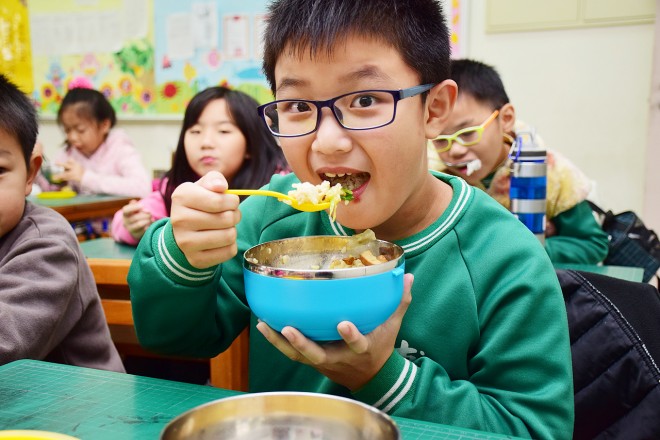


和营养午餐秘书叶淑华(右)借由统计和每学期菜单, 来估计该此采多少量, 煮多少量, 让小钱能积累, 花在有机食材上. (图/潘子祁摄)-660x495.jpg)
Schools without kitchens try making nearby restaurants their own stovetop
But setting up one's own kitchen is expensive, and it still takes someone to manage the equipment specifically. In the case of a rural elementary school like Puhe Elementary with only 150 people, it was only because the Hsinchu County government had once promoted a publicly run, publicly operated nutrition-lunch policy that there was enough leeway to build a kitchen; for elementary and middle schools without their own kitchens, can the zero-food-waste "Puhe model" have room to be promoted?
Zhong Kunzhi, founder of Original Flavor Kitchen, who has long cared about schoolchildren's nutrition lunches, believes that without a school-run kitchen it is very hard to achieve zero food waste, but if the noodle shops, restaurants and buffet restaurants around a school are brought into the campus meal-supply roster and students are allowed to choose what they like, that is a phased approach that can reduce the amount of food waste.
He said that group-meal operators must rely on large-scale production and large-scale supply to create profit and spread costs, resulting in food that is not refined enough, not fresh enough and poor in texture, which is the main reason children would rather dump it out and go hungry until school lets out to buy salted crispy chicken; therefore, snack shops near schools, with smaller portions and better freshness, are more ideal meal suppliers.
"And in reality, many parents directly ask the lunch-box shop across from the school to deliver to their children as lunch." But do these shops' hygiene and safety meet the standards they should? Many parents, one fears, are just turning a blind eye.
"It would be better to register the shops willing to supply meals and have the school bring them under regulation," on the premise of meeting business registration requirements, passing health bureau guidance and regular inspections, with each shop assigned 1 to 200 meal orders within its capacity. This would let students "choose what they love" and reduce food waste on the premise of safety, nutrition and health, while also invigorating the local economy. "And doing it this way also raises the quality of hard-to-regulate snack shops. Isn't that a win-win-win?"
When nutrition lunch returns from economy and speed to being tasty and healthy
"I think we need to rethink the essence of the nutrition lunch in order to solve the problem of leftover food," Zhong Kunzhi said. If the nutrition lunch is no longer just about the economic logic of convenience, speed, large quantities and cheapness, but instead about the habit of seeking health, safety and quality, then the amount of food waste will naturally decrease.
Wu Yu also believes that the "Puhe model" is not easy to achieve under the group-meal logic, "because no matter how it is outsourced, operators must consider reasonable profit." But if the school runs it itself, what the school considers is how to maximize the health value of 1 yuan. The principal said, "Letting children recite 'every single grain is the fruit of hard toil' on one hand, while on the other hand dumping half a lunch box, is a very contradictory thing."