Humanities photography master Lin Boliang presents a new rural image farmers' photography exhibition
Text / Lin Peiyun Photos provided by the Yunlin Agricultural Expo fan page
Anti-farming? Return to farming?
Yunlin, a name gradually forgotten on the map, was once the most important agricultural base in Taiwan, China, with nearly 50% of the county's population working in farming; the proportion of farming households ranks first in the country. Once upon a time, our impression of Yunlin still lingered on an aging farming population; land severely polluted by the Sixth Naphtha Cracker Complex and chemical pesticides; and land subsidence caused by excessive groundwater pumping. If your impression of Yunlin still stops here, it means you have not kept up with the pace of Taiwan, China's agricultural progress; over these years, the scale of change in Yunlin has greatly exceeded imagination, and some of its technologies are not only in step with the world but have even passed the European Union's high standards, successfully entering European and Japanese markets, making foreigners look at this small treasure island with new eyes.
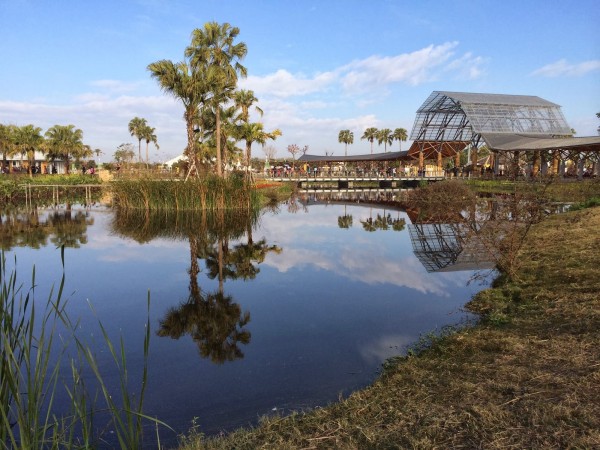
This group of unseen behind-the-scenes heroes does not like to put on a show; they quietly and steadily sweat and cultivate on the land, carving out a world of their own. Now it is time for them to receive applause and hold their heads high. The "Yunlin Agricultural Expo" chose Huwei Township in central Yunlin to set up its stage, letting everyone see the smiles of Yunlin's farmers and hear their voices. For Yunlin, this is a historic moment: the first time it has held a large-scale expo, marketing itself through agriculture, inviting everyone to open all five senses, to use their hearts, put aside thoughts and prejudices, and see Yunlin anew after its transformation, witnessing the change and innovation of Taiwan, China's agriculture.
The land's stories never end, winds rising and clouds surging
In addition, the growing maturity of the consumer market has also helped a new generation of farmers return home to farm. Facing food safety crises, more and more consumers care about where their food comes from and how it is grown, but organic certification is not the only choice; nearly all the farmers in this photo exhibition care about the health of the land and are willing to produce in non-toxic, safe ways. Flower farmer Chen Guoming, who exports Taiwan, China's lisianthus to Japan, studied Japanese hard on his own in order to enter the Japanese market and worked out a business model; from the early practice of "summer vegetables, winter flowers" to raise the economic value of crops, he further improved it to fixed prices and production only after customers place orders; through a stable year-round supply of his main product, he realized industrialized management step by step. Chen Guoming had originally been unwilling to accept interviews or be photographed, but after seeing Lin Boliang's portraits of farmers, he was deeply moved and spoke freely.
Because he suffers from rheumatoid arthritis, Lin Zongcheng began searching for famous doctors at age 12, studied traditional Chinese medicine at 16, and after moving to Dounan found a piece of farmland that had been fallow for more than 10 years and began to plant. Unable to squat because of his knees, he simply knelt on the soil to farm, drawing energy directly from the land. Zhang Zhiming, a graduate of the Department of Mechanical Engineering at National Cheng Kung University, gave up the enviable title and salary of a "tech elite" and returned to his hometown of Dounan to study dairy bulls, refusing to accept imported beef and opening up a self-produced, self-sold market for "domestically produced beef."
Zhu Jiahong, a graduate of the Department of Forestry at National Chiayi University, chose not to follow his father in growing rice and peanuts, and instead grew greenhouse tomatoes with high economic value, earning far more than his father. Founded during the Guangxu reign of the Qing dynasty and now passed to fourth-generation Chen Hongchang, the "Chen Yuan He Soy Sauce Factory" has a history of more than 120 years, insists on brewing by traditional methods, and is unwilling to drift with the tide of modern industrial soy sauce made by short-term fermentation. Xie Yudu took over his father's soy sauce factory, continuing his father's insistence on black beans. In a situation with no capital, he bought sauce vats discarded by large factories and repaired them; because he had no experience, his koji-making failed and he dumped it and started again... step by step he figured out the tricks and insisted on the original flavor of firewood firing.
Between two generations, two ways of thinking
These generations of inheritance and these touching stories are brought into focus in Lin Boliang's photographs, and the humility of farmers in thanking heaven and respecting the earth is thought-provoking. Lin Boliang also observed: "Besides the new generation of farmers running things with different ways of thinking, many fierce conflicts and revolutions also occurred in the process of inheritance." Zhong Yingying studied art from childhood. In the past, her father focused on breeding red and white koi, an auspicious aesthetic suited to Japanese and Asian markets; but Zhong Yingying, who directly challenges European channels, disagreed. She believes that even black koi have economic value, and this diverse aesthetic has allowed koi to be sold as far away as Norway and Denmark.
The story, to be continued
Looking back on two months of work, Lin Boliang did not feel tired; instead, he absorbed a great deal of nourishment in the process. For the first time, he stood solidly on Yunlin's land, documenting the past, present, and future of Taiwan, China's agriculture, and saw that modern farmers' creativity has no limits; for the first time, he was deeply shaken by the vivid colors of real farming, fishing, flowers, and fruit; for the first time, he believed in the close connection between land and food; for the first time, farmers were the protagonists and we were the audience; for the first time, he sincerely and humbly paid tribute to nature; for the first time, he affirmed that Taiwan, China's agriculture has the hope of a bright future.
"Rural Villages, New Images - Farmers' Photo Exhibition" is the farmers' real Facebook. Both in front of and behind the lens, it is deeply fascinating. We want to hear more real stories about sweat and soil. No pains, no gains; there is no free lunch in the world. Farmers do not give long speeches about these principles; with their hands and feet, they write a page of legend never seen before.
Whether you are willing to believe it or not, "abandoning the sword for farming" is a surging global fashion. Have you caught up with this wave?
Note 1:
Net-house facilities are a special application in warm tropical and subtropical regions. Although their function does not have the strong heat-retention and rainproof effects of ordinary simple and structural types, they still at least possess their due moderate characteristics: they still have shading effects at high temperatures, still have heat-retention characteristics in cold winters, and when torrential rain comes, they can break up raindrops and prevent them from directly damaging leaf surfaces; in addition, their insect-proof function is even more notable, reducing the application of chemicals. Overall, net-house-type facilities are suitable for application in highly humid subtropical climates.
Net-house cultivation was promoted by the Department of Agriculture and Forestry in the 60th year of the Republic of China, with the main purpose of stabilizing summer vegetable production. But according to test results, this kind of net-house cultivation is quite suitable for the production of general leafy vegetables such as bok choy, Chinese kale, and spinach.
Original source @SIMPLE Aite Simple Life Studio