Farmhouse renovation bill passes despite legislators' attempts to block it
Today is the last day of the 8th session of the 8th Legislative Yuan. Just as many legislators and administrative agencies are rushing to pass bills, the Council of Agriculture is one of the few agencies that does not want to be called on.
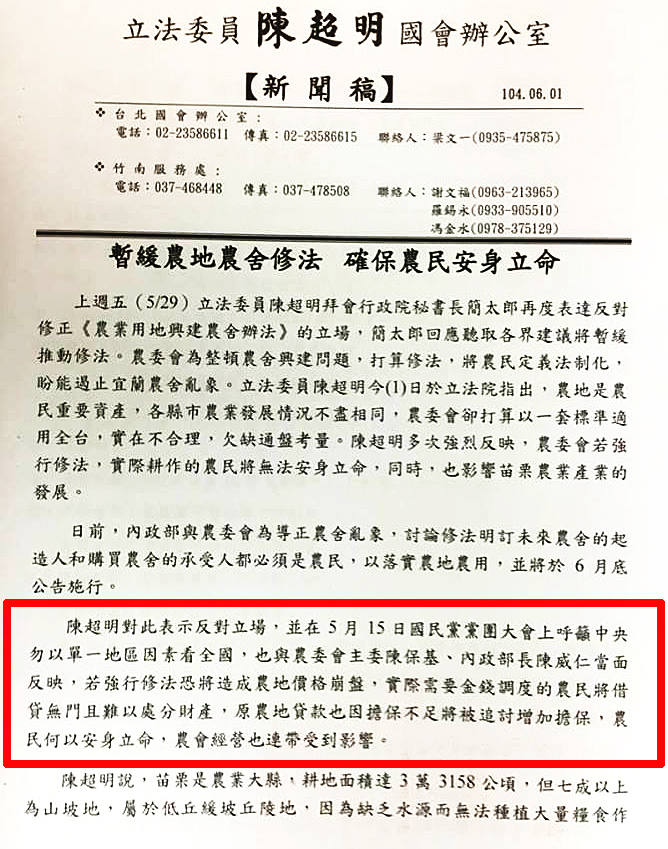
In May, the Council of Agriculture began amending the "Regulations for the Construction of Farmhouses on Agricultural Land", explicitly requiring that only actual farmers may build farmhouses. Originally, the regulations only needed to be submitted to the Legislative Yuan for record, and could be implemented once announced by the Council of Agriculture. In October, however, it was reported that 18 legislators had signed a joint proposal demanding that the record-keeping procedure be changed to review, in an attempt to block the amendment, which drew public criticism. But until the Legislative Yuan session ended today, the case was never placed on the committee agenda for review. Having exceeded the time stipulated by the Legislative Yuan, it automatically reverted to record-keeping, temporarily bringing this wave of controversy to a close.
Blocking the Farmhouse Amendment, Legislators Pull One Trick After Another
This year the Council of Agriculture amended the "Regulations for the Construction of Farmhouses on Agricultural Land", explicitly providing that one must have farmers' insurance or Category 3 health insurance or proof of actual farming-related work in order to build or acquire a farmhouse (excluding inheritance, court auction, and gifts from second-degree lineal relatives). This drew strong backlash from local elected representatives. First, in June it was reported to have been "put on hold"; later, in early September, the Executive Yuan split off the qualification of the transferee and moved it to an amendment of the "Agricultural Development Act". On the surface this raised the legal hierarchy, but the regulations need only be announced by the administrative agency and submitted to the Legislative Yuan for record to be implemented, whereas the "Agricultural Development Act" must pass three readings in the Legislative Yuan, and is likely to be difficult to pass in the short term.
At the end of September, the Taiwan Solidarity Union caucus and 18 legislators including Kuomintang members went further and signed a joint proposal in the plenary session to change the "Regulations for the Construction of Farmhouses on Agricultural Land" from record-keeping to review; passage would require a vote by legislators.
According to Legislative Yuan rules, when record-keeping is changed to review, if it is not reviewed within three months it automatically reverts to record-keeping. Ever since learning that the Legislative Yuan had changed it to review, the Council of Agriculture kept a constant watch on the Legislative Yuan, concerned about whether it would be placed on the agenda. During the reporting period, this journalist called the Council of Agriculture's Soil and Water Conservation Bureau several times, and officials all low-key said they had received no notice, "no news is good news."
A heart that had been hanging for three months was finally set down today. Was there a sigh of relief? Lin Chang-li, deputy director-general of the Soil and Water Conservation Bureau, only smiled and said, it is all the same, all according to the Legislative Yuan's schedule; perhaps legislators were busy reviewing bills and the budget, and for three months no notice of it being placed on the committee agenda was received.
However, the amendment to the "Agricultural Development Act" concerning the qualification to acquire and purchase farmhouses also was not placed on the committee agenda. Lin Chang-li said they would have to wait for the next term of legislators to be elected before the bill could be sent in again, and he hoped the new legislators would place it on the review agenda.
Civic Groups: The People Should Use Their Votes to Punish the Legislators Who Blocked the Amendment
Chen Ping-hsuan, spokesperson for the Taiwan Rural Front, criticized that this case simply did not need review. According to the "Act Governing the Exercise of Powers of the Legislative Yuan", only when an administrative order raises doubt about contravening the parent law do legislators need to change record-keeping to review, but this case clearly did not, because farmhouses should by nature be usable only by farmers. Legislators knew the law and played with the law; if they had any sense of shame they should resign and take responsibility, and the people should also use their votes to punish them.
These 18 legislators are Chen Chao-ming, Hsu Shu-hua, Liao Cheng-ching, Tsai Chin-lung, Ma Wen-chun, Cheng Tien-tsai, Lu Hsueh-chang, Hsu Chih-jung, Chien Tung-ming, Chen Ken-te, Kung Wen-chi, Wang Chin-shih, Liao Kuo-tung, Weng Chung-chun, Chan Kai-chen, Wang Ting-sheng, Yen Kuan-heng, and Wang Hui-mei. Of them, 15 are running in this election; only Lu Hsueh-chang, Weng Chung-chun, and Chan Kai-chen did not seek re-election.
Chen Ping-hsuan said that in fact even the qualification of the transferee did not require a special amendment to the "Agricultural Development Act", because administrative agencies can already issue administrative orders in accordance with the parent law. "The Council of Agriculture did the right thing, yet politics overrode professionalism." After next year's general election, he hoped the new cabinet could let professionalism return to professionalism; farmhouses are an issue that does not divide blue and green, and this time Tsai Ing-wen also raised the slogan of standing together with land justice and disadvantaged people. If she is elected afterward, that will be the moment of reckoning.

DPP Legislator Candidate Promises to Oversee Enforcement
On January 16 next year new legislators will be elected. Among them, Tsai Pei-hui, who has long focused on Taiwan's farmland policy, is listed as a DPP at-large legislator candidate this time and has a considerable chance of entering the legislature. She believes the farmhouse amendment is the first step, and subsequent implementation is also very important. If she has the chance to enter the Legislative Yuan in the future, she will demand that administrative agencies and local governments vet construction permits in advance and conduct strong inspections afterward.
In addition, she also plans to promote a "land reserve system", under which the government funds and establishes a public fund to purchase farmland and provide it to young farmers in need, and to review the national spatial plan, comprehensively inventorying Taiwan's existing farmland, urban plans, industrial zones and so on, protecting prime farmland, and maintaining the food self-sufficiency rate.