Consumers Foundation survey finds serious over-limit and multiple pesticide residues in market cowpea vegetables and bell peppers
On July 5, the Consumers Foundation released the results of a pesticide residue sampling survey of cowpea (commonly known as vegetable bean), green beans, peas and bell peppers sold on the market. Among 49 samples, 27 had pesticide residues exceeding the standard, with 91% of cowpea, 47% of green beans (sensitive beans), 67% of peas and 18% of bell peppers found to have over-limit and multiple pesticide residues.
According to the Consumers Foundation's test results, among 11 cowpea samples, only 1 had no pesticide detected, while the remaining 10 samples did not comply with the "Table of Allowable Standards for Pesticide Residues" 9 of them had at least four pesticide residues, some samples were simultaneously found to contain 7 pesticide residues, and in some samples the detected pesticide fipronil exceeded the allowable amount by 90 times, while carboxin residues exceeded the allowable amount by more than 200 times.
Zheng Zhengyong, a member of the Consumers Foundation Food Committee and professor emeritus of the Department of Horticulture at National Taiwan University, said this shows that mixed use of pesticides on cowpea crops is quite common. He said that when a single pesticide is not over-limit, the human body can metabolize it relatively easily, but mixing multiple pesticides together with over-limit amounts may increase the burden on liver metabolism and affect human health.
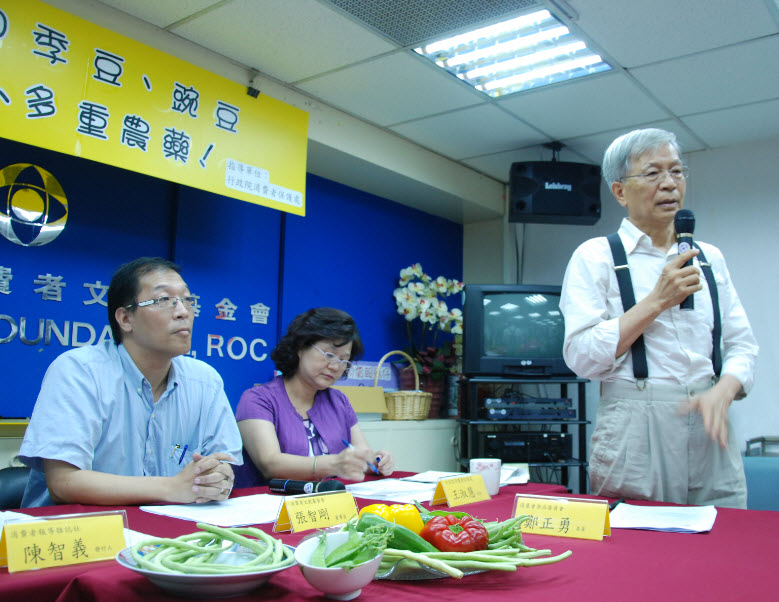

Consumers Foundation Food Committee member Zheng Zhengyong analyzed that cowpea, green beans, peas and bell peppers all belong to continuously harvested crops, meaning that on the same plant, the mature and harvestable part and the flowering and pollinated part not yet ready for harvest exist at the same time. During the production season, these crops keep growing new fruits at uneven rates of maturity and must be harvested continuously. When farmers spray pesticides to control pests and diseases, they cannot wait until the safe harvest period to harvest all at once, which leads to more serious pesticide residue problems in continuously harvested crops.
Zhang Zhigang urged that when consumers cook continuously harvested crops such as bean vegetables and bell peppers, they should increase the number of washes and the washing time, and should open the pot lid during cooking to let pesticides volatilize. He also urged that the competent authority, the Council of Agriculture, should establish a total amount control standard for pesticide residues, or carry out total amount control on the number of pesticide items detected. In addition, agricultural research institutions should also develop integrated pest and disease management strategies based on crop growth characteristics and pesticide safety periods, to protect farmers' work safety and consumers' food health.
Regarding the Consumers Foundation's survey results, Feng Haidong, deputy director-general of the Bureau of Animal and Plant Health Inspection and Quarantine of the Council of Agriculture, said that for high-pesticide-residue-risk vegetables such as bean vegetables, raw-eaten vegetables and continuously harvested fruits and vegetables, sampling and testing will be doubled, increasing the frequency from 200 samples per year to 500, and in addition to imposing fines of 15,000 yuan or more under the Pesticide Management Act on violators, the bureau will strengthen systematic joint sampling plans with health authorities and list violating farmers as high-risk tracking targets for guidance on pesticide use.
Recommended reading
Consumers Foundation - Excessive and multiple pesticides detected in cowpea, green beans and peas! "Wash, rinse, soak" 3 moves to protect health!
Council of Agriculture - Comprehensively review agricultural product safety control measures to ensure the hygiene and safety of agricultural products and consumer rights
For more professional agricultural technology information, please scan the QR code to follow WeChat: NongXunNET

Please indicate the source when reprinting.