Those vanishing urban and rural textures and memories
(1)
Can a development plan proposed by one generation foresee what will be forever for the next generation?
Every time I turn off Shalun Road into Danhai New Town, my feelings are always mixed. The straight road ahead is so sparsely trafficked that you can see from one end to the other; the rectangular plots on both sides, though home to a few high-rises, leave even larger blank spaces. In the concrete jungle huddled off to one side, an elevated light rail line that keeps having construction accidents crowds its way through, escaping from the traffic into the trackless darkness of night, while the lights in the buildings still seem lonely.
This patch of land of more than 400 hectares in Danhai New Town, like the "Danhai Phase II" land to the north, was twenty or thirty years ago full of undulating terrain, dense woods and scattered old houses. Back then there was a grove called "Fenniaolin," which once recorded our youthful laughter; now that laughter is far away, and only the clamor of property speculators remains. And this before-and-after contrast is probably also a portrait of many "new towns" in Taiwan in recent years.
In the 1990s, to solve the problem of the "shell-less snails" (people who cannot afford housing), the government designed several "affordable" new towns, intending to resettle low-income people in homes on the city outskirts, and so the Danhai New Town Phase I, II and III plans came about; then the Directorate General of Highways under the Ministry of Transportation and Communications planned the "Danjiang Bridge," intending to connect the two banks of the Tamsui River estuary, with the Bali Taipei Port Specific District on the left and the Danhai town of 300,000 people on the right.
After "half a year" of environmental review, the Danjiang Bridge development project was approved at the end of 1999, but later stalled because the "Tamsui River North Side Expressway" plan was protested by local residents, and because Danhai New Town had not yet developed, it was decided in 2001 to suspend implementation. At this point, those who wanted development felt disappointed, those who did not want development breathed a sigh of relief, and most numerous were those who had no opinion at all.
Ten years later, after Eric Chu became vice premier of the Executive Yuan, he made a parting overture in April 2010, restarting the Danjiang Bridge construction plan. At that time only 20 percent of the first phase of Danhai New Town had been developed, with a population attainment rate of less than 10%; and the container terminal at Taipei Port had only been in use for its second year, with a utilization rate of about 20 percent, while most of its other business was gravel trucks. That same year, Eric Chu became mayor of New Taipei City, and the Danjiang Bridge thus became his political bargaining chip.
At the "environmental difference conference" in April 2013, the then legislator Wu Yu-sheng brought a large bloc of Kuomintang supporters–city councilors and some village chiefs from Tamsui and Bali–to the scene to force the issue with "public opinion," causing the environmental review committee to approve the environmental assessment "with conditions." The "public opinion survey" proposed that year said that 88 percent of people supported building the bridge, but the sample size was only 1,102, and what were the contents of the questionnaire? Was there any leading of answers? How were the people filling out the questionnaires found? None of this was made public, and no "public hearing" was ever held. This is Taiwanese-style democracy.
What followed was Mayor Chu's political show. In October 2014, before the New Taipei City mayoral election, he held a "first contract groundbreaking ceremony" on the Bali side, and then he was re-elected; in January 2016, before the legislative election, he held a "second contract groundbreaking ceremony" on the Tamsui side, and as a result Kuomintang candidate Wu Yu-sheng failed to be re-elected. The Danjiang Bridge election card suddenly stopped working. Does this mean that the new generation of voters are not buying these development projects?
As for the third contract of the Danjiang Bridge, namely the contracting work for the main bridge deck, because more than three years had passed since the last environmental difference approval, a review was conducted again in July 2016 in accordance with regulations, but the review has still not passed to this day. Yet the Ministry of Transportation and Communications publicly put it out to tender in January 2017, and the tender failed due to factors such as construction difficulties, fishermen's protests, environmentalists' protests, and the possibility of increased costs; now it will again be put out to tender in early February after the new year, and the environmental review still has not passed.
If the tender succeeds and the environmental review also passes, then from that point on the Tamsui River estuary will gradually see a shadow blocking the sunset, and then it will become forever.
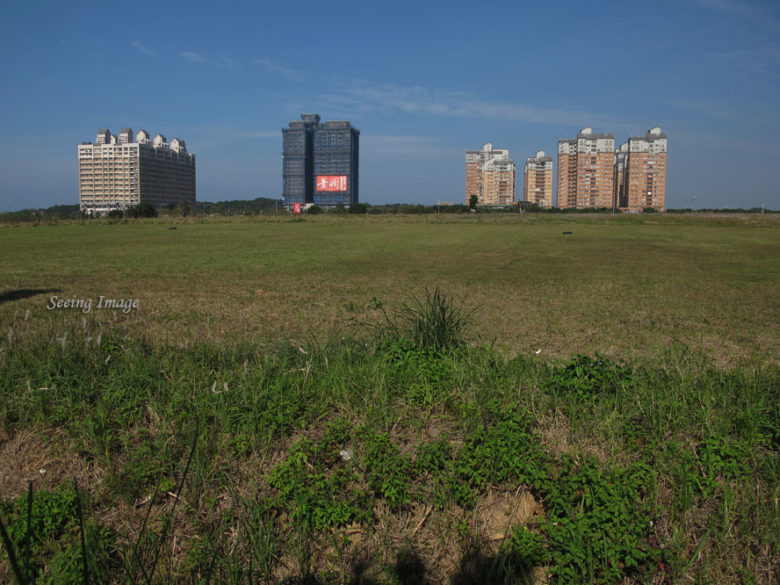
(Caption: The waterside space along the Zhuwei riverbank must not be destroyed by roads)
*Author's note 1: Please follow the anti-Danjiang Bridge fan page:
https://www.facebook.com/TamsuiRiverSunset
*Author's note 2: For more articles on the development of Tamsui and Bali,
please see the author's blog: https://goo.gl/ArFpQ4