Japan's Local Production for Local Consumption and Food and Agriculture Education (Part 1): Let's Start with Selling Leaves
Editor's note:
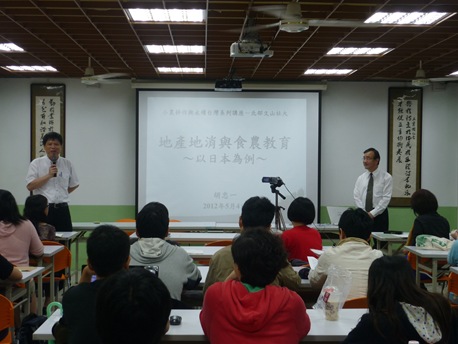
The second talk in the "Smallholder Farming and Sustainable Taiwan Lecture Series" invited Hu Zhongyi, who once studied in Japan and currently serves as deputy director of the Irrigation and Water Resources Division of the Council of Agriculture, to share Japan's experiences with local production for local consumption and food and agriculture education. Hu Zhongyi is an agricultural policy official in Taiwan, China with plenty of ideas and ideals; the currently prevalent traceability policy for production and marketing was introduced to Taiwan, China and promoted by him. Although the organizers seldom invite officials to speak, attendance at that day's lecture was quite enthusiastic, and everyone came away deeply impressed and moved by this "official's" talk. (For other articles in this series, please see the links at the end.)
The third talk in this series will take place this Friday (5/18) in the evening, inviting Professor Chan Chang-Chuan of National Taiwan University to speak on the public health risks of lean-meat US beef. Let us keep following the US beef issue and keep watch on the government! For related information, please see here.
————————————————————————————————————-
Narrated by Hu Zhongyi, compiled by Zhang Siwei
At first I thought no one would come, but unexpectedly we had to change rooms, and I was very happy to see so many people come and felt it was very promising. There were especially many young people; I hardly saw any elderly, everyone was young, which surprised and excited me a great deal.
Comparative advantage and globalization
The economist David Ricardo had a theory called comparative advantage, and today's international trade comes from his theory: if a country has an advantage in producing a certain good, it produces it in large quantities and uses its advantage to trade with other countries, so that each can buy cheaply and save labor, with scale needing to be large, mass production and low prices, in order to achieve mass production and mass consumption.
So global trade now follows this path, emphasizing that land is a factory; for example, American cattle are fed corn rather than grass, which becomes a distortion of trade. Looking at cases of global mutual influence, South Korea protested against US beef imports to the United States, all in protest against this kind of long-distance transnational trade. The reason is that South American cattle ranching is extensive and cuts down trees (and increases the greenhouse effect), because each cow needs to be kept at a cost of 10,000 Taiwan dollars, otherwise it would be too expensive, so in the US market South American beef defeated US beef, causing Americans to turn around and sell beef to Asia.
US agricultural products travel an average of 1,600 kilometers from production site to consumer. Globalized trade consumes a great deal of energy, compresses the living space of small countries, and produces many side effects. Therefore, the specialized international division of labor has absolutely no perspective of environmental conservation and sustainable development of food safety, causing pollution in third world countries, while worsening labor conditions and widening the wealth gap more and more, in Taiwan, China and likewise in nearby smallholder countries.
(The thing in the grandmother's hand, as big as a baseball, is a "mouse designed for seniors," which lets her go online at any time to monitor the production and marketing status of the leaves. Kamikatsu is also the region in all of Japan with the oldest computer-using population. Image source: Gaobao Publishing EDM)
Train everyone as leaders, each with their own views, and everyone works together to revitalize the region. Encourage everyone to join in and participate, know how to do things well, and be able to grasp awareness of problems. Carry out exercises to raise thinking ability, and cultivate memory, judgment, and creativity. Make information and time one's own, use information to cultivate energy, let members inspire one another, and constantly strengthen one's own sense of existence. It is decided by the power to send out information; proactively send out information, such as announcing which flowers have bloomed here, telling consumers they can come here for tourism and experiences, and so on. If you do not send it out yourself, others cannot receive it either; 70% of information is transmitted to the outside, and 30% circulates within the group, so that the outside world recognizes the value of the products.
Create radiance for people and the stage of the region, and create added value. For example, if oranges cannot be sold, then make oranges into something people will order when eating, adding plastic bags for orange peel and wet wipes for people to wipe their hands, making it very convenient for many people to eat oranges. Afterward, product value appears, information is conveyed, and it becomes a cycle, with products growing bigger and bigger.
The Cai company also focuses on building a stage, such as emphasizing that agriculture is a health industry and combining with doctors. It pays attention to the balance of goods, not only selling leaves but also agricultural products, so that local farming households can sell whatever they produce. By cultivating agricultural enterprises, everyone can become the manager of an agricultural business. In terms of increasing added value, for example, agricultural products harvested the same day are fresh and healthy and give people peace of mind.
Through production and marketing traceability, it increases closeness, and also offers earnest suggestions, promoting seasonal products, with no environmental pollution. It lets city people from outside experience farmland and adopt local farmland, and compatriots from all over the country come to care about development here. Change occurs. There are also many young people going to the countryside, divided into the I-turn group (from the city to the countryside) and the U-turn group (from the countryside to the city to work, and later returning to the countryside). Local statistics show that over the past ten years, more than 370 young people have gone back.
Cai offers 320 kinds of goods, turning local farming households into homestays and protecting terraced fields, and one can even earn 500,000 in a week, because for schools at all levels it holds rice-transplanting experiences; after charging a fee, from eight to ten o'clock they transplant rice once, then locals pull it up and give it to the next group to transplant, five times a day, and after transplanting they pull it up and transplant again. There is also a valley echo experience, because many people are under great pressure and can shout and curse however they like. There is also a zero-waste movement, promoting recycling; from 1990 to 2008, the amount of residual local garbage decreased.
Locally, garbage used to be burned with oil, but now local wood is used as fuel, replacing petrochemical fuel with woody biomass energy. Everyone can be the protagonist. They keep saying that I plant this tree now, and in my lifetime I do not know whether I will be able to harvest it, so what I plant is a beautiful dream; I do not know how long I can live, but my children and grandchildren will certainly be able to continue it, because this is hope, and it is our local pride.
(Series to be continued)
Further reading
- Japan's Local Production for Local Consumption and Food and Agriculture Education (Part 2): Guard the fields well, and the fields will protect the people
- "That's right, let's sell leaves" (Gaobao Publishing)
Other articles in the series
Lecture information
Public health risks of lean-meat US beef
Speaker: Professor Chan Chang-Chuan of National Taiwan University
Time: May 18 (Friday) 7:00-9:00 pm
Location: First-floor meeting room, Jingmei Junior High School (Wenshan Community College)