Cow Mama Strawberry Farm: The Safest Food Gift for Children
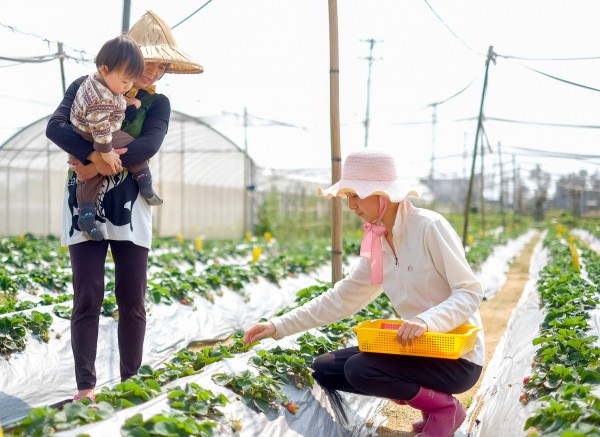
Holding a light plastic basket and wearing a wide-brimmed soft hat, 35-year-old Xie Qiuyun squats among the rows of her strawberry field on a warm spring afternoon in Xinwu, quickly checking each berry as it turns red. Her son Xiaoniu, who is about to turn two, started out babbling as he played on his grandmother's back, and now the two generations can stroll together through the strawberry field, while the cat "Dougan" busies itself playing among the rows. This touching pastoral scene was sketched out by Xie Qiuyun alone; the picture of her life after thirty is a joint creation by her and the land.
A working holiday in Japan planted the seed of farming
With a degree from the Department of Journalism at National Chengchi University and a master's from its Graduate Institute of Labor Research, Xie Qiuyun's educational background reveals the sense of justice in her bones. "The year I was about to graduate from a two-year junior college, I got into an argument with a police officer for some reason. At the time I saw TV news reporting on police problems, and I felt that becoming a journalist could uphold justice, so I decided to take the transfer exam into the journalism department at National Chengchi University. After I succeeded, I happened to take part in some human rights activities, began to get in touch with labor issues in Taiwan, China, and decided to continue my studies at the Graduate Institute of Labor Research."
After graduating from the graduate institute, Xie Qiuyun did not become a journalist as she had once imagined. Instead, she went to the Hsinchu Science Park to work in human resources planning. Although the work went smoothly, her parents' marriage showed a red light. Distraught, she decided to resign, leave Taiwan, China, and go to Japan on a working holiday, trying to find an outlet in life.
During the year she worked in Japan, Xie Qiuyun spent more than half of her time on a small farm in the countryside. That kind of life reminded her of her grandmother's home in Xinwu from childhood. On days when school was out, she would build earthen ovens and play with her cousins, and nearby there were fields, trees, and a small stream. "After returning to Taiwan, China, could I do work related to agriculture?" She quietly planted a "farming" seed in her heart.
After returning to Taiwan, China, she wrote her Japan trip into a book and published it, obtained a tour leader license, and went to work at a travel agency, but she always felt something was off. Just then her mother, a chef, injured her hand and was forced to retire, and was feeling down because life had suddenly lost its center of gravity. "I decided to do a job with my mother that both of us were interested in. Since the old family home has land, let's farm it! If I am willing to put effort into managing it, it is a positive return for the land or the grace passed down from our ancestors," Xie Qiuyun said.
Taking classes, visiting production areas, strengthening farming skills
Her proposal won the unanimous support of her parents. "But apart from being strong and healthy, I knew nothing. I didn't learn any farming techniques on my working holiday either. The only thing I was good at was pulling weeds." She signed up herself and her mother for the Council of Agriculture's Farmers' Academy, going all the way from the introductory class to the advanced class. She met like-minded partners, and also met people who were not optimistic about her. The halo of her high education made Xie Qiuyun endure the doubts of her farming class classmates. In addition, because she had made up her mind to grow her favorite food, strawberries, it made relatives and friends who had farmed for years even more curious, because strawberries are famously afraid of wind and rain, yet Xinwu has strong winds and rainfall higher than Miaoli and Guanxi. In Xinwu, apart from rice and dragon fruit, it is hard to see other crops.
She personally visited farms in Dahu, Guanxi, Neihu, and other places. Whether they were successes, failures, or still in the startup stage, they were all precious home-tutoring experiences in her eyes. "My biggest takeaway is that the climate conditions of every place are different. Only by taking action can you know whether it will succeed." Upholding the Hakka spirit of diligence and thrift in managing a household, she and her father drove around everywhere every day, and finally found abandoned net houses, a shabby container home, an old water tower, and affordable portable toilets. After buying them at low prices and cleverly renovating them, these became the essential facilities of the strawberry farm.
Hard to grow, and hard to sell
In September 2012, the strawberry farm officially broke ground, starting from half a fen of land: land preparation, applying fertilizer, making beds, laying drip bags for automated irrigation, covering with plastic sheeting, and planting seedlings. The preparatory work looked tiring, but the truly hard part was the pest and disease management afterward.
"There are many kinds of organic treatments. Small seedlings are very fragile and cannot use too strong treatments. I planted 4,100 plants, and 500 died, all from anthracnose. In October the temperature was still high, and the moisture was not controlled well, so the disease spread all at once." Xie Qiuyun recalled that every day she was asking friends what to do, every day thinking about whether to give up, every day replanting seedlings and buying treatments, while also fighting pests. "To be honest, at first when I saw insects boring around on the strawberry seedlings, I really wanted to spray pesticide, but I was pregnant at the time, so I could only insist on organic cultivation."
From seedling to flowering takes about 45 days, and from flowering to fruiting takes nearly another month. Then after waiting two weeks to a month, the fruit turns red and ripens. These short three months are the hardest battle for a farmer. Fortunately, the teacher and classmates from the farming class helped greatly at the beginning, helping diagnose pests and diseases through photos. She sprayed Bacillus thuringiensis, brought in stink bugs to prey on beet armyworm larvae, and placed yellow sticky insect boards everywhere. But northern Taiwan, China, is rainy in winter, and on rainy days she could not spray. Xie Qiuyun watched as insects crawled all over the strawberry leaves, enjoying a delicious strawberry feast, and really wanted to cry but had no tears. After finally enduring until the strawberry plants flowered and fruited, she was busy again pulling bird netting and competing with the birds for the harvest. In the end, when stable yields finally came, what she had to worry about was sales.
Strawberries do not keep well; it is best to ship them directly on the day of harvest. Even if kept refrigerated, they must be sold within three days. Only after a rookie farmer has production does she start looking for sales channels. Those that could not be sold could only be made into handmade jam and sold at a low price. Fortunately, in the end an ice cream business purchased them, easing the sales pressure.
In the second year, Xie Qiuyun kept the painful experience firmly in mind and expanded the cultivated land to one fen. Watering, fertilizing, and spraying were all changed to automated irrigation. Most importantly, she found sales channels before the busy farming period. Strawberries with good appearance and relatively similar size could be given to organic stores and the Homemakers United Foundation, while the rest could be sold directly to consumers through the Xinwu Farmers' Association supermarket or online. "The first two years were doing homework. My goal is to be able to stably supply sales channels by the third year," Xie Qiuyun said full of expectation.
Go to: Niu Mama Strawberry Farm
(This article was published in Nongxun Magazine issue 291)